Documents Required to Sell a Used Car or Bike in India (RC Transfer Checklist)
Selling a used car or bike in India? Here is the full document checklist, how Form 29 and Form 30 work, and when you need an NOC, in the right order.
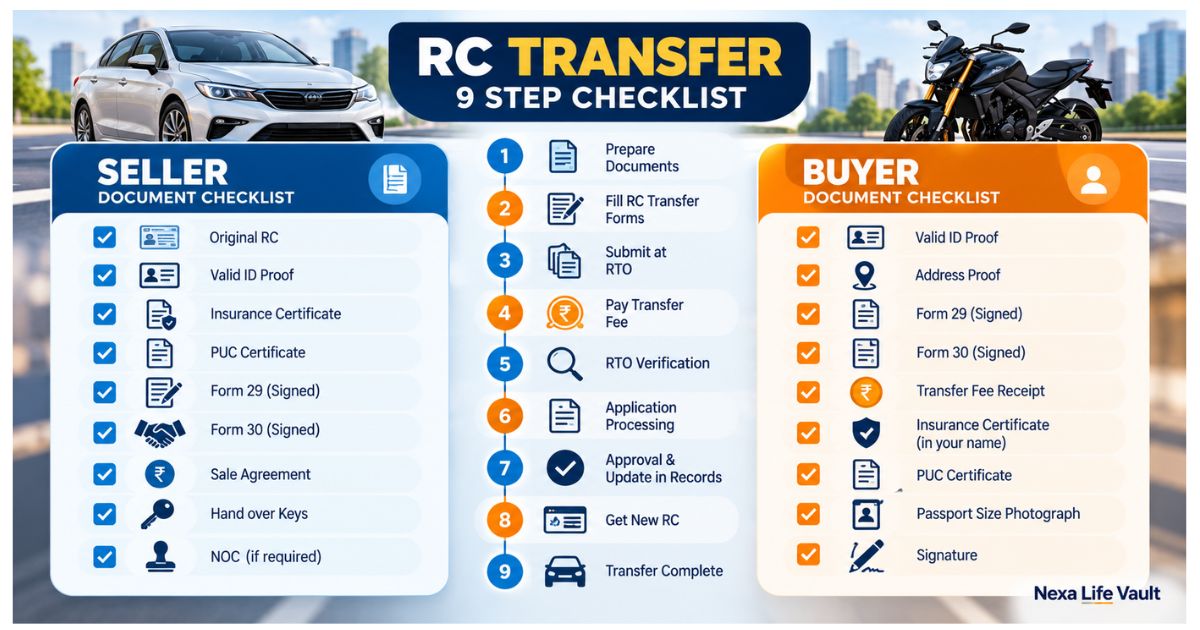
To sell a used car or bike in India, you need the original RC, valid insurance, a PUC certificate, Form 29 and Form 30 signed by both sides, ID and address proof, and PAN or Form 60 details. If a loan is running, add the bank's NOC and Form 35. For inter-state sales, add Form 28.
Last updated: October 2026
Selling a car or bike is easy until the buyer asks for a paper you cannot find. The documents required to sell used car or two-wheeler in India are not many, but each one has a job: proving you own the vehicle, showing it is free of loans, and moving the name on the RC. This checklist covers what you and the buyer each need, how Form 29 and Form 30 work, when you need an NOC, and the order to do things in.
This is general information, not legal, tax or financial advice. Rules and forms can differ by state and change over time. Verify with the official source (Parivahan, parivahan.gov.in, or your state RTO) before acting.
What are the documents required to sell a used car in India?
As the seller, you are the one who starts the paperwork, so most of the documents come from you. Keep this set ready before you list the vehicle.
- Original Registration Certificate (RC): This is the main proof that the vehicle is registered in your name. Without it, the transfer usually cannot start.
- Valid insurance policy: The buyer needs the current policy copy, and the insurance also has to be moved to the new owner later.
- Valid PUC certificate: The Pollution Under Control certificate should be current at the time of sale.
- Form 29 (Notice of Transfer of Ownership): You fill this in to report the sale. More on it below.
- Form 30 (Report of Transfer of Ownership): This is the buyer's side of the same transfer. Both parties sign it.
- Your ID and address proof: Aadhaar is the common choice. The address should match what is on the RC, or you may be asked for extra proof.
- Passport-size photographs: Many RTOs ask for these with the forms.
- Service history and spare keys: These are not legal documents, but buyers ask for them, and they help you get a fair price.
If you bought the vehicle second-hand yourself, also keep your own purchase papers. They show the chain of ownership.
What documents does the buyer need to give you?
The buyer has paperwork too. Asking for it before you hand over the keys protects you.
- ID proof and address proof (Aadhaar or another accepted document)
- PAN card details, or Form 60 if the buyer has no PAN
- Passport-size photographs
- Signed Form 30 (and a signature on Form 29 where the form asks for it)
- A signed sale receipt or agreement showing the price and date
Take a photocopy of the buyer's ID and keep it with your records. If the vehicle is later involved in a challan or accident before the name changes, this copy shows who had it.
Buyer vs seller: who brings which document?
| Document | Seller | Buyer | Why it matters |
|---|---|---|---|
| Original RC | Yes | Checks it | Proves ownership and starts the transfer |
| Insurance policy | Yes | Checks it | Shows valid cover; must be moved to the new owner |
| PUC certificate | Yes | Checks it | Needed for a legal, road-ready vehicle |
| Form 29 | Fills and signs | Signs where required | Notifies the RTO of the sale |
| Form 30 | Signs | Fills and signs | Records the transfer of ownership |
| ID and address proof | Yes | Yes | Confirms both parties |
| PAN or Form 60 | Usually not | Yes | Asked in the transfer process |
| Bank NOC and Form 35 | Yes, if there was a loan | Checks it | Shows the hypothecation is cleared |
| Form 28 (NOC) | Yes, for inter-state sale | Needs it for re-registration | Lets the vehicle be registered in another state |
| Sale receipt or agreement | Keeps a signed copy | Keeps a signed copy | Proof of price, date and handover |
What are Form 29 and Form 30 in an RC transfer?
These two forms are the heart of RC transfer, so it helps to know who does what.
Form 29 is the notice of transfer of ownership. The seller fills it in to tell the registering authority that the vehicle has been sold. It carries the vehicle details, the seller's details and the buyer's details.
Form 30 is the report of transfer of ownership. The buyer uses it to apply to have the vehicle registered in their name. The seller signs it too, which shows that the seller agrees to the transfer.
In many cases both forms are signed by both parties. Some states allow the process online through the Parivahan portal, while others still need a visit to the RTO. Check what your state follows.
When do you need an NOC for a car or bike?
Not every sale needs an NOC. Two situations do.
Is a bank NOC needed if the car had a loan?
Yes. If the vehicle was bought on a loan, the bank's name is on the RC as the lender (this is called hypothecation). Before you sell, you need the bank's No Objection Certificate and Form 35 to show the loan is closed and the lender's name can be removed from the records. Without it, the RTO will not move ahead with the transfer.
Ask the bank for the NOC as soon as you make the last payment. Sometimes it takes a few days or weeks, so do not leave it for the day you find a buyer.
Is an NOC needed if the buyer lives in another state?
Usually yes. If the vehicle will be registered in a different state, you need an NOC (Form 28) from the RTO where it is currently registered. The buyer then uses it to re-register the vehicle in the new state. Rules for this can differ by state, so confirm the process with your RTO or Parivahan before you agree on a handover date.
How do you transfer an RC step by step?
Doing things in the right order saves you repeat trips and disputes. This is a common sequence.
- Clear any loan. If there is one, close it and collect the bank NOC and Form 35.
- Check challans. Look up pending traffic fines on the Parivahan or state traffic portal and pay them before the sale.
- Collect your documents. Keep the original RC, insurance, PUC and your ID proof together.
- Agree on the price and sign a sale receipt. Mention the date, time, odometer reading, and both parties' names and signatures.
- Fill and sign Form 29 and Form 30. Attach the buyer's ID proof, address proof and photographs.
- Submit the forms. Do this through Parivahan or the RTO, depending on your state, and note the application number or receipt.
- Hand over the vehicle with the documents. Give the original RC, keys and service records only after the payment is confirmed.
- Confirm the new RC. The buyer should receive an RC in their name. Ask for confirmation or a screenshot of the updated record for your own file.
- Transfer or cancel the insurance. The buyer should move the policy to their name. Ask them to confirm it.
The law sets short deadlines for both seller and buyer to report the sale and apply for the transfer, so do not let the paperwork sit.
Example: Meera sold her hatchback in Bhavnagar to a buyer in Rajkot. She had a bank loan that she had already closed, but she had never collected the NOC. The buyer wanted to leave in two days. The delay in getting the bank's Form 35 and an inter-state NOC pushed the handover back by almost two weeks. Had she asked the bank earlier, the sale would have gone through on the first date.
What documents are required to sell a bike in India?
The sell bike documents list is almost the same as for a car. You still need the original RC, valid insurance, PUC, Form 29 and Form 30, ID and address proof, and the bank NOC if there was a two-wheeler loan. The same inter-state NOC rule applies.
Bike sales tend to be quicker and cheaper, and many people sell through informal deals. That is where mistakes creep in. Even for an older bike or a low price, sign a sale receipt, submit the transfer forms and keep a record of the buyer's ID. An undocumented sale leaves the bike in your name.
For a full explanation of RC details, duplicate RC and registration rules, read our RC registration guide. For a broader list of papers every vehicle owner should hold, see the vehicle documents checklist.
What should you do after the sale is complete?
The handover is not the end. A few follow-up steps keep you safe.
- Remove or deactivate the FASTag linked to your account if it is still on the vehicle.
- Keep the signed sale receipt, form acknowledgements and the buyer's ID copy for your records.
- Inform your insurer about the sale, or confirm that the buyer has moved the policy.
- Check the Parivahan record after some time to confirm the owner's name has changed.
If you stay on top of this, you will not receive surprise notices for a vehicle you no longer own.
How Nexa Life Vault helps
Most sale delays come from missing papers: an RC in a drawer, an expired PUC, a loan NOC nobody remembers collecting. The Vehicle Vault in Nexa Life Vault gives you one place to store your RC, insurance, PUC, loan papers and service records for each vehicle you own.
With Smart Document Alerts, you get expiry and renewal reminders, so your insurance and PUC are valid on the day a buyer comes to see the vehicle. When it is time to sell, you can open the vault, find each document and share what you need. You can also add a nominee or executor so family members know where the vehicle papers are. Nexa Life Vault protects files with AES-256-GCM encryption and a separate key for each file. Whether a digital copy is accepted for a particular purpose depends on the authority asking, so keep the originals handy.
Conclusion
The documents required to sell used car or bike in India come down to a short list: RC, insurance, PUC, Form 29 and 30, ID proofs, and an NOC when a loan or another state is involved. Get these ready early, submit the transfer and keep proof of every step. Want to keep every vehicle paper in one place, with reminders before they expire? Track your vehicle documents in one place with the Vehicle Vault.
Frequently Asked Questions
Shailesh Nagar
Cloud Infrastructure & Security Contributor
Technology specialist at NexaLifeVault focusing on cloud infrastructure, data resilience protocols, and modern digital asset management.
Share this post
Comments (0)
No comments yet. Be the first to comment!