


Scanned Copy vs Original: Which Document Copies Are Accepted in India?
Is a scanned copy valid in India? See which copies banks, colleges, employers and govt offices accept, and when you still need the original.
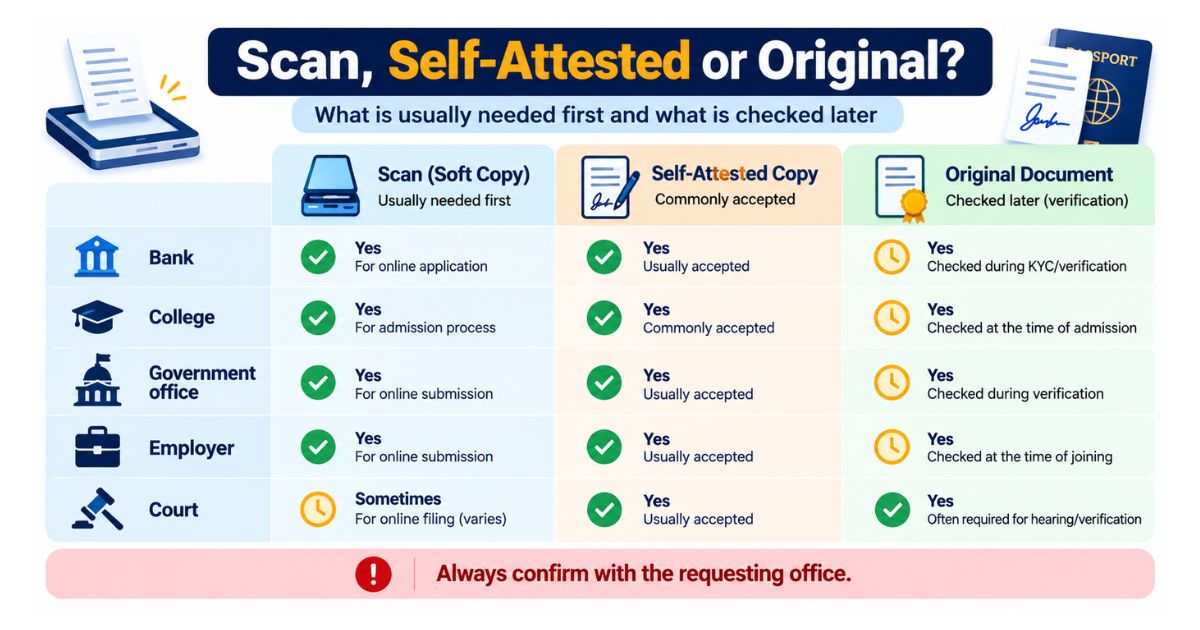
Sometimes. A scanned copy of documents is valid in India only when the office asking for it accepts it. Banks, colleges and employers often take scans for the first step, then ask to see originals or self-attested photocopies later. Courts and some government offices may need attested or original papers. Always confirm with the requesting office.
Your college portal asks for a PDF of your marksheet. The ration office wants a self-attested photocopy. The bank manager wants to see your Aadhaar in original. Same document, three different rules.
No single rule covers every office in India. What counts depends on who is asking and why. This article explains the main types of copies, where each is usually accepted, and how to stay ready for all of them.
This is general information, not legal, tax or financial advice.
What is the difference between an original, a scan, a photocopy and an attested copy?
People use these words loosely, and that causes most of the confusion. Here is what each one usually means in practice.
| Type of copy | What it is | Where it is usually used | Watch out for |
|---|---|---|---|
| Original | The document as issued: the paper marksheet, the registered sale deed, the passport itself | Verification at a counter, final admission, court matters | Losing it. Getting a duplicate can take time and needs a formal request |
| Scanned copy (PDF or image) | A digital picture of the original, made with a scanner or phone | Online forms, email applications, first-stage checks | Blurry, cropped or dark scans get rejected |
| Photocopy | A paper copy made on a copier | Walk-in submissions with the original shown alongside | Unsigned photocopies are often refused |
| Self-attested copy | A photocopy you sign yourself, often with a line such as "Self-attested" and a date | Many government forms, college and job applications | Some offices want a specific wording or signature style |
| Attested or certified copy | A copy confirmed as a true copy by a notary, gazetted officer or the issuing authority | Legal, court and some official uses | The office may name exactly who can attest |
| Digitally issued document | A document issued electronically by the authority, such as through DigiLocker or a downloadable e-Aadhaar | Online verification, many government and private services | Check whether the office accepts that format and whether it wants a masked or full number |
Is a scanned copy of documents valid in India?
Indian law gives legal recognition to electronic records. The Information Technology Act, 2000 says an electronic record should not be denied legal effect only because it is in electronic form. In court, electronic records can be admitted as evidence, usually with a certificate that explains where the record came from.
That does not mean every office must accept your scan. A scanned copy is a picture of a document. Whether it is "valid" depends on three things:
- Who is asking. A private company, a bank, a university and a court each set their own rules.
- What for. A first application is treated differently from final verification.
- What the scan shows. A clear scan of an original is stronger than a scan of a photocopy.
So the honest answer is: legally recognised in many settings, but not automatically accepted everywhere. Verify with the official source, in this case the office or portal that asked for the document, before you rely on a scan.
Are digital documents legally valid in India?
It depends on what kind of digital document you mean.
A scan you made yourself
This is your own picture of a paper document. Many offices accept it for upload, but they may still ask to see the original later.
A document issued digitally by the authority
Some documents are issued electronically at source. Examples include a driving licence or marksheet pulled through DigiLocker, or an e-Aadhaar downloaded from the UIDAI website. The government's position is that documents issued through DigiLocker are treated as equal to the original. Even so, a few private offices may not know this, so carry a printout or show it on screen if asked.
A digitally signed document
Electronic signatures also get legal recognition under the IT Act. Whether a particular office accepts one is still the office's call.
Never assume a digital copy replaces the original in every situation. Property papers, court filings and some affidavits often have their own rules.
Which copies do banks, colleges, government offices and employers accept?
Here is a quick verdict for each situation. These are common patterns, not guarantees. Practice varies by bank, university, department and state.
| Situation | Usually accepted | Short verdict |
|---|---|---|
| Bank account or KYC update | Copy of an officially valid document, with the original shown to the bank, or a digital document through an approved route | Scan or self-attested copy often works to start. Keep the original handy. |
| College or university admission | Scans for online application; self-attested or attested copies at admission | Scan to apply, originals to confirm the seat. |
| Government application (licence, scheme, certificate) | Self-attested photocopies, with originals for verification, or uploads on the portal | Follow the department's checklist word for word. |
| Job application and joining | Scans during hiring; originals at document verification on joining | Scan to apply, originals on day one. |
| Court or legal proceedings | Often certified copies, originals, or documents filed as the court directs | Do not rely on a plain scan. Ask your lawyer or the court registry. |
Bank and KYC
Banks follow RBI's KYC rules, and each bank builds its own process on top. A branch officer may mark a photocopy as "seen and verified with original" after checking your Aadhaar, PAN or passport in person. Some banks also accept documents shared digitally. Ask your branch which route it prefers.
College admission
Most colleges ask for scans at the application stage. At admission you usually bring originals and a set of attested copies. If your marksheet is from another state board or an overseas university, ask the admissions office about any extra verification. Keeping your marksheets and certificates in an Education Vault makes this stage far less stressful.
Government offices
Many forms say "attach self-attested copies". Some portals want PDF uploads under a size limit. Others want both. Read the checklist on the department's own website, not a third-party page.
Employers
Companies often collect scans during hiring and verify originals at joining, or through a background check agency. Keep your degree, experience letters, relieving letter and ID proofs organised in a Job Vault so you can respond within hours when HR asks.
Courts and legal matters
Legal documents such as sale deeds, wills, affidavits and powers of attorney have stricter rules. Courts may ask for certified copies from the registry or the issuing authority. Keep scans of your agreements and legal papers in a Legal Vault for reference, but ask your lawyer which version to file.
How do you self-attest a document correctly?
Self-attesting simply means you confirm that the copy is a true copy of your original. Most offices expect this:
- Make a clear photocopy of the original. Every word, stamp and photo must be readable.
- Write "Self-attested" or "True copy of the original" on the copy, if the office asks for it.
- Sign across the copy in blue or black ink. Keep your signature clear of photos and key numbers where possible.
- Add the date, and your name if the form asks for it.
- Keep the original with you. Be ready to show it if asked.
If the office asks for gazetted officer or notary attestation, self-attestation will not do. Check the wording in the instructions.
How do you prepare a scanned copy that offices will accept?
- Read the requirement first. Note the file format (PDF or JPG), the size limit and whether the office wants colour or black and white.
- Scan the original, not a photocopy. A scan of a scan loses detail.
- Check readability. Zoom in. Can you read every name, number and date?
- Include both sides where there is content on the back, such as an address on a licence or a stamp on a certificate.
- Name files clearly. "Aadhaar-front-back.pdf" is better than "IMG_2043.jpg".
- Decide on masking. Some offices accept a masked Aadhaar. Others need the full number. Ask before you hide anything.
- Keep the original safe. You may need it for verification even after uploading.
For a closer look at how to organise these files, see your own checklist folder structure first, then add anything missing as each office asks for it.
How does Nexa Life Vault help?
When an office asks for a document, you usually need it within minutes, and the right version. The Legal Vault gives you one place to store scanned copies of affidavits, agreements, attested papers and ID proofs, so you are not digging through email attachments or phone galleries.
AI-powered search helps you find a document by what is in it, not just by what you named the file. Searching for the sale agreement or the notarised affidavit can bring up the right file quickly. Files are protected with AES-256-GCM encryption, and each file has its own key.
Nexa Life Vault stores your copies. It does not decide whether an office will accept them, so always confirm that with the requesting office.
Conclusion
A scanned copy of documents valid in India for one office may be rejected by another. Know which copy each situation calls for: scan to apply, self-attested copy to submit, original to verify. Check the requesting office's own instructions, and treat this article as a starting point rather than a rule. Keep clean digital copies ready, so the next request takes minutes, not a scramble.
Verify with the requesting office, and for legal matters with a qualified lawyer, before acting. This is general information, not legal, tax or financial advice.
Frequently Asked Questions
Vishal Singh
Full-Stack Developer & Systems Contributor
Full-stack developer at NexaLifeVault specializing in secure web applications, data encryption standards, and digital legacy preservation systems.
Share this post
Comments (0)
No comments yet. Be the first to comment!