Vehicle Insurance Renewal: Documents Needed and How to Never Miss the Date
Know exactly which vehicle insurance renewal documents to keep ready, how NCB and the grace period work, and how to stop missing your expiry date.
For vehicle insurance renewal, keep your RC, previous policy, valid PUC certificate, driving licence and KYC ready. If you are switching insurers, add your NCB details. Renew before the expiry date, because motor policies in India generally have no grace period, and a lapse can cost you your No Claim Bonus.
Most people remember their insurance renewal about two days late, usually when a reminder SMS lands in a forgotten inbox. Then comes the scramble: where is the old policy, is the PUC still valid, who has the RC copy? This guide gives you the exact vehicle insurance renewal documents to keep ready, a step-by-step checklist, and a simple system so the date never sneaks up on you.
This is general information, not legal, tax or financial advice.
What vehicle insurance renewal documents do you need?
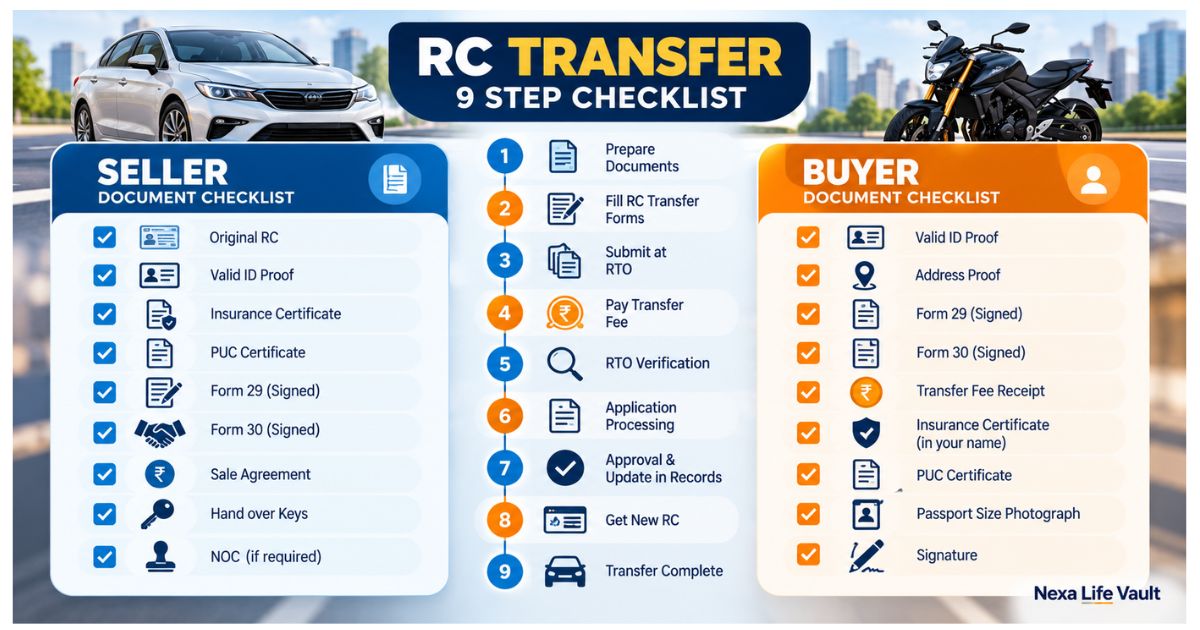
The exact list varies by insurer, but these are the documents most renewals ask for. Keep clear copies of all of them in one place.
| Document | Why it is needed | Where to find it |
|---|---|---|
| Registration Certificate (RC) | Confirms the vehicle, owner, chassis and engine details | Your copy of the RC, or DigiLocker / mParivahan |
| Previous policy copy or policy number | Links the renewal to your existing cover and claim history | Your email, insurer app or policy folder |
| Valid PUC certificate | Pollution Under Control proof, often checked alongside insurance | Fuel station or authorised PUC centre |
| Driving licence | Identifies the owner-driver, especially for personal accident cover | Your physical licence or DigiLocker |
| KYC: Aadhaar, PAN or other ID/address proof | Insurers collect KYC details at renewal | Your own records |
| NCB certificate or NCB details | Carries your No Claim Bonus if you switch insurers | Your previous insurer |
Your insurer may ask for a few more items, such as photos of the vehicle or an inspection report if the policy has already lapsed. Verify with the official source (your insurer, and IRDAI for regulatory rules) before acting.
Does bike insurance renewal need different documents?
Mostly no. Bike insurance expiry follows the same pattern as car cover: RC, previous policy, licence, KYC and PUC. The main difference is in how people treat it. Cars get a calendar reminder because the premium is large. Bikes get forgotten because the premium is small, and the policy quietly expires while the bike sits in the parking lot.
If you own more than one vehicle, expiry dates rarely line up. Write each one down separately, with the vehicle number next to it.
For the full list of papers you should carry and store for each vehicle, see our vehicle documents checklist.
What is the car insurance renewal checklist?
Use this order. It takes about 15 minutes if your papers are in one place, and much longer if they are not.
- Check your current expiry date. Open your policy and note the exact end date, not just the month.
- Collect your documents. RC, previous policy, PUC, licence and KYC, as listed above.
- Check your PUC validity. If it has expired, renew it first so you are not chasing it later.
- Review your claim history. Did you make a claim this year? This affects your No Claim Bonus.
- Compare plans. Look at third-party only cover versus comprehensive cover, add-ons and your vehicle's current value (Insured Declared Value).
- Confirm your details. Check the name, vehicle number, chassis number and address on the quote. Mistakes here can cause trouble during a claim.
- Pay and download. Save the new policy document immediately, and note the new expiry date.
- Set your next reminder. Do this the same day, while the date is fresh.
Common mistake: Renewing on autopilot without checking the Insured Declared Value or add-ons. A car that is two years older is worth less, and the cover you picked last time may no longer fit. Take two minutes to read the quote before you pay.
What is an NCB certificate and when do you need it?
NCB stands for No Claim Bonus. It is a discount on the own-damage part of your premium for every claim-free year. Importantly, the NCB belongs to you, the owner, and not to the vehicle or the insurer.
An NCB certificate is the proof of that discount. You will typically need it when you:
- switch to a new insurer and want your discount to carry over,
- buy a new vehicle and want to move your earned NCB to it, or
- cannot find your previous policy document, which usually shows the NCB percentage.
Ask your old insurer for the certificate before or at the time you switch. Many insurers share the details on request or through their app or website. The rules on how long NCB stays valid after expiry, how it transfers, and how it changes after a claim vary by insurer and can be updated. Verify with the official source (your insurer, and IRDAI circulars) before acting.
A quick example: Rohan has a car policy ending on the 12th. He thinks a week's delay is harmless and renews on the 19th. In the meantime, there was no active cover, and his insurer asks for an inspection before issuing a new policy. If he had renewed before the 12th, none of this would have happened.
Is there a grace period for vehicle insurance in India?
This is where many people get caught. In health and life insurance, you may be used to a grace period after the due date. Motor insurance generally does not work that way. When the policy end date passes, cover stops at that point. Some insurers may offer a short window to renew without penalty, but you should not plan around it, and you should not assume your cover continues during it.
Driving without valid insurance is not just a financial risk. Third-party motor insurance is a legal requirement in India, and penalties can apply. Verify with the official source (the Motor Vehicles Act as published by the Government of India, and your insurer) before acting.
Three things typically change once a policy lapses:
- No cover. Any accident after expiry is usually not claimable.
- Possible inspection. Insurers may want to inspect the vehicle before they issue a fresh policy.
- NCB at risk. If you renew after a long gap, your accumulated discount may be reduced or lost. The cut-off differs by insurer.
How do you never miss your vehicle insurance expiry date?
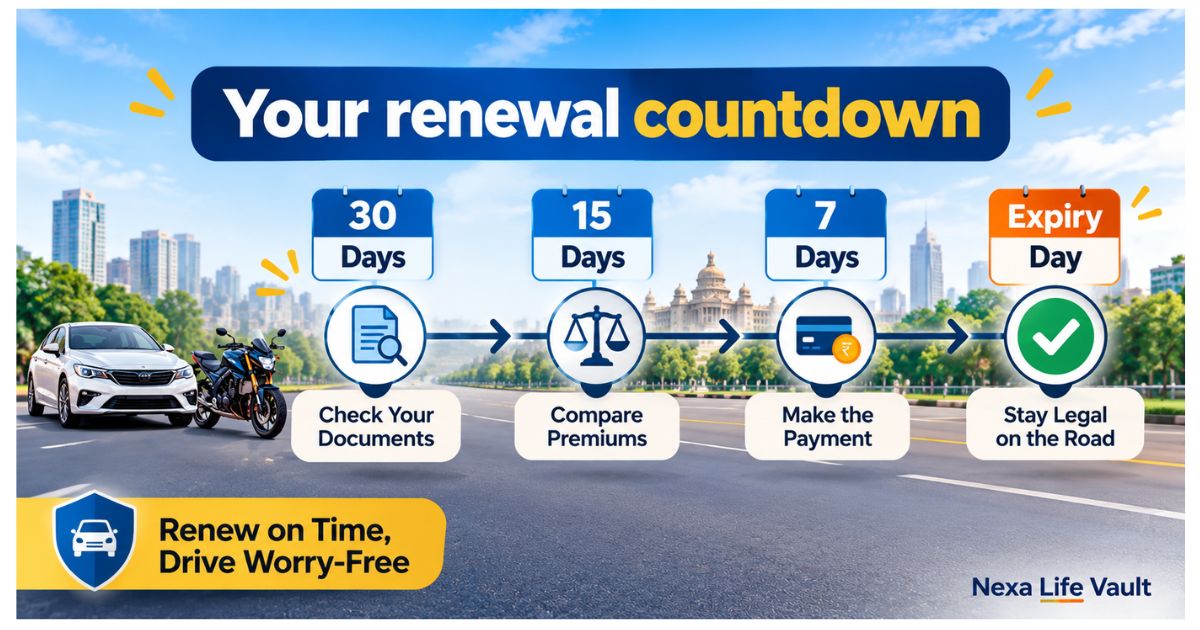
Do not rely on your insurer's reminders alone. They can land in spam, go to an old phone number, or arrive while you are travelling. Build your own reminder system with a few layers.
| When | What to do |
|---|---|
| 30 days before expiry | Collect documents, check PUC, request an NCB certificate if switching |
| 15 days before expiry | Compare quotes and review add-ons |
| 7 days before expiry | Pay, download the policy, check all details |
| Day of expiry | Last chance. Confirm the new policy has started |
Pro tip: Set the first reminder for 30 days before expiry, not 3. A one-week warning is enough to remember, but not enough to fix a missing document, an expired PUC or a slow NCB certificate request.
Keep the policy PDF, the RC copy and the PUC certificate together, so that when the reminder fires, you are not searching for papers. Scattered documents are the real reason renewals get delayed, not forgetfulness.
What should you check after you renew?
The job is not done when the payment goes through. Spend two minutes on this short check:
- Open the new policy and confirm the start and end dates.
- Check the vehicle number, chassis number, and your name for typos.
- Confirm that add-ons you paid for are listed.
- Note the NCB percentage shown on the policy.
- Save the policy where you can find it quickly, and set the next reminder.
How Nexa Life Vault helps
Keep your vehicle papers in the Vehicle Vault. Store the RC, your policy, the PUC certificate, your driving licence copy and any NCB certificate together, one folder per vehicle, so everything you need at renewal time is in one place.
Then add the expiry dates to Smart Document Alerts. You get reminders ahead of expiry and renewal dates, so the date does not depend on an SMS you might miss. Your car, your bike and a family member's scooter can each have their own alert.
With the Vehicle Vault, your documents are protected with AES-256-GCM encryption, with a unique key for each file. You can also use mobile access to pull up a policy on the road or at a garage.
Conclusion
Good vehicle insurance renewal documents are half the battle: RC, previous policy, PUC, licence, KYC and NCB details, all in one place. The other half is the date. Set your reminders 30 days ahead, check your PUC, and do not count on a grace period. Turn on expiry alerts in Nexa Life Vault's Smart Document Alerts today, so your next renewal arrives as a reminder, not a surprise.
Frequently Asked Questions
Ayush Singh
Software Engineer & Security Systems Writer
Software engineer and tech writer focused on digital security, system reliability, and user-friendly document organization workflows.
Share this post
Comments (0)
No comments yet. Be the first to comment!