Moving Abroad: The Documents to Gather Before You Relocate
Moving abroad means more paperwork than most people expect. This checklist shows the documents needed to move abroad and what to do at 12 weeks, 4 weeks and 1 week before you leave, so nothing is missing when you land.
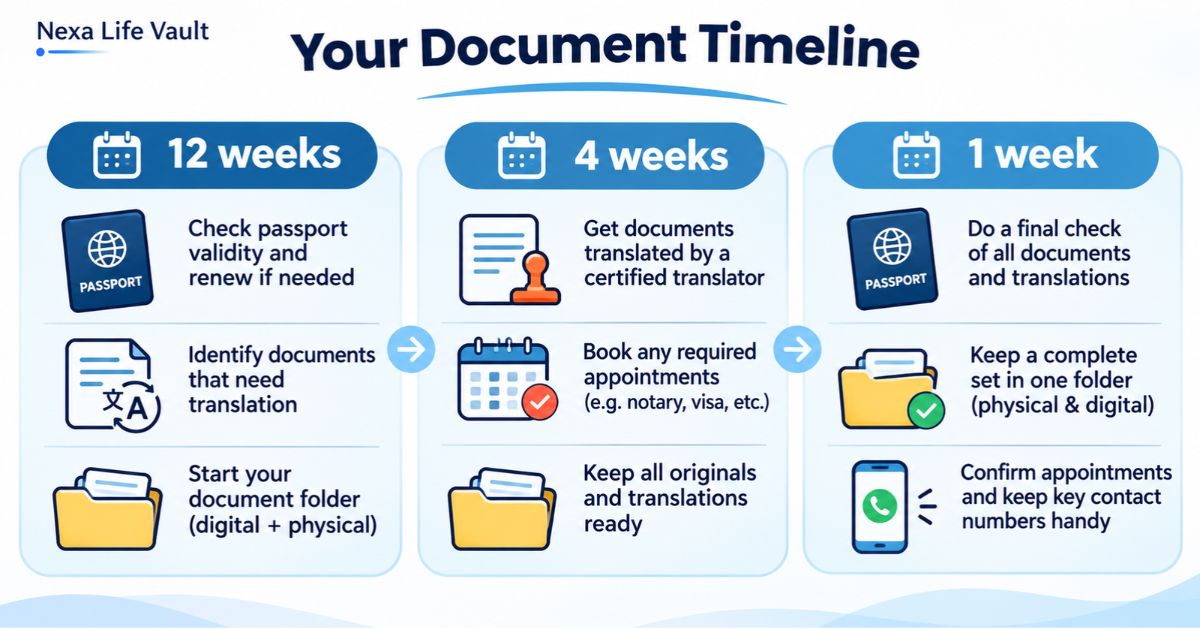
The documents needed to move abroad are your passport, visa or residence permit, identity and civil records (birth and marriage certificates), proof of work or study, financial and health records, and any official translations. Start gathering 12 weeks before you leave, confirm requirements at 4 weeks, and pack originals and copies in the final week.
A missing certificate can hold up a visa, a bank account or a school place, and you can rarely fix it from the other side of the world. Birth certificates, degree transcripts and employer letters can take weeks to replace. This checklist splits the work into three stages so you collect things in the right order and arrive with a folder you can actually use.
This is general information, not legal, tax or financial advice.
What are the documents needed to move abroad?
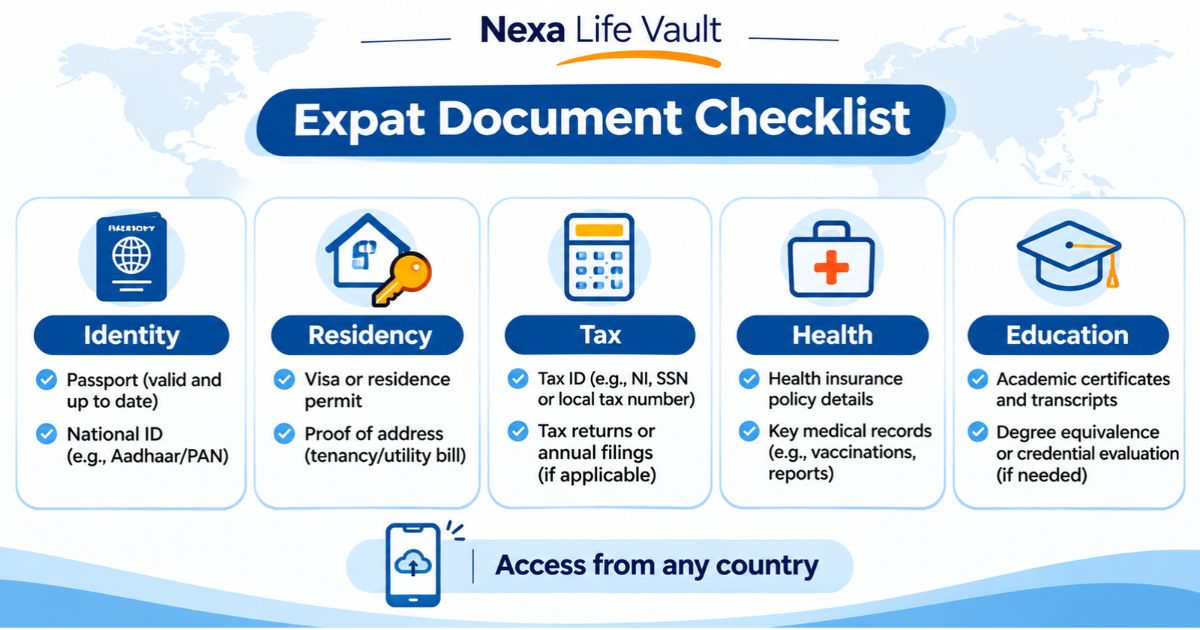
Requirements change with the country you are moving to and your reason for going: work, study, family or retirement. Even so, most moves rely on the same core set. It helps to think in groups rather than one long list.
| Group | Typical documents | Why you need them |
|---|---|---|
| Identity | Passport, national ID card, passport-size photos | Visa application, border entry, bank accounts |
| Immigration | Visa or entry permit, sponsor or invitation letter, residence permit paperwork | Legal entry and stay |
| Civil records | Birth certificate, marriage certificate, divorce decree, police clearance certificate | Family visas, dependants, residency applications |
| Work and education | Offer or contract letter, reference letters, payslips, degree certificates, transcripts | Work permits, school enrolment, credential checks |
| Money and tax | Bank statements, tax returns, proof of funds, insurance policies | Visa funds checks, renting a home, opening accounts |
| Health | Vaccination records, prescriptions, medical reports, health insurance proof | Medical checks, continuing treatment |
| Travel and vehicle | Tickets, driving licence, vehicle papers, pet records | Entry, driving, shipping belongings |
Verify with the official source (the immigration authority or embassy of your destination country) before acting. Its list for your visa category overrides any general checklist, including this one.
What should an international relocation checklist include?
Which identity and immigration documents come first?
Start with your passport. Many countries expect it to stay valid for a set period beyond your arrival date, and some ask for blank pages. The exact rule differs by country, so check the destination's official immigration page before you decide whether to renew.
Your visa or permit comes next. Apply only through the official government portal or its named application centre. Copycat websites exist, and they often charge extra for nothing.
Keep scans of your passport, visa and tickets together. Our Travel Vault is built for exactly this kind of folder.
Which civil records will you be asked for?
If you are moving with a partner or children, expect to show proof of the relationship. That usually means birth certificates, a marriage certificate and, if relevant, a divorce decree or adoption papers. Some countries also ask for a police clearance certificate from places you have lived.
Order certified copies early. The issuing office sets the timeline, and you cannot speed it up. While you wait, compare the spelling of your name across your passport, birth certificate and degree. A mismatch is far easier to fix at home than during a visa review.
What work and education papers should you bring?
Employers and immigration offices often want proof that your career or studies are real. Gather your offer letter or contract, recent payslips, and reference letters on company letterhead. Ask your employer for a relieving or experience letter before your last day, not after.
For education, you may need degree certificates, final transcripts and sometimes a letter from the institution confirming your course. Keeping them together in your Education Vault saves hunting through old emails. Your Job Vault can hold the work side: contracts, payslips and reference letters.
Which money, tax and health records matter?
Visa officers and landlords both like evidence of stable money. Collect recent bank statements, your latest tax return and any proof of savings that a visa category asks for. Tax residency rules in both countries can affect what you owe, so speak to a qualified tax adviser or the tax authority in each country.
For health, request your vaccination record, a copy of current prescriptions and summaries of any ongoing treatment. Some countries ask for a medical exam or specific vaccinations as part of the visa process. Check the official immigration page for your category.
What is the 12 weeks, 4 weeks and 1 week relocation timeline?
Use this as a working schedule. If your visa takes long to process, shift everything earlier.
12 weeks before: build the master list
- Check your passport expiry date and renew it now if the destination's rules require more validity.
- Read the official immigration page for your exact visa or permit type and write down every required document.
- Order certified copies of birth, marriage and other civil records.
- Request degree certificates, transcripts and reference letters from institutions and employers.
- Ask whether your documents need translation, an apostille or embassy legalisation.
- Start your visa application if its processing time requires it.
- Make one master list with every document, its expiry date and where the original is kept.
Pro tip: Photograph or scan every document the day you receive it, and name the file clearly, such as "birth-certificate-certified-copy". When an office asks for a copy at short notice, you will find it in seconds instead of digging through a drawer.
4 weeks before: confirm and fill the gaps
- Check your visa status and note any biometrics or passport-collection appointments.
- Get translations done by a translator the receiving authority accepts.
- Download recent bank statements and payslips, since many offices want recent ones.
- Collect medical records, prescriptions and vaccination proof. Ask your doctor how to carry medicines legally across borders.
- Tell your bank, insurer, employer and tax office that you are moving.
- Check whether your driving licence is valid in the new country or whether you need an international driving permit.
- Scan everything that arrived since week 12 and update the master list.
1 week before: pack and share
- Put originals in a folder in your hand luggage, never in checked bags.
- Keep certified copies in a separate bag, so one loss does not cost you everything.
- Make sure your digital folder opens on your phone, including offline if possible.
- Print entry documents, accommodation proof and onward travel details if the official guidance asks for them.
- Tell a trusted person where your documents are stored and how to reach them.
- Look for anything expiring in your first few months abroad and set a reminder.
Do your documents need translation or an apostille?
Often, yes, if they are not in the official language of your destination. Some countries accept translations only from approved or sworn translators. Many also want the original document certified, for example with an apostille. An apostille is a certificate used between countries that have joined the Hague Apostille Convention. Countries outside that system may ask for legalisation through their embassy instead.
Rules vary by country and by document type, so verify with the official source (the destination country's immigration authority or embassy, plus the government office that issued your document) before paying for anything.
What mistakes do people make when gathering relocation paperwork?
The most common one is leaving proof in places you cannot reach later. Picture this: you land, a landlord asks for three months of payslips, and they sit in an old work email account that was closed on your last day. Download them while you still have access.
Other frequent slips:
- Assuming a photocopy is enough when the office wants a certified copy or the original.
- Applying for a visa with a passport that is too close to expiry.
- Translating documents before checking which translators the authority accepts.
- Forgetting documents for family members, such as a child's vaccination record.
- Storing the only copy of everything on one phone.
How Nexa Life Vault helps
The Travel Vault is a good home for your relocation folder. Keep your passport, visa, permit, tickets and insurance in one place, with scans of the supporting papers beside them.
Smart Document Alerts can remind you before a passport, visa or permit expires, so renewals do not catch you off guard abroad. With Mobile Access, you can open your folder from your phone when a landlord or bank asks for a copy.
Files are protected with AES-256-GCM encryption, and each file has its own key. Digital copies are a handy backup. Authorities may still ask for originals, so keep those safe.
Conclusion
Moving abroad goes smoothly when the paperwork is ready before the boxes are. Use the 12-week, 4-week and 1-week steps to collect the documents needed to move abroad, check each one against the official source, and carry originals with you. Keep scans in one place you can open anywhere. Ready to start? Build your relocation folder.
Frequently Asked Questions
Pratyush Kumar
Technology Lead & Digital Transformation Strategist
Technology leader and digital transformation strategist writing about secure enterprise data architecture, privacy-first engineering, and next-generation vault solutions.
Share this post
Comments (0)
No comments yet. Be the first to comment!