Expat Document Checklist: What to Keep When You Live Abroad
Moving abroad means paperwork turns up at unexpected moments. This expat document checklist sorts your identity, residency, tax, health and education papers into five clear groups, so you know what to carry, what to scan and what to leave at home.
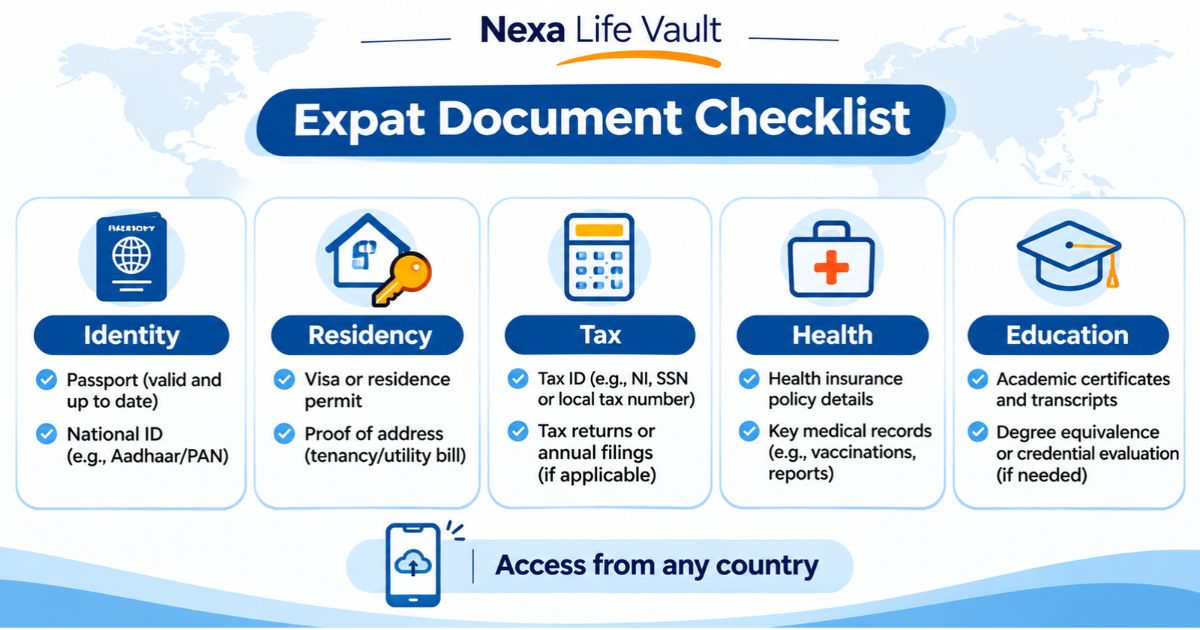
A solid expat document checklist covers five groups: identity, residency, tax, health and education records. Keep originals safe, carry certified copies, and store scanned copies where you can reach them from any country. Add family papers and expiry dates, so a lapsed passport or permit never catches you off guard.
Living abroad means being asked for paperwork at moments you cannot predict. A bank wants proof of address. A landlord wants proof of income. A school wants transcripts from three years ago. Missing one paper can stall a week of plans. This expat document checklist sorts everything by category, so you know what to carry, what to scan and what to leave with someone you trust.
This is general information, not legal, tax or financial advice.What should be on your expat document checklist?
Most expat paperwork fits into five categories. The table shows what belongs in each one and how to keep it.
| Category | Key documents | Where you will need them | How to keep them |
|---|---|---|---|
| Identity | Passport, national ID, birth certificate, marriage certificate, driving licence | Visas, bank accounts, tenancy, ID checks | Original, certified copy and scan |
| Residency | Visa or residence permit, local registration, lease, utility bills, employment contract | Proof of address, permit renewals, bank and school applications | Scan, plus originals in a safe place |
| Tax | Tax ID numbers, tax returns, payslips, tax residency certificate, foreign income records | Filing, loans, claims, official queries | Scan and a digital archive |
| Health | Insurance policy, vaccination record, prescriptions, medical summaries | Registering with doctors, insurance claims, school entry | Key copies with you, plus a scan |
| Education | Degree certificates, transcripts, professional licences, school records | Job offers, licence recognition, school enrolment | Original and scan; certified copies if asked |
Every country sets its own rules about what it accepts. Treat this as a base list. Verify with the official source, which is the immigration authority of the country you are moving to, before acting.
Which identity documents should you keep?
Identity papers are the ones everything else depends on. If you lose your passport abroad, replacing it is much easier when you have a clear copy and your passport number to hand.
- Passport: Some countries refuse entry or renewals when little validity remains. Check the rule for your destination.
- National ID card: Useful as a second form of ID, even if you rarely use it abroad.
- Birth certificate: Often needed for visas, marriage registration and children's school applications.
- Marriage or divorce certificate: Needed when you apply for a spouse or family visa.
- Driving licence: Check whether your destination accepts it or asks for a local licence or an international driving permit.
- Passport-size photos: Applications for permits and ID cards often ask for them, and sizes vary by country.
Verify with the official source, such as the embassy or consulate of your destination country, because document rules and validity requirements change.
What residency proof do you need as an expat?
Residency proof is the paper trail showing that you live where you say you live. Banks, landlords, schools and government offices all ask for it, often in different forms.
Keep these together in one folder:
- Your visa or residence permit, including the permit number and expiry date
- Entry and exit records, such as stamps or e-visa confirmations
- Local registration papers, if your host country requires you to register your address
- Your lease or rental agreement
- Recent utility bills and bank statements showing your name and address
- Your employment contract or offer letter
Here is a common scenario. You land, sign a lease, and head to a bank. The bank asks for a utility bill, but you have not received one yet. Your lease and employment contract may be enough, but only if you can pull them up on the spot. What counts as valid residency proof differs by country and even by institution, so ask each one what it accepts.
Which tax documents should expats keep?
Tax paperwork is the category people regret neglecting. Living abroad can create tax duties in your host country, your home country, or both. The rules depend on where you are considered tax resident, and that varies widely.
- Tax identification numbers for every country where you are registered
- Past tax returns and the notices or assessments that came with them
- Payslips and year-end income statements
- A tax residency certificate, if your tax authority issues one
- Records of income earned abroad, such as rent, interest or freelance invoices
- Proof of tax already paid in another country
- Social security or pension contribution records
Picture someone applying for a mortgage two years after moving. Lenders commonly ask for recent tax returns and payslips. If those sit in a drawer in another country, the application stalls.
Verify with the official source before acting: the tax authority in your home country and the one in your host country.
What health records should you carry when relocating?
Health papers matter most when something goes wrong, which is exactly when you do not want to be searching for them. Keep a short, current set rather than every medical file you own.
- Your health insurance policy, card and the claims contact number
- Vaccination records, including any certificates a country or school requires
- Current prescriptions, written with the generic name of each medicine
- A short summary of your medical history, allergies and ongoing conditions
- Glasses and dental records if you use them regularly
Rules on bringing medicines into a country differ, and some common medicines are restricted in some places. Verify with the official source, such as the health ministry or customs authority of your destination, before you pack anything.
Which education and work documents travel with you?
Qualifications are easy to forget until a job offer or a licensing body asks for proof. Replacing old certificates from a university in another country can take a long time.
- Degree certificates and final transcripts
- Professional licences or registrations
- Reference letters and past employment letters
- Children's school reports and transfer certificates
Some countries ask for certificates to be attested, legalised or apostilled before they will accept them. The process depends on the country that issued the document and the one receiving it. Verify with the official source, such as your destination's education or immigration authority, before you pay for any service.
Which family documents matter most?
If you move with a partner or children, each person needs their own set. Family paperwork also tends to be the slowest to replace, because it often comes from a government office in your home country.
- Marriage certificate and any name-change records
- Children's birth certificates and passports
- Adoption or custody papers, if they apply to you
- Written consent from the other parent if a child travels alone or with one parent
- Records for dependent parents, if they will join you
A shared space makes this easier to manage. The Family Vault keeps these records together, so a partner or relative can find a document when you are in a different time zone.
Should you carry originals or copies?
Carry the originals you will be asked to show in person, and keep the rest at home or with someone you trust. A good rule is to travel with originals of your passport and any permit, and certified copies of everything else.
Digital scans are useful for filling in forms, sending to a landlord or restoring a lost paper trail. Some offices will ask for the original or a certified copy instead, so do not assume a scan is enough. Verify with the official source for each application, as acceptance rules differ.
How do you organise your paperwork before you move?
You do not need a perfect system. You need one that works when you are tired, busy and in a new country.
- Gather everything in one place at least a few weeks before you leave.
- Sort by the five categories in the table above, plus a family folder.
- Scan every page in good light, including the back of cards and permits.
- Name files clearly, for example "passport-main-page" instead of "scan0042".
- Write down expiry dates for your passport, visa, licence and insurance.
- Leave a set of originals with a trusted person in your home country.
- Test your access from a phone before you fly, not after you land.
Where should you store digital copies of your documents?
Pick a place you can reach from any country, on any device, without relying on one laptop. Email attachments and loose photos work for a while, but they get messy and hard to search.
Where your files are stored can also matter to some people, especially if work or family circumstances span several countries. Nexa Life Vault offers Regional Data Residency for people who want a say in that choice. For a wider look at keeping papers safe while moving between countries, read our guide on safe travel document management.
How Nexa Life Vault helps
The Travel Vault is built for the papers you carry across borders: passports, visas, permits, tickets and insurance. You keep them in one organised place and open them from your phone, wherever you are.
Its most useful feature for expats is Smart Document Alerts. You add an expiry date once, and Nexa Life Vault reminds you before a passport, visa or insurance policy runs out. That gives you time to renew, instead of finding out at the airport.
Nexa Life Vault encrypts files with AES-256-GCM and gives each file its own key. A digital copy may not be accepted everywhere, so always check what an office requires.
Your expat document checklist, in one place
An expat document checklist works best when it lives somewhere you can open from any country, not in a drawer at home. Sort your papers into identity, residency, tax, health and education, add your family's records, and track the expiry dates. Then keep your scans where you can reach them. Start Free – access documents from any country.
Frequently Asked Questions
Ayush Singh
Software Engineer & Security Systems Writer
Software engineer and tech writer focused on digital security, system reliability, and user-friendly document organization workflows.
Share this post
Comments (0)
No comments yet. Be the first to comment!