Data Room 101: How Small Businesses Can Get Due-Diligence Ready
Get your small business ready for investors and buyers. This due diligence documents checklist covers nine folders to organise, a simple data room index template and how to share files with controlled access.
A due diligence documents checklist is a list of the records a buyer or investor will ask for before they commit money. For a small business, it covers company registration, financials, tax filings, contracts, employee records, licences and intellectual property. Keep them in one organised folder, called a data room, so you can share them fast.
Picture this. An investor likes your numbers and says, “Send over your papers.” You then spend two weeks digging through email attachments, old WhatsApp chats and a drawer of stamped agreements. The deal slows down, and the buyer starts to wonder how well you run things. A solid due diligence documents checklist fixes that before anyone asks. This guide shows what to collect, how to organise it and how to share it without losing control.
What is due diligence, and why does it matter for a small business?
Due diligence is the check a buyer, investor or lender runs before they put money in. They want to confirm that what you told them is true. Does the company legally exist? Are the accounts clean? Does anyone else have a claim on the business?
It happens when you raise funds, sell the business, take a large loan or merge with another firm. Small businesses get caught out because records sit in different places: some with the founder, some with the accountant, some with the lawyer. Nobody holds the full picture.
A business that answers quickly looks organised. One that takes weeks looks risky, even when the business is sound.
What is a data room, and does a small business need a virtual data room?
A data room is one organised place where every document a buyer or investor needs is stored. Large deals use paid services built for this. A virtual data room for a small business can be much simpler: a well-structured set of digital folders, clear file names and control over who can open what.
You do not need anything fancy for a first conversation. You do need three things: one location, one consistent folder structure and a way to limit access to named people.
This applies to a family-run firm or a two-partner LLP just as much as a funded startup. The data room is really a habit of keeping papers in order.
What should be in your due diligence documents checklist?
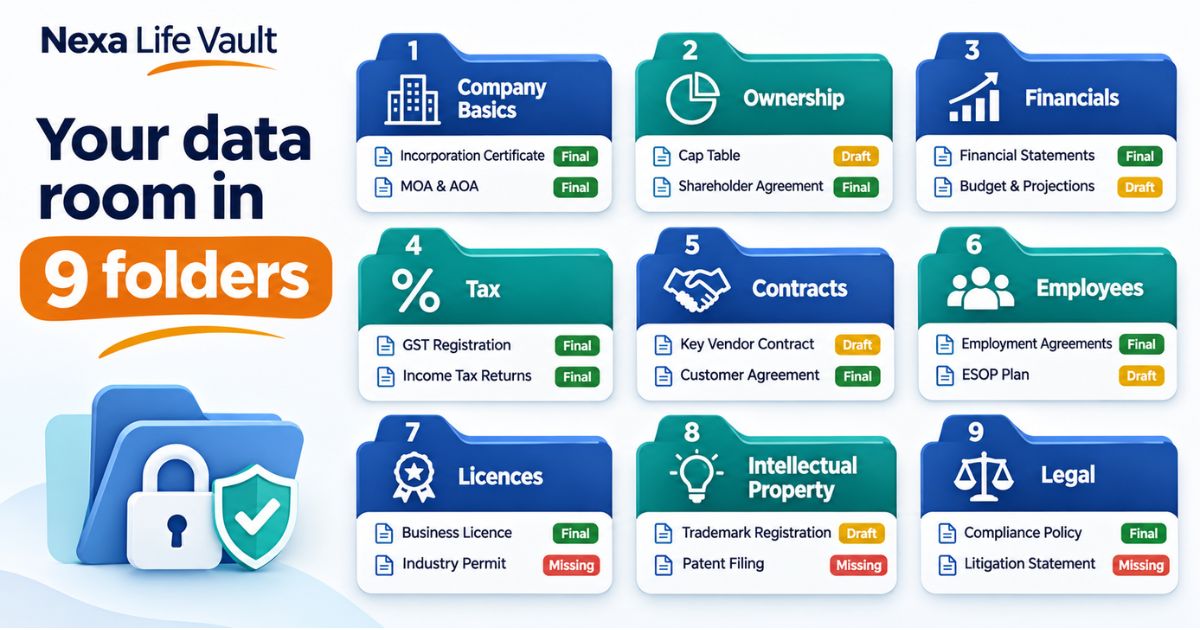
Every buyer asks for a slightly different list, but most requests fall into the same nine groups. Use the table below as a starting point and drop what does not apply to you.
| Folder | Documents to collect | What the reader checks |
|---|---|---|
| 1. Company basics | Certificate of Incorporation (or LLP agreement or partnership deed), MoA and AoA for companies, PAN, TAN, GST registration certificate, Udyam registration if you have one | That the business exists and is what you say it is |
| 2. Ownership | Shareholder or partner details, share certificates, cap table, shareholder or partnership agreements, board and shareholder meeting minutes | Who owns what, and who can approve what |
| 3. Financials | Financial statements for past years (audited where applicable), current-year management accounts, bank statements, loan and sanction letters | Revenue, profit, debt and cash position |
| 4. Tax | Income tax returns (ITR) with computations, GST returns, TDS returns and challans, any tax notices and your replies | Whether you file on time and have open disputes |
| 5. Contracts | Customer and supplier agreements, rent or lease deed, NDAs, distributor or partner agreements | Who depends on you and what you have promised |
| 6. People | Offer letters and contracts for founders and key staff, PF and ESI records where they apply, ESOP papers if any, contractor agreements | Staff costs, liabilities and key-person risk |
| 7. Licences and compliance | Shops and Establishments registration, trade licence, industry licences (such as FSSAI for food businesses), fire or pollution clearances where relevant | That you are allowed to operate |
| 8. Intellectual property | Trademark applications or registrations, domain ownership proof, software or design assignment agreements | That you own your brand, code and designs |
| 9. Legal matters | List of court cases or notices, settlement papers, insurance policies | Open risks and how well covered you are |
Verify with the official source (the Ministry of Corporate Affairs, the Income Tax Department and the GST portal) before acting. Required filings and thresholds differ by business type and can change.
Which financial and tax documents do buyers ask for first?
Start with the numbers. Buyers usually want several years of financial statements, GST returns and ITRs, and they want the three to agree. If your GST turnover and your books tell different stories, expect questions.
Add any tax notices and your replies. An old notice with a clear answer on file looks far better than one you have to hunt for later.
Which contracts and employee records matter most?
Check that every contract is signed, dated and complete, including annexures. A missing last page is a classic delay. Your biggest customer and supplier agreements come first, followed by your lease.
For staff, keep appointment letters and PF and ESI payment records where they apply. For contractors, keep written agreements that say who owns the work they produce. Investors in software and design businesses check this closely.
Pro tip: Name every file the same way: folder number, document, year, status. For example, 04-GST-Returns-FY2024-25-Final.pdf. A reviewer who can sort by name finds things without calling you, and every call you avoid keeps the deal moving.
How do you build a data room step by step?
- Name one owner. One person, usually the founder or finance head, decides what goes in and approves every change.
- Create the folders. Use the nine groups above and number them so they sort in order.
- Collect final, signed copies. Scan signed and stamped versions, not drafts. Check that every page is readable.
- List the gaps. Maybe your lease has no renewal letter, or an old partner exit was never papered. Chase what you can.
- Write a short cover note for anything missing. A gap you explain is a minor point. A gap the buyer finds alone becomes a worry.
- Name and date every file using one pattern.
- Add an index. One sheet listing every document (see the template below).
- Get a review. Ask your chartered accountant and lawyer to scan it before anyone outside sees it.
- Decide who sees what, then share. Update the room whenever something changes.
What does a simple data room index template look like?
The index is the one page that saves everyone time. Copy this layout into a spreadsheet and fill one row per document.
| No. | Document | Folder | Date | Status | Owner |
|---|---|---|---|---|---|
| 3.1 | Annual financial statements | Financials | Year-end date | Final / Draft / Missing | Finance head |
| 5.4 | Warehouse lease deed | Contracts | Signing date | Final | Founder |
| 7.2 | Trade licence | Licences | Renewal date | Final | Operations |
The Status column does most of the work. A reviewer sees in seconds what is final, what is still a draft and what you are still chasing.
How do you share documents with investors without losing control?
Do not email a zip file to five people. Once it is sent, you cannot take it back, and you will not know who forwarded it.
Say a distributor wants to buy a stake in your company. Their lawyer needs your corporate papers and contracts. Their accountant needs financials and tax records. Neither needs your employees’ bank details. Give each person only the folders their job requires.
A few habits help:
- Sign a confidentiality agreement before you share anything sensitive.
- Share summaries early and deeper documents as the deal becomes serious.
- Keep a record of who received what, and when.
- Remove access when talks end.
- Share employee personal data only where needed, and mask ID numbers the reader does not require. Check your duties under Indian data protection law.
What do you do if you plan to sell your business?
The sell business documents list looks much like the one above, with extra weight on ownership, customer contracts and any loans or liens on your assets. Buyers want proof that the business does not depend on you alone.
Start early. Fixing a missing agreement or an unfiled return takes far longer than uploading a file. A quarterly check of your index keeps surprises small.
How Nexa Life Vault helps
The Business Vault is built for this pile of papers. Incorporation records, tax filings, contracts and licences sit in one place instead of across inboxes and drives.
The feature that matters most here is Smart Document Alerts. Licences, leases and agreements expire or need renewal, and finding an expired trade licence in the middle of due diligence is an avoidable problem. Alerts remind you before the date passes, so your records stay current without a calendar full of sticky notes.
Keep your signed originals safe, and ask your lawyer whether a scanned copy is enough for a given purpose. To see how a vault can pay for itself, read our business case for a digital vault, or explore the Business Vault.
Conclusion
A good due diligence documents checklist is less about paperwork and more about proof. Build the nine folders, fix the gaps and keep the index current. When an investor says “send your papers”, you can reply in minutes. Set up your Business Vault today and share documents with controlled access, so the right people see the right files.
Frequently Asked Questions
Nishi Naik
Product & Digital Legacy Writer
Product and technology writer passionate about digital estate planning, family data privacy, and secure information lifecycle management.
Share this post
Comments (0)
No comments yet. Be the first to comment!