Startup Documents Checklist for Indian Founders: Incorporation to ROC Filings
Learn which documents Indian founders need at each stage, from incorporation to ROC filings and fundraising, and how to keep every record organised.
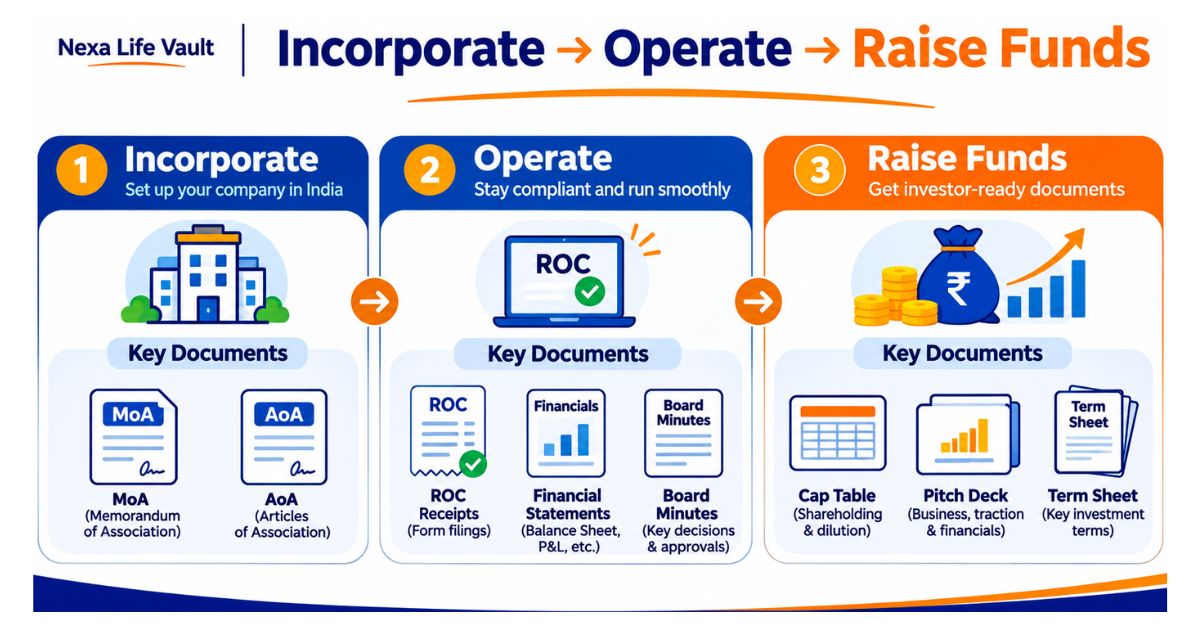
A startup documents checklist for India covers three stages. At incorporation, you need founder KYC, a DSC, a DIN, the MoA, the AoA and the Certificate of Incorporation. While operating, you need PAN, TAN, GST, bank and statutory records. For fundraising, you need a cap table, a shareholder agreement and share allotment papers. Keep each stage's records in one organised place.
Most founders remember the incorporation certificate and forget everything that follows it. Then an investor asks for your signed MoA, a bank asks for board resolutions, or an auditor asks for last year's filing receipts. You spend a weekend digging through email threads and WhatsApp chats. This checklist is arranged by stage, so you know what to collect, when, and why.
his is general information, not legal, tax or financial advice.
What is the startup documents checklist for India, stage by stage?
The table below is the short version. The sections after it explain each stage. It assumes you are setting up a private limited company, which is the most common structure for venture-funded startups. An LLP or a sole proprietorship has a different list.
| Stage | Key documents | Why they matter |
|---|---|---|
| Incorporate | Founder PAN and Aadhaar, address proof, DSC, DIN, MoA, AoA, Certificate of Incorporation, company PAN and TAN, registered office proof | They prove the company exists and who controls it |
| Operate | Bank account papers, GST registration, board minutes, statutory registers, auditor appointment, ROC filing receipts, tax returns, employment and vendor contracts | They show you are running the company in line with the law |
| Raise funds | Cap table, term sheet, shareholder agreement, board and shareholder resolutions, share certificates, allotment filings, valuation report, DPIIT recognition if you have it | Investors check them during due diligence |
Which founder documents do you need before you incorporate?
Founder documents come first because every other form depends on them. Each director and subscriber needs to prove identity and address. Gather these before you open the incorporation form:
- PAN card of every founder and director.
- Aadhaar card or another accepted identity proof.
- Address proof, such as a recent bank statement or utility bill. Accepted proofs and their age limits change, so check the current list.
- Passport-size photographs and email and mobile details for each director.
- Digital Signature Certificate (DSC) for each director. You sign the e-forms with it.
- Registered office proof: a rent agreement or ownership paper, a no-objection letter from the owner, and a recent utility bill.
If a co-founder lives abroad, the identity and address documents usually need extra steps such as notarisation or apostille. Ask your professional what applies to that person.
Common mistake: the name on the DSC, PAN and Aadhaar does not match exactly. A missing middle name or a different spelling can get your filing rejected. Check all three before you apply.
What incorporation documents do you get from the ROC?
Company incorporation in India is filed online through the MCA portal, typically using the SPICe+ form. Once the Registrar of Companies (ROC) approves it, you receive the documents that define your company. Treat them as permanent records and never lose the originals:
- Certificate of Incorporation, which carries your company name and CIN (Corporate Identification Number).
- Memorandum of Association (MoA), which states the company's name, registered office state and objects.
- Articles of Association (AoA), which sets the internal rules: how directors are appointed, how meetings run, how shares transfer.
- Company PAN and TAN, which are generally allotted along with the incorporation.
- DIN allotment details for each director.
MoA and AoA storage deserves special care. Investors, banks, and later, acquirers read these two documents closely. If you amend them, keep every version with its date and the resolution that approved the change. A folder named "AoA_final_v3" tells nobody which one is current.
Verify with the official source (the Ministry of Corporate Affairs portal, mca.gov.in) before acting, as forms, fees, and required attachments change.
What should you collect right after incorporation?
The first weeks after incorporation are when records pile up fastest. Set up this baseline:
- Commencement of business declaration. Companies with share capital generally need to file a declaration before starting business. Confirm the current form and deadline on the MCA portal.
- First board meeting minutes. They usually cover auditor appointment, bank account opening, and authorised signatories.
- Auditor appointment papers, including the consent letter and the related ROC filing.
- Share certificates issued to the founders, plus the register of members.
- Bank account opening documents and the board resolution that authorised them.
- GST registration, if your turnover or business type requires it.
- Other registrations that apply to you, such as shops and establishment, professional tax, EPFO and ESIC for employees.
Pro tip: Name every file with the same pattern: document type, date, and entity. For example, "Board-Minutes_2026-04-12_CompanyName.pdf". Six months later, you can find any record in seconds, and so can your accountant.
Which ROC filing records must you keep every year?
Once the company is running, you file regularly with the ROC, the Income Tax Department and the GST portal. The exact forms and due dates depend on your company type and turnover, so build your calendar from the official sources rather than from memory. Records you will typically need include:
- Annual financial statements and the auditor's report.
- Annual return filed with the ROC, along with the financial statements filing.
- Director KYC confirmations, which directors must complete periodically.
- Minutes of board meetings and the annual general meeting, with notices and attendance records.
- Income tax return acknowledgement and computation.
- GST returns and payment challans, if you are registered.
- TDS returns and certificates, if you deduct tax.
- SRN and payment receipts for every ROC filing.
ROC filing records are easy to neglect because the filing itself feels like the finish line. It is not. The receipt is your proof. If a filing is ever questioned, the acknowledgement and the signed copy of what you filed are what you will be asked for.
Scenario: A founder gets a notice about a missed director KYC. Her CA has the filing, but the SRN is in an old email. She loses two days proving she filed. With the receipt stored next to the filing, the reply takes ten minutes.
Verify with the official sources (MCA portal, Income Tax portal, GST portal) before acting on any due date or form number.
What contracts and employee documents should a startup store?
Compliance is not only government forms. Day-to-day contracts also decide whether your company is protected. Keep signed, final copies of:
- Employment offer letters and appointment letters.
- Founder and employee confidentiality and IP assignment agreements.
- Customer contracts, vendor agreements, and NDAs.
- Office lease or co-working agreement.
- Trademark applications and registration records, if you have filed any.
Contracts expire, auto-renew, or hit notice periods without warning. For a practical way to track them, read our guide on contract management made easy. For a wider view of how businesses organise records, see digital document management for businesses.
What documents do investors ask for when you raise funds?
Due diligence is where weak record-keeping gets exposed. Investors and their lawyers usually ask for a clean set of company and ownership records. Expect requests for:
- Cap table showing who owns what, including any ESOP pool.
- Term sheet and the final shareholders' agreement and share subscription agreement.
- Board and shareholder resolutions approving the issue of shares.
- Share certificates and the updated register of members.
- Allotment filings with the ROC and receipts.
- Valuation report, where the law or the deal requires one.
- Foreign investment filings with the RBI, if money comes from outside India.
- DPIIT recognition certificate, if you have applied for startup recognition and received it.
If your cap table and your ROC records disagree, deals slow down. Reconcile them before you share a data room link, and keep a dated copy of every version.
Verify with the official sources (MCA portal, RBI, and the DPIIT Startup India portal) before acting, since rules on valuation, foreign investment and recognition change.
How Nexa Life Vault helps
The Business Vault gives your company records one organised home, instead of scattered folders, inboxes and chat apps. You can group documents by stage (incorporation, compliance, fundraising) and find a specific file when a bank, auditor or investor asks.
Smart Document Alerts can remind you before renewal and expiry dates you enter, such as a DSC validity date, a lease renewal or a contract end date. Your files are protected with AES-256-GCM encryption and per-file keys. Nexa Life Vault is a place to store and organise copies. Whether a digital copy is accepted for a particular purpose depends on the authority asking, so keep your originals safe too.
Conclusion
A good startup documents checklist for India is really a habit: collect, name and store each record as the stage changes. Do it from day one and ROC filings, audits and funding rounds become routine instead of stressful. Start with your incorporation papers today. Set up a business vault and keep every stage of your company in one place.
Frequently Asked Questions
Nishi Naik
Product & Digital Legacy Writer
Product and technology writer passionate about digital estate planning, family data privacy, and secure information lifecycle management.
Share this post
Comments (0)
No comments yet. Be the first to comment!