Background Verification (BGV) Documents Checklist for a New Job in India
Got an email from HR asking for background verification documents? This checklist covers the ID, address, education and employment proofs Indian employers commonly ask for, what to do if your relieving letter is missing, and how to fix name or date mismatches before the agency flags them.
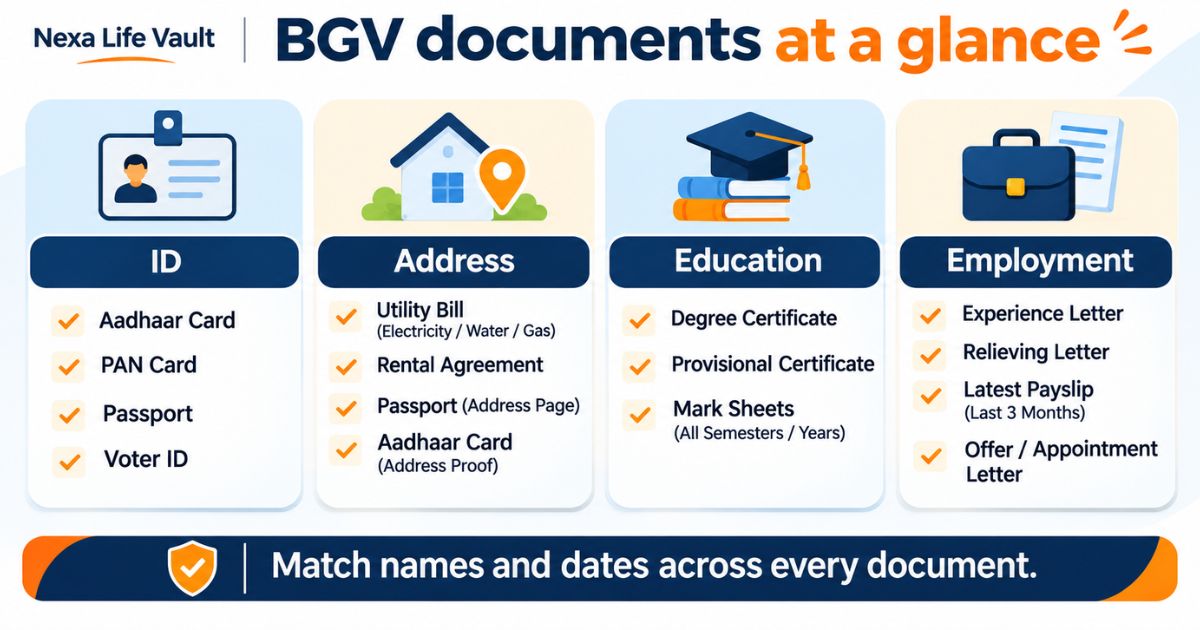
The background verification documents most Indian employers ask for are ID proof (Aadhaar, PAN, passport), address proof, education certificates with marksheets, and employment proof from past jobs: offer, relieving and experience letters plus recent payslips. Requirements vary by employer and verification agency, so confirm the list with HR.
This is general information, not legal, tax or financial advice.
You have signed the offer, and then an email arrives from HR or a verification agency asking for documents within a few days. Send the wrong set, or find out your relieving letter is missing, and your joining can stall. This checklist covers the background verification documents Indian employers commonly ask for, grouped by what is being checked: ID, address, education and employment. It also explains what to do when a document is missing or does not match.
What is background verification, and what does an employer check?
Background verification (BGV) is a check an employer runs, usually through a third-party agency, to confirm that what you told them is true. Most checks cover four areas: your identity, your education, your past jobs and your address.
Some roles add criminal record, reference or professional licence checks. That depends on the job and the company.
The agency compares your documents with your resume and application form. A wrong date, a different spelling of your name or a changed job title can all trigger questions. So the documents matter, and so does consistency across them.
What background verification documents do employers ask for?
The table below groups documents by verification type. Treat it as a working list and match it against the email you received from HR.
| Verification type | Documents commonly asked | What the check looks at |
|---|---|---|
| ID | Aadhaar, PAN card, passport, driving licence, voter ID | Name, date of birth and photo match across documents |
| Address | Aadhaar, passport, rental agreement, recent utility bill | Your current address, sometimes your previous one |
| Education | Class 10 and 12 marksheets, degree certificate, semester marksheets, provisional certificate | Institution, board or university, course and year of passing |
| Employment | Offer letter, relieving letter, experience letter, recent payslips, Form 16 | Employer name, designation, joining and leaving dates |
What is the complete BGV documents list?
Use this BGV documents list as a tick sheet. Not every employer asks for every item, but having all of them ready means you will not scramble later.
ID proof
- ☐ Aadhaar card (check that the name and date of birth are correct)
- ☐ PAN card
- ☐ Passport, if you have one
- ☐ Driving licence or voter ID as a backup
- ☐ Passport-size photographs, if the employer asks
Address proof
- ☐ Aadhaar or passport showing your current address
- ☐ Rental agreement, if you rent
- ☐ Recent electricity, gas or broadband bill in your name or a family member’s name
- ☐ Details of your previous address, if the form asks for one
Education proof
- ☐ Class 10 and Class 12 marksheets
- ☐ Graduation and post-graduation degree certificates
- ☐ All semester or year-wise marksheets
- ☐ Provisional certificate, if your final degree has not been issued yet
- ☐ Diploma or professional certificates listed on your resume
Employment proof
- ☐ Offer letter and appointment letter from each past employer
- ☐ Relieving letter from each past employer
- ☐ Experience letter
- ☐ Recent payslips from your last job
- ☐ Form 16 from past employers
Other items sometimes requested
- ☐ A signed consent or authorisation form for the check
- ☐ Contact details of professional references
- ☐ A short written explanation for any career gap
Verify with the official source (UIDAI for Aadhaar, the Income Tax Department for PAN) before acting on any name or date correction.
What is a relieving letter for BGV, and what if you don’t have one?
A relieving letter comes from your previous employer. It confirms that you have been released from your duties and states your last working day. In BGV, a relieving letter supports your employment dates. An experience letter confirms your role and how long you worked there. Some companies issue both in one document, and others issue them separately.
If you do not have a relieving letter yet, take these steps:
- Ask your previous HR for it in writing, by email, and keep the thread.
- Tell your new HR early that it is pending. Do not wait for them to find out.
- Collect supporting proof: the resignation acceptance email, your final settlement statement and your last payslips.
Some employers accept these as interim proof and ask for the letter later. Others will not clear the check without it. That is the new employer’s decision, so ask HR what they will accept.
Pro tip: Ask for your relieving letter, experience letter and final payslips in the last week of your notice period, while your old HR team still knows you. Chasing them three months later, after your contact has left, takes far longer.
Why do employment verification documents cause the most delays?
Employment verification documents depend on other people. Your previous employer’s HR has to respond, and many companies are slow to reply or only confirm details through a specific channel. Education documents come from a university or board, which can also take time.
Delays often come from small gaps. A missing payslip month, a relieving letter without a date or an offer letter from a company that has since been renamed can all raise a flag.
If a past employer has shut down or cannot be reached, ask your new HR what substitutes they accept. Options employers sometimes consider include Form 16, bank statements showing salary credits or an EPF passbook downloaded from the EPFO member portal. Do not assume any of these is enough until HR confirms.
What if your name or dates don’t match across documents?
This is more common than people expect. Your marksheet may say “Mohd Imran Khan” while your Aadhaar says “Mohammed Imran Khan”. Your resume may say you left a job in March, but your relieving letter says April.
A mismatch does not always mean rejection, but the agency will flag it and HR will ask you to explain. Here is how to deal with it:
- Tell HR about the difference before the agency finds it.
- Ask whether a self-declaration or other supporting document is acceptable.
- Correct the record with the issuing body if it is a genuine error. The process depends on that body, so check its official website.
- Fix your resume if the error is yours, and use the dates on your documents.
Never alter a document or submit one you are unsure about. A flagged mismatch can be explained. A forged document usually cannot.
How do you get BGV-ready, step by step?
- Read the HR email line by line. Note which documents they want and in what format.
- Gather everything in one place. Scan documents as clear PDFs, with all four corners visible and text readable.
- Compare against your resume. Check names, dates, designations and employer names.
- Request missing papers in writing. Email your previous employers and your university for anything you lack.
- Fill in the BGV form accurately. Use the same details as your documents, and sign the consent form.
- Answer agency queries quickly. Slow replies stretch the process.
- Keep a record. Save reference numbers, emails and the date you submitted each item.
How long the check takes varies by employer and agency, so ask HR for their expected timeline rather than guessing.
Which mistakes slow down background verification?
- Sending blurry or cropped scans. The agency asks you to resend, and the clock restarts.
- Leaving out a short job. If it shows up in a past-employer check or provident fund records, it looks like concealment.
- Using rounded dates on the resume. “2021 to 2023” will not match a letter that says “14 June 2021 to 9 March 2023”.
- Assuming the old employer will respond fast. Many do not.
- Keeping documents scattered across email, WhatsApp and old laptops, so you cannot find the right one when HR asks.
If you are changing jobs and want the wider picture, our job change document checklist covers everything beyond BGV, from notice period to final settlement.
How Nexa Life Vault helps
BGV usually arrives as one email with a short deadline. Job Vault in Nexa Life Vault gives you one place for your offer letters, relieving letters, payslips, marksheets and degree certificates, so they are together when HR asks.
With AI-powered search, you can look for a document by what it is, such as “relieving letter” or “degree certificate”, instead of opening folder after folder. Files are protected with AES-256-GCM encryption using per-file keys.
Whether an employer accepts a digital copy is their decision, so confirm with HR first. For more on organising your certificates, read our resume and certificate storage tips.
Conclusion
Background verification documents are easy to manage once you sort them into four groups: ID, address, education and employment. Check each against your resume, request any missing relieving letter early and keep clean scans ready. When the HR email arrives, you can reply with confidence. Keep career proofs verified-ready: store yours in Job Vault today.
Frequently Asked Questions
cmp6hs57y000oc2bxnj5buqzv
Editorial Contributor
Author and technology contributor at NexaLifeVault.
Share this post
Comments (0)
No comments yet. Be the first to comment!