Documents Required to Study Abroad: Complete Student Checklist for Indian Students
Learn which documents you need to study abroad, stage by stage: before applying, after the offer, for the visa and on arrival. A clear checklist for Indian students.
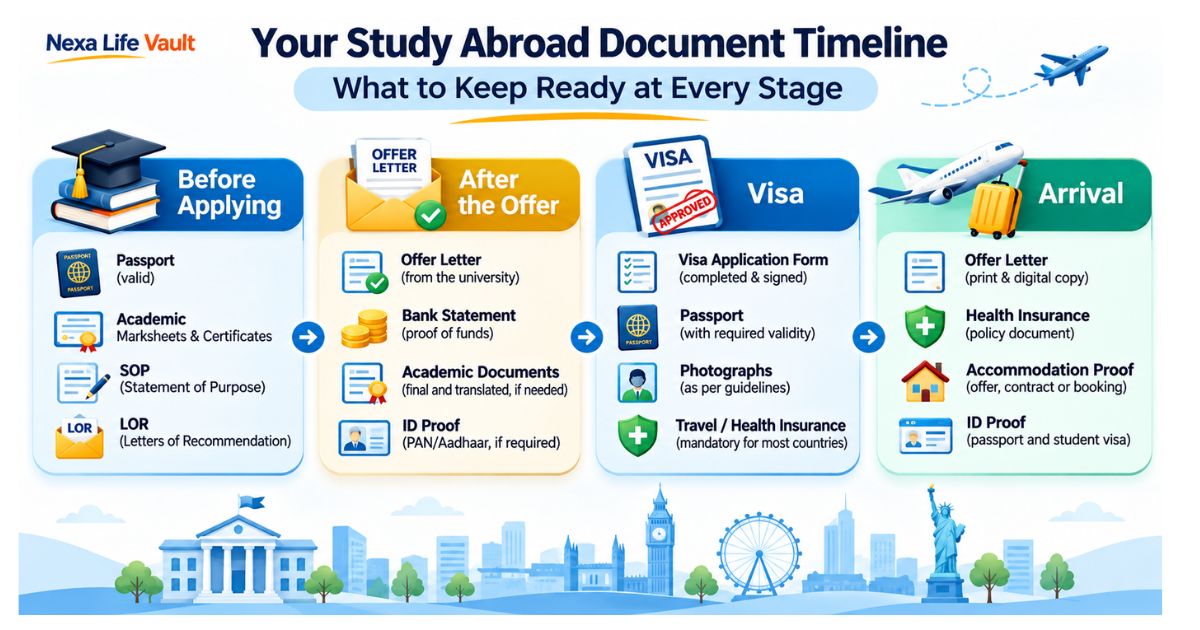
The documents required to study abroad usually include a valid passport, academic transcripts and degree certificates, English test scores, SOP and LOR, a CV, financial proof, and the offer letter. The visa stage adds forms, medical or police clearance in some countries, and insurance. Requirements differ by country and university, so check each official source.
Imagine your visa slot is nine days away and your bank needs a week to issue a statement. Or a university portal rejects your marksheet because the scan is blurry. Missing papers cost Indian students time, and sometimes an entire intake. The fix is to know what each stage asks for and collect it early. This checklist follows four stages: before applying, after the offer, for the visa, and on arrival.
What are the documents required to study abroad before you apply?
Universities first want proof of who you are, what you studied and how well you can communicate in English. Start with this table, then add anything your specific course asks for.
| Document | What it shows | Tip |
|---|---|---|
| Passport | Identity and nationality | Check its expiry date now. Destinations have their own validity rules. |
| Class 10 and Class 12 marksheets | School record (CBSE, ICSE or State Board) | Scan both sides in colour. |
| Semester-wise and consolidated degree marksheets | Undergraduate performance | Ask your college for extra official copies early. |
| Degree or provisional certificate | Course completion | If your result is pending, ask the exam cell what interim letter they issue. |
| English test report (IELTS, TOEFL, PTE or Duolingo) | Language ability | Scores have a validity period. Note the date. |
| GRE or GMAT score | Aptitude, where the course asks | Some courses waive it. Read the course page. |
| CV or resume | Academics, projects, work | Keep it to what the course values. |
| Experience and relieving letters | Work history | Common for MBA and some master's courses. |
| SOP and LORs | Your reasons and your referees' view | Covered in the next section. |
| Passport-size photographs | Identification | Follow the size and background rules on the portal. |
Some universities accept a medium of instruction (MOI) certificate from your college in place of an English test. Many do not, so confirm before you skip the exam.
You will also use your Aadhaar and PAN, but mostly for education loan applications and bank KYC, not for university forms.
Not every university asks for everything. A research degree may want a research proposal. Design and architecture courses often ask for a portfolio. Make a separate checklist for each university. For everyday education records beyond study abroad, see our education documents checklist.
How do you prepare your SOP and LOR documents?
These two take the most time because the SOP is yours alone and the LORs depend on other people.
Statement of Purpose (SOP). Admission teams read hundreds of these. Yours should answer three things: why this subject, why this university, and what you plan to do afterwards. A line like "I have always been passionate about technology" tells them nothing. A line about the college project where you built a flood-alert tool tells them something. Check the word limit on each portal, and write a fresh SOP for each course instead of swapping the university name.
Letters of Recommendation (LOR). Choose professors or managers who know your work, not the most senior name you can find. Give them your CV, a draft of your SOP and a list of deadlines. Many portals email the recommender directly, so you may never see the final letter. Save the submission confirmation and ask for a copy if they are willing to share one.
Do you need attested marksheets abroad?
It depends on the country and the university. This is the point where many students pay for attestation they did not need yet.
Attestation means an official body confirms that a copy matches the original. An apostille is a specific certificate that countries in the Hague Apostille Convention accept as proof that a document is genuine. In India, the process can involve your university, state authorities and the Ministry of External Affairs (MEA).
What universities usually do, in practice:
- Accept clear scans of your marksheets at the application stage.
- Ask for certified or official copies after you accept the offer.
- Ask your college to send transcripts to them directly.
- Use a credential evaluation service to convert your grades.
Attested marksheets abroad may also be needed for the visa or for enrolment, depending on the destination. Read the attestation line on your admission portal before ordering stamped copies.
Verify with the official source (the admission portal of each university, the destination country's visa page, and the MEA website for apostille) before acting.
What documents do you need after you receive an offer?
Once you accept, the university sends the papers that support your visa. The names change by country, which confuses many students.
- Signed offer acceptance. Many universities want this by a set date.
- Deposit or tuition fee receipt. It is often required before the university issues visa papers.
- The university's visa-support document. For example, the I-20 for the US, the CAS for the UK and the CoE for Australia.
- Scholarship letter or education loan sanction letter, if you have one.
- Final or certified academic documents, if the offer is conditional.
- Accommodation confirmation or vaccination records, if the university asks.
Read your offer letter twice. Conditions such as "submit final transcripts by July" are easy to miss, and they can block your visa papers.
What is the student visa documents checklist for Indian students?
Each embassy or consulate publishes its own list, so treat this as a starting point. The student visa documents checklist usually covers:
- Valid passport, plus old passports if the form asks for them.
- Visa application form or confirmation page and fee receipt.
- The university's visa-support document from the previous stage.
- Photographs in the exact size and format the embassy specifies.
- Academic documents and English test report.
- Proof of funds: bank statements, fixed deposit certificates or an education loan sanction letter.
- If a parent or relative sponsors you: their income tax returns, Form 16 or other income proof, and documents showing your relationship, such as your birth certificate.
- Police clearance certificate, where the country requires one. In India this is applied for through the Passport Seva system.
- Medical examination report from an approved doctor, where required.
- Health insurance proof, where required.
- SOP or study plan, if the visa office asks for one.
Verify with the official source (the embassy or consulate website, GOV.UK for the UK, IRCC for Canada, the US Department of State, or the Australian Department of Home Affairs) before acting.
Common mistake: keeping one copy in one place. Picture a student whose phone stops working two weeks before the visa interview. Her marksheets, offer letter and bank statements were all in the phone gallery. Getting fresh copies cost her several days. Keep a clear digital backup somewhere other than your phone, and a printed set of originals and photocopies in a folder.
Which documents should you carry when you arrive?
Border officers and university staff may ask for papers on day one. Keep the important ones in your hand luggage, never in a checked bag.
- Passport with visa or entry permit
- Offer letter and the university's visa-support document
- Printed visa approval or grant letter
- Proof of accommodation for the first days or weeks
- Proof of funds and insurance papers
- Original academic documents the university may check at enrolment
- Vaccination records, if the country or university requires them
- University contact numbers and an emergency contact
Tickets, bookings, insurance papers and passport copies fit naturally in the Travel Vault, so you can find them at the airport without scrolling through email.
How Nexa Life Vault helps
A study abroad application is mostly a sorting problem. The Education Vault lets you keep your marksheets, certificates, test reports, SOP drafts and LOR copies in one place, instead of across WhatsApp chats, email attachments and a laptop folder.
Smart Document Alerts add dates to the picture. You can set reminders for documents that expire or need renewal, such as your passport, so you see the date before an application or visa slot depends on it.
Files are stored with AES-256-GCM encryption, and each file has its own key. A digital copy keeps you organised, but whether a university or embassy accepts it is their decision, so follow their upload and submission rules.
Conclusion
The documents required to study abroad are not hard to find. They are hard to find at the last minute. Work stage by stage, scan everything clearly, and note the dates that matter, such as passport expiry and test score validity. Then keep it all in one place. Build your admission folder in the Education Vault, and start with your passport and marksheets today.
This is general information, not legal, tax or financial advice. Visa and admission rules change, so always confirm with the official source.
Frequently Asked Questions
Nishi Naik
Product & Digital Legacy Writer
Product and technology writer passionate about digital estate planning, family data privacy, and secure information lifecycle management.
Share this post
Comments (0)
No comments yet. Be the first to comment!