Documents to Keep for Elderly Parents: A Senior Citizen Paperwork Checklist
Keep your parents’ IDs, medical records, pension papers, insurance and legal documents in one place. Use this senior citizen paperwork checklist for India to be ready for emergencies.
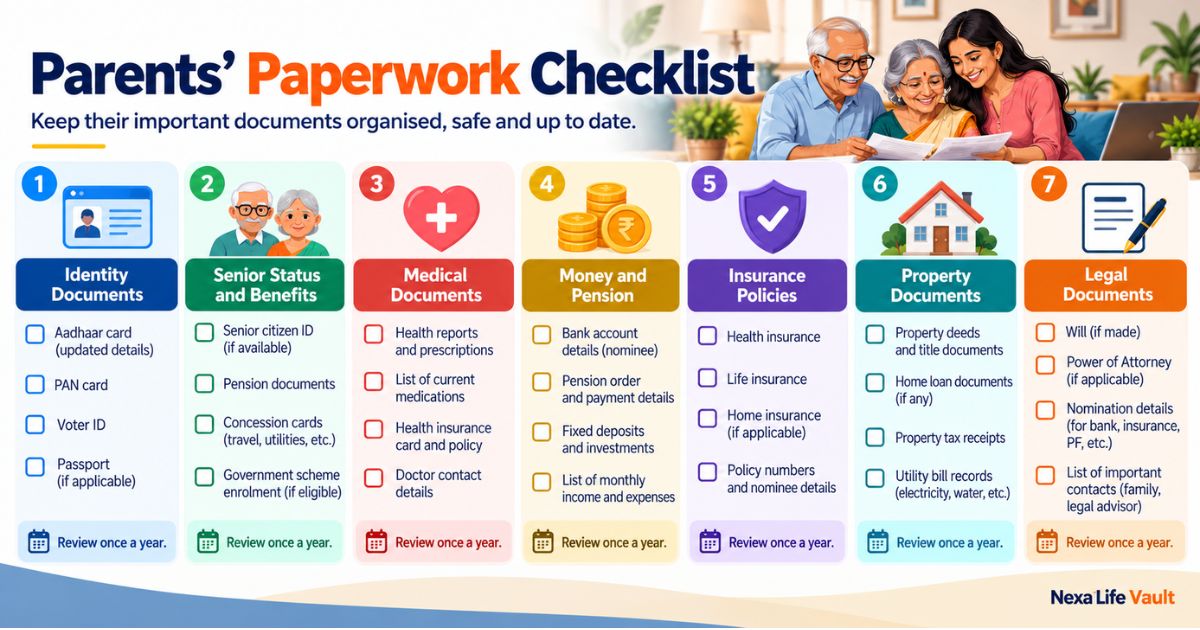
Keep these documents for elderly parents in one place: Aadhaar, PAN, senior citizen card, medical records, bank and pension papers, insurance policies, property papers, will and power of attorney. This documents for senior citizens checklist covers each one, so you can find the right paper fast during a hospital visit or a bank request.
It usually happens at a bad time. Your father is being admitted at 11 pm, and the front desk asks for his ID, insurance card and past reports. Nobody can find them. Or your mother's pension needs yearly proof that she is alive, and the form is lost somewhere at home.
If you look after ageing parents while raising your own family, a simple paperwork system saves hours of stress. Here is what to collect, why each item matters, and how to keep it within reach.
Last updated: October 2026. This is general information, not legal, tax or financial advice.
What should be on a documents for senior citizens checklist?
Think of seven groups of papers. If you have at least one copy of each group, you can handle most emergencies, bank visits and government formalities.
| Group | Key documents | Why it matters |
|---|---|---|
| Identity | Aadhaar, PAN, passport, voter ID, driving licence | Proof for banks, hospitals, travel and government services |
| Senior status | Senior citizen card, age proof | Needed where age-based benefits or services apply |
| Medical | Prescriptions, test reports, discharge summaries, ABHA ID | Doctors need the full history, especially in emergencies |
| Money and pension | Bank passbooks, FD receipts, PPO, EPF details, ITR copies | Keeps income, savings and claims traceable |
| Insurance | Health policy, life policies, premium receipts | Speeds up claims and renewals |
| Property | Sale deed, property tax receipts, society documents | Proves ownership and avoids family disputes |
| Legal | Will, power of attorney, nominee records | Lets you act for them and settle matters smoothly |
Which identity documents do elderly parents need?
Start with the basics. Most services, from a bank KYC update to a hospital admission, ask for one or more of these.
- Aadhaar card: check that the mobile number linked to it is one you can still reach. OTPs fail when the old number is switched off.
- PAN card: needed for tax filing, fixed deposits and many financial forms.
- Passport: note the expiry date, even if they rarely travel.
- Voter ID and driving licence: useful as secondary ID and address proof.
- Passport-size photographs: keep a few recent ones. Forms ask for them more often than you expect.
Check that the name, date of birth and address match across all of these. A small spelling difference between Aadhaar and PAN can hold up a pension or bank request for weeks.
What is a senior citizen card, and do your parents need one?
A senior citizen card is an age-based identity card, usually issued through a state or local government office. Some places and services recognise it for age-linked benefits, but the rules, name of the card and process differ from state to state.
Ask your parents' bank, local social welfare office or municipal office whether they need one. Verify with your state government's social welfare department (or the official state portal) before acting.
Which medical records for parents should you keep?
Good medical records for parents help doctors avoid repeat tests and wrong guesses. Keep these together, sorted by date:
- Current prescriptions and a written list of all regular medicines with doses
- Discharge summaries from every hospital stay
- Lab and scan reports (blood tests, ECG, X-ray, MRI)
- Records of surgeries, implants or pacemakers
- Allergy details and past drug reactions
- Vaccination records
- Names and numbers of their regular doctors
- Health insurance card and policy number
Also keep an ABHA (Ayushman Bharat Health Account) ID if they have one, since it can link health records digitally. Check the National Health Authority's official ABHA site for how it works.
Common mistake: keeping only the latest report. A doctor often wants to compare today's result with last year's. Keep the older ones, and write the year on each paper before you scan it.
If a parent has several conditions, add a one-page summary: diagnosis, medicines, doctor names and emergency contact. Hand a copy to a sibling or a neighbour who lives close by.
What money and pension papers should you keep?
Money papers are where small gaps turn into big delays. Gather these:
- Bank details: account numbers, branch names, passbooks or statements, and the nominee on each account.
- Fixed deposits and savings schemes: receipts or certificates, maturity dates, and nominee details. This includes schemes like the Senior Citizens' Savings Scheme if they hold one.
- Pension papers: the Pension Payment Order (PPO), pension account details and the yearly life certificate. Many pensioners submit this digitally through Jeevan Pramaan, but the process depends on the pension provider.
- EPF/UAN details: if your parent worked in the private sector, keep the UAN and passbook downloads.
- Income tax papers: PAN, filed ITR copies and Form 16A or interest certificates from banks.
- Form 15H or similar declarations: some senior citizens use these to reduce tax deducted on interest income. Whether it applies depends on their total income.
Tax rules for senior citizens change from time to time. Verify with the Income Tax Department (incometax.gov.in) or a chartered accountant before acting.
Do you need a power of attorney for parents?
Not always, but it is worth thinking about early. A power of attorney (POA) is a legal document in which your parent gives you the authority to act for them in specific matters, such as handling a bank account or signing property papers.
The type you need depends on the task. A general POA covers broad matters, while a special POA is limited to a named purpose. Stamp duty, registration and format rules differ by state.
The hard part is timing. A POA is normally made while your parent is mentally fit to understand and sign it. Waiting until a crisis can leave you with no legal way to help. For documents, steps and common pitfalls, read our power of attorney documents guide.
Along with a POA, keep these legal papers together:
- A registered or properly witnessed will, if one exists, and the location of the original
- Nominee records for bank accounts, deposits, insurance and investments
- An advance medical directive (living will), if your parent has made one
Rules on wills, POAs and medical directives are specific and can change. Verify with a qualified lawyer or the official sub-registrar's office in your state before acting.
Which insurance and property papers should be easy to find?
Insurance: keep the health policy document, the e-card, the policy number, the insurer's helpline and the renewal date. Add life insurance policies and premium receipts. If a claim is ever needed, the family should know which policies exist and where the originals are.
Property: gather the sale deed or title documents, latest property tax receipts, electricity and water bills, and society share certificate or maintenance receipts if they live in a housing society. If a property was inherited, keep the documents showing how it came to them.
Missing property papers cause some of the most stressful family disputes. A clear folder today is worth far more than a search after a loss.
How do you organise all of this without a family fight?
Talking about documents with parents can feel like talking about death. Many parents resist. Try framing it as making life easier for everyone, not planning for the end.
A real-life scenario: Meera lives in Ahmedabad, and her parents live in Surat. When her father had chest pain, her brother took him to hospital, but the insurance card was in a drawer at home. Meera spent the night calling relatives for the policy number. After that, the family agreed to keep everything scanned and shared.
Here is a simple way to start:
- Pick one weekend and one parent. Do not try to cover everything in a day.
- Collect the originals group by group, using the table above.
- Scan or photograph each paper in good light, and name files clearly, for example "Father-Health-Insurance-Policy-2026".
- Note every expiry and renewal date in one list: insurance, passport, driving licence, FD maturity, life certificate.
- Decide who needs access. Usually that means you, one sibling and, later, a nominee or trusted person.
- Put originals in one safe place and tell the family where it is.
- Review every year. Pick a fixed month, such as your parent's birthday month.
Pro tip: keep a one-page "emergency sheet" on top of everything. Include blood group, regular medicines, allergies, doctor names, insurance policy number and two emergency contacts. It is the first thing a hospital or neighbour will need.
Scanned copies are good for quick access, but they may not be accepted everywhere. Keep the originals safe and check each office's rules.
How Nexa Life Vault helps
Paper folders work until a document expires or a sibling lives in another city. Nexa Life Vault's Family Vault gives you one place to store your parents' IDs, policies and records, so they are not scattered across phones, drawers and email chains.
Its Smart Document Alerts feature sends expiry and renewal reminders, which helps with things like health insurance renewals, passport expiry and driving licence dates. You can keep medical papers in the Health Vault and legal papers such as a POA or will in the Legal Vault.
Files are encrypted with AES-256-GCM, each with its own key. Nexa Life Vault is a storage and organisation tool. It does not decide whether a digital copy is legally valid, so check with the relevant office when you need an original.
Conclusion
You do not need a perfect system. Use this documents for senior citizens checklist to collect the essentials, scan them, and note every renewal date. Do it once, review it yearly, and your family will not scramble when it matters. If you want a shared place to start, set up a vault and manage your parents' records together.
Frequently Asked Questions
Nishi Naik
Product & Digital Legacy Writer
Product and technology writer passionate about digital estate planning, family data privacy, and secure information lifecycle management.
Share this post
Comments (0)
No comments yet. Be the first to comment!