What Executors Need: Probate Documents Checklist (UK)
Being named an executor can feel overwhelming when you don’t know what paperwork to gather. This probate documents checklist for UK executors covers the will, death certificate copies, asset records and HMRC forms, laid out as a simple timeline for the first 7 days, first month and first year.
A probate documents checklist UK executors can use starts with the original will, the death certificate, a list of assets and debts, and your own contact and identity details. You will also need Inheritance Tax paperwork for HMRC and the application form or online account. Gather these first, then order extra certified death certificate copies for banks and insurers.
Being named as an executor often lands at the worst possible time. You are grieving, and suddenly you are expected to find paperwork, deal with banks and speak to HMRC. Most of the stress comes from not knowing what to collect, or in what order. This article gives you a plain checklist and a timeline split into the first 7 days, the first month and the first year.
This is general information, not legal, tax or financial advice. It mainly covers England and Wales. Scotland and Northern Ireland use different processes and terms.
What does an executor actually do?
An executor carries out the instructions in a will. Your executor duties in the UK usually include registering the death, arranging the funeral, finding and valuing the estate, dealing with Inheritance Tax, paying debts, applying for probate if needed, and passing on what is left to the people named in the will.
The paperwork matters because every step needs proof. A bank wants to see who you are and that the person has died. HMRC wants figures. The probate registry wants the will. If you can lay your hands on the right document quickly, each step moves faster.
What is a grant of probate, and do you always need one?
A grant of probate is the legal document that confirms an executor's authority to deal with the estate. Banks, building societies and the Land Registry often ask to see it before they release money or transfer property.
You do not always need one. Some small accounts can be closed with just a death certificate, and jointly owned property or accounts usually pass to the surviving owner. Each organisation sets its own limits, so ask them before you apply.
If there is no will, nobody is named as executor. A relative applies for "letters of administration" instead, which follows a different form and a set order of priority.
Verify with the official source (GOV.UK: "Applying for probate") before acting.
What is the probate documents checklist UK executors should use?
The documents needed for probate depend on the estate, but most executors end up collecting the items below. Use it as a starting point and tick items off as you go.
| Document | Why you need it | Where to find it |
|---|---|---|
| Original will and any codicils | Confirms the executors and the wishes of the person who died | Home, solicitor, bank, or a will storage service |
| Death certificate (original and certified copies) | Proof of death for the application and for every organisation | The registrar, after the death is registered |
| Your own identity and contact details | Needed to apply and to prove you are the executor | You |
| Bank, building society and savings statements | To value the estate and find account numbers | Post, online banking, bank letters |
| Pension, insurance and investment papers | Policies and pensions may pay out or need to be stopped | Filing cabinet, email, annual statements |
| Property documents (title deeds, mortgage statements) | To value property and deal with any loan | Home, solicitor, mortgage lender, HM Land Registry |
| Debt and bill records (credit cards, loans, utilities, funeral invoice) | Debts are paid from the estate and reduce its value | Post, email, online accounts |
| Vehicle documents (V5C logbook) | To value, sell or transfer a vehicle | Glove box, home, DVLA |
| Inheritance Tax forms | Reports the value of the estate to HMRC | GOV.UK |
| Probate application (online, or paper form PA1P if there is a will) | Asks the probate registry for the grant | GOV.UK |
Not every estate needs every row. A simple estate with one bank account and a rented flat looks very different from one with a house, shares and a small business.
Pro tip: Make a single "estate list" as you go, with the organisation name, account or policy number, contact details and what you have done with it. When someone rings you in month four asking about a policy, you will know the answer in seconds.
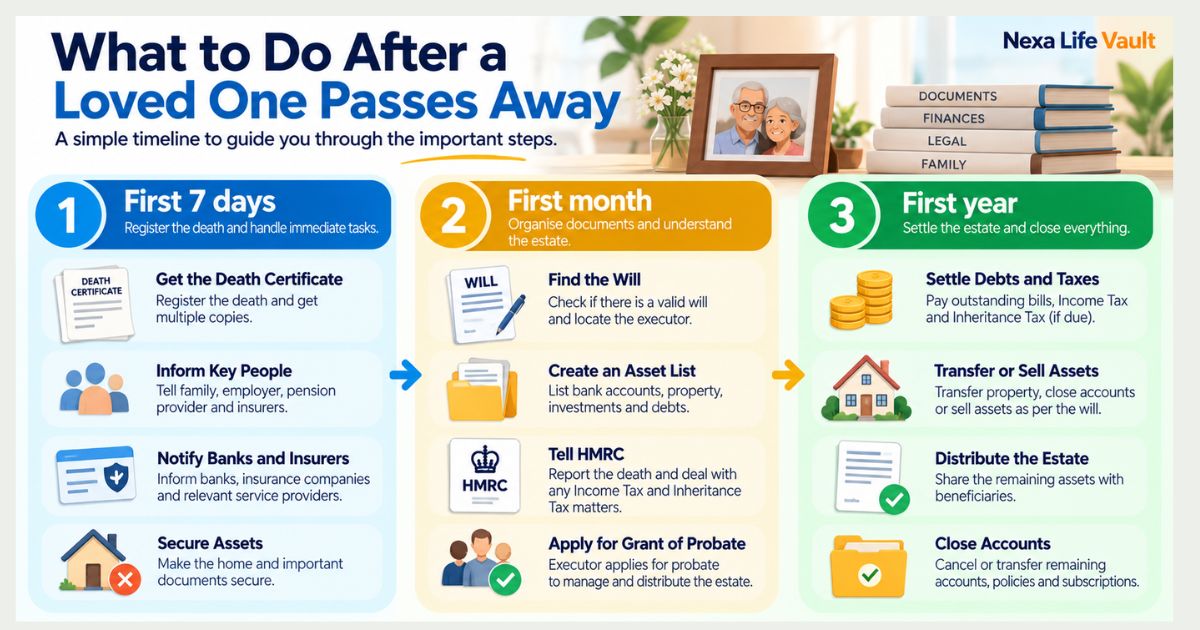
What do you need in the first 7 days?
The first week is about the essentials. Do not try to sort the whole estate yet.
- Get the medical certificate. A doctor or medical examiner issues the Medical Certificate of Cause of Death. If the death was referred to a coroner, the registrar will wait for the coroner's paperwork.
- Register the death. In England and Wales this is usually expected within five days. Book an appointment with the local register office. The registrar then issues the death certificate.
- Buy death certificate copies. Order more than you think you need (see the section below).
- Find the will. Check the home, ask the family, and contact any solicitor, bank or will-writing firm the person used. Keep the original safe and unfolded.
- Use "Tell Us Once" if offered. Many registrars offer this GOV.UK service, which informs several government departments in one go.
- Secure the home. Keep it locked, redirect post if needed and tell the home insurer the person has died.
Verify with the official source (GOV.UK: "What to do after someone dies") before acting.
What do you need in the first month?
Once the first week is done, you can start building a picture of the estate. This is where most of your document gathering happens.
- Confirm you are an executor. Read the will carefully. Check whether other executors are named and whether you all need to act together.
- Notify banks, building societies and pension providers. Send the death certificate or a certified copy. Ask what each one needs from you and whether they will freeze the account.
- List every asset and debt. Look through post, emails, bank statements and phone contacts. Do not forget small items such as premium bonds, old workplace pensions and loyalty balances.
- Get property valuations. You will usually need a written estimate of what a property is worth at the date of death. Ask a local estate agent.
- Contact the benefits and pensions offices. Pension payments and benefits stop or change after a death. Overpayments may need to be returned.
- Ask a solicitor if the estate is complicated. Overseas assets, a business, or a family disagreement are good reasons to get advice.
Here is a short example. Marcus's mother died in March. In week two he found a bank statement, a pension letter and a car logbook in a kitchen drawer. By week four he had a spreadsheet with seven organisations, each with a reference number and a date of contact. When he started the probate application, he already had most of the figures he needed.
What do you need in the first year?
The first year covers the formal steps: tax, the grant, and paying out the estate. Timings vary a lot, so treat the order below as a guide rather than a deadline schedule.
- Report the estate to HMRC. Even if no Inheritance Tax is due, you may still need to complete a form. HMRC has different forms depending on the estate. Deadlines and interest rules apply to any tax owed, so check them early.
- Apply for the grant of probate. You can apply online or by post, or use a solicitor. You will need the original will and the death certificate or coroner's certificate. Reporting the estate to HMRC usually comes first.
- Pay any Inheritance Tax and the application fee. Check the current fees and thresholds on GOV.UK rather than relying on older articles.
- Use the grant to collect assets. Send a copy of the grant to banks, insurers and other organisations, as they ask.
- Pay debts and funeral costs. Keep every invoice and receipt.
- Sell or transfer property and vehicles. This may involve HM Land Registry and DVLA paperwork.
- Prepare final estate accounts. Record everything that came in and went out. Beneficiaries may ask to see this.
- Distribute the estate. Pay each beneficiary as the will says, and keep a signed receipt.
Verify with the official source (GOV.UK: "Applying for probate" and HMRC Inheritance Tax guidance) before acting.
How many death certificate copies do you need?
There is no fixed number. A good rule is one certified copy for each organisation that will ask for one, plus a few spares. That usually means each bank, insurer, pension provider, mortgage lender and the probate application itself.
Some organisations return the certificate and some keep it, so policies vary. Ask each one when you first call. Ordering extra copies when you register the death is usually easier than going back later.
Check the current cost per copy with your local register office.
What if the paperwork is missing or scattered?
This is very common. Most people do not keep a neat folder. Start with whatever the person left behind: recent post, a laptop or phone, a desk drawer, a bank app. Statements usually point you to the next account.
If you cannot find the will, ask the family, check with any solicitor they used, and ask their bank. You can also read our guide on important documents for loved ones, which explains what to gather and share while someone is alive, so executors are not left searching later.
If you are planning ahead for your own family, a shared place for core records helps. Our Family Vault is designed for that kind of household paperwork.
How Nexa Life Vault helps
The hardest part of being an executor is often not the law. It is finding the paperwork. Our Legal Vault gives you one place to keep wills, powers of attorney and related legal documents, so they are not scattered across drawers and email folders.
With Nominee & Executor Access, you can choose who should be able to reach those documents when the time comes. That means your executor can be directed to the right files, rather than starting from nothing.
Your files are protected with AES-256-GCM encryption and per-file keys, and they are decrypted only in server memory for authorised requests. A digital copy is a convenient reference, not a replacement for the original will, which you will still need for probate.
Conclusion
A good probate documents checklist UK executors can rely on comes down to three habits: register the death and order spare certificates early, build one list of assets and debts, and keep every original safe. Take the timeline one stage at a time. If you want your own executor to find everything quickly one day, give executors organised access with Nexa Life Vault.
Frequently Asked Questions
Pratyush Kumar
Technology Lead & Digital Transformation Strategist
Technology leader and digital transformation strategist writing about secure enterprise data architecture, privacy-first engineering, and next-generation vault solutions.
Share this post
Comments (0)
No comments yet. Be the first to comment!