Newborn Baby Documents Checklist: What You Need in the First 30, 90 and 365 Days
Birth certificate, insurance, vaccination card and Aadhaar: here is every document your newborn needs in India, sorted into 30, 90 and 365-day windows.
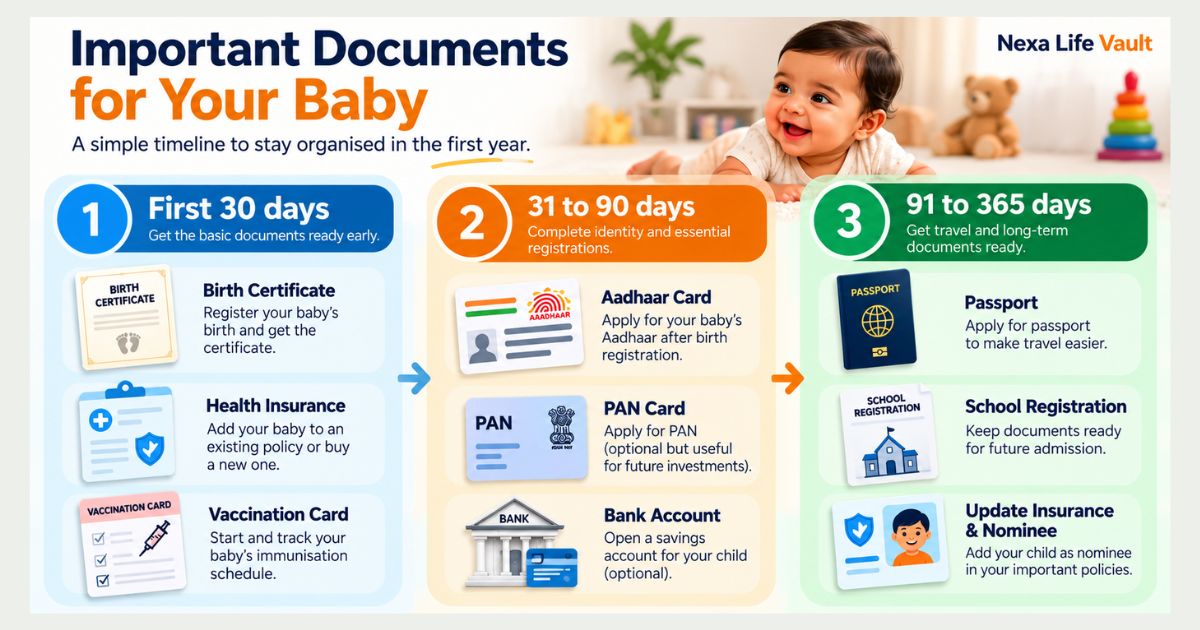
A newborn baby documents checklist for India starts with the hospital discharge summary and the birth certificate. Next, add your baby to your health insurance and start the vaccination card. Then apply for Aadhaar and keep every record updated through the first year, adding a passport only if you plan to travel.
The hospital hands you a baby, a bag of reports and a long list of things to do. Within weeks, someone will ask for a birth certificate, an insurance form or a vaccination card, and you will be digging through that bag at 2 a.m. This checklist splits the paperwork into three windows, so you only deal with what matters right now.
What documents does a newborn baby need in India?
Most parents need about six or seven documents in the first year. Some are mandatory, some are optional, and a few depend on your plans. The 30, 90 and 365-day windows below are a planning guide, not legal deadlines, except where the table says a rule applies.
| Document | Suggested window | Who issues it |
|---|---|---|
| Hospital discharge summary and birth records | Day 1 to 7 | Hospital or nursing home |
| Birth certificate | First 30 days | Local registrar of births and deaths |
| Health insurance addition | First 30 days | Your insurer or employer |
| Vaccination card or digital record | Starts at birth | Hospital, paediatrician or government centre |
| Mother and Child Protection card | First 90 days | Government health system |
| Aadhaar (Baal Aadhaar) | 31 to 90 days | UIDAI enrolment centre |
| Passport (only if travelling) | 91 to 365 days | Passport Seva |
What should you do in the first 30 days?
The first month is the busiest. Your goal is simple: get the birth certificate started, protect the baby with insurance, and keep the vaccination record safe.
Collect the hospital papers before you leave
Before discharge, ask for the discharge summary, the birth notification or birth report, and any newborn screening or test results. Check the baby's date and time of birth, the parents' names and the mother's name spelling. Fixing a mistake at the hospital desk takes minutes. Fixing it after the certificate is issued takes weeks.
How do you get a baby birth certificate in India?
A baby birth certificate is issued after the birth is registered with the local registrar, usually through the municipal corporation, gram panchayat or the state's online civil registration portal. Many hospitals send the birth report to the registrar for you, but do not assume this has happened. Ask for the registration number.
Here is the usual sequence:
- Get the birth report or notification from the hospital.
- Fill in the birth registration form, available from the registrar's office or your state portal.
- Attach the hospital report and your parents' ID proof, such as Aadhaar cards.
- Submit it and note the registration number.
- Collect the certificate and check every detail.
The Registration of Births and Deaths Act sets a time limit for registering a birth, and late registration usually needs extra steps and sometimes a fee. Rules and portals differ by state. Verify with the official source (your state's civil registration portal or local registrar) before acting.
Order a few certified copies. You will need them for school admission, passport and insurance claims. For safe storage ideas, read our birth certificate storage guide.
Common mistake: Registering the birth before you have chosen a name, then forgetting about it. Many registrars allow the name to be added later, but the process is slower and the rules vary by state. If you cannot decide in time, still register the birth, then ask your registrar how to add the name afterwards. Whatever you choose, spell it identically on every document.
How do you add a baby to health insurance?
To add a baby to health insurance, inform your insurer or employer's HR team, submit the birth certificate or hospital birth report, and ask for a written endorsement. Insurers set their own rules, so check how soon after birth you must apply and when cover for the baby begins.
Take these steps:
- Family floater policy: Ask the insurer to add the newborn as a member and confirm any change in premium.
- Employer group policy: Ask HR for the dependent enrolment window. Some companies keep it short.
- Maternity cover: If your policy includes newborn cover, ask what is covered and from which day.
- Keep the proof: Save the endorsement letter or updated policy schedule.
Verify with the official source (your insurer's policy wording and the IRDAI guidelines) before acting.
Start the vaccination card on day one
Most newborns receive their first vaccines at the hospital. Ask for the vaccination card and make sure the date, vaccine name and batch details are filled in. Many parents also use the government's U-WIN portal, which is a digital vaccination record, where it is available in their area. Keep the paper card even if you have a digital record, since clinics still ask for it.
Store vaccine records alongside the baby's other health papers. A dedicated place such as a Health Vault keeps them together for each check-up.
What comes next in the 31 to 90 day window?
By now you have a rhythm and a few key papers. This window is for adding identity and tightening your records.
How do you apply for a newborn's Aadhaar?
Children under five can be enrolled for Aadhaar, often called Baal Aadhaar. For young children, the enrolment is linked to a parent's Aadhaar, and fingerprints and iris scans are not captured at that age. You usually need the birth certificate or hospital discharge proof, and a parent's Aadhaar. Book an appointment at an Aadhaar enrolment centre through the UIDAI website, and carry original documents.
Biometric updates are generally required later in childhood. Verify with the official source (UIDAI, uidai.gov.in) for the current document list and update ages.
Collect the Mother and Child Protection card
The Mother and Child Protection (MCP) card is a government health record that tracks pregnancy care, birth details and the child's early immunisation. If you received one at a government facility or from an ASHA or anganwadi worker, keep it. Private hospitals may give a different card, and some families have both. Use whichever your doctor asks for, and do not throw the other away.
Update your own records
Now is a good time to review nominee details on your own insurance, bank accounts and investments. Some families also revisit their will. This is general information, not legal, tax or financial advice. For anything specific, speak to a qualified professional.
What should you handle between 91 and 365 days?
The first year ends with fewer urgent tasks and more tracking. The risk now is forgetting dates.
- Follow the vaccination schedule. Your paediatrician will tell you the dates. Photograph each page of the card after every visit.
- Check the name everywhere. Birth certificate, Aadhaar, insurance and hospital records should match exactly.
- Apply for a passport only if you need one. A minor's application usually needs the birth certificate and parents' documents. Verify with the official source (Passport Seva, passportindia.gov.in) for the current list.
- Renew or review insurance. At your policy renewal, confirm the baby is listed correctly.
- Make digital backups. Scan every document in good light, in colour, with all four corners visible.
How do you keep newborn documents organised?
Picture this: your baby has a fever at 11 p.m., the new clinic asks for her vaccination history, and the card is in a drawer at your parents' house. A phone photo would have solved it.
A simple system works better than a perfect one:
- Keep one physical folder with originals and certified copies.
- Scan each document the day you receive it.
- Name files clearly, such as "baby-birth-certificate" or "baby-vaccination-card-page-1".
- Note renewal and review dates in one place.
- Tell one trusted adult where everything is.
Pro tip: Ask the hospital for two copies of the discharge summary on day one. One goes in your physical folder and the other travels with you to the first paediatrician visits, so the original stays safe.
How Nexa Life Vault helps
A newborn adds a lot of papers in a short time, and they belong together. The Family Vault gives your baby a dedicated place for the birth certificate, Aadhaar, insurance papers and hospital records alongside your own family documents.
Smart Document Alerts are especially useful in the first year. You can add reminders for insurance renewals and other dates tied to your documents, so deadlines do not depend on memory. Files are protected with AES-256-GCM encryption, with a separate key for each file.
Digital copies are for convenience and easy access. They do not replace originals, and their acceptance depends on who is asking.
Conclusion
A newborn baby documents checklist works best when you split it by time: papers and insurance in the first 30 days, identity and records by 90, and tracking through the first year. Keep originals safe, scan everything early and match the baby's name across all records. When you are ready to keep it all in one place, create your baby's vault.
This is general information, not legal, tax or financial advice. Rules differ by state and insurer, so verify with the official source before acting.
Frequently Asked Questions
Nishi Naik
Product & Digital Legacy Writer
Product and technology writer passionate about digital estate planning, family data privacy, and secure information lifecycle management.
Share this post
Comments (0)
No comments yet. Be the first to comment!