Lasting Power of Attorney Documents UK: What You Need and How to Store Them Safely
Making an LPA in England and Wales means gathering the right paperwork, registering with the Office of the Public Guardian, and storing the originals where your attorneys can find them. This checklist covers the documents you need, the two LPA types, and safe storage.
To make a lasting power of attorney in England and Wales, you need the completed LPA form, names and addresses for your attorneys and certificate provider, and the registration fee or a fee-reduction form. After the Office of the Public Guardian registers it, store the registered original and certified copies where your attorneys can reach them.
Picture this. Your dad has a stroke on a Tuesday night. He made an LPA two years ago, but nobody can find it. The bank wants to see the registered document before it will talk to you. Meanwhile, bills keep arriving.
Most LPA stress comes from missing paperwork, not from the law. This article lists the lasting power of attorney documents UK families need, explains how registration works, and shows how to keep everything safe and findable.
What is a lasting power of attorney in the UK?
A lasting power of attorney (LPA) is a legal document that lets you, the "donor", choose one or more people, called attorneys, to help with decisions or make them for you. It matters if you ever lose mental capacity because of illness, injury or dementia.
This article covers England and Wales. Scotland and Northern Ireland have their own systems and terms, so do not assume the same steps apply there.
You must be 18 or over and have mental capacity when you make an LPA. An LPA cannot be used until it is registered with the Office of the Public Guardian (OPG), the government body that registers LPAs in England and Wales.
Verify with the official source (GOV.UK, "Make, register or end a lasting power of attorney") before acting.
Health and welfare vs property and financial affairs LPA: what is the difference?
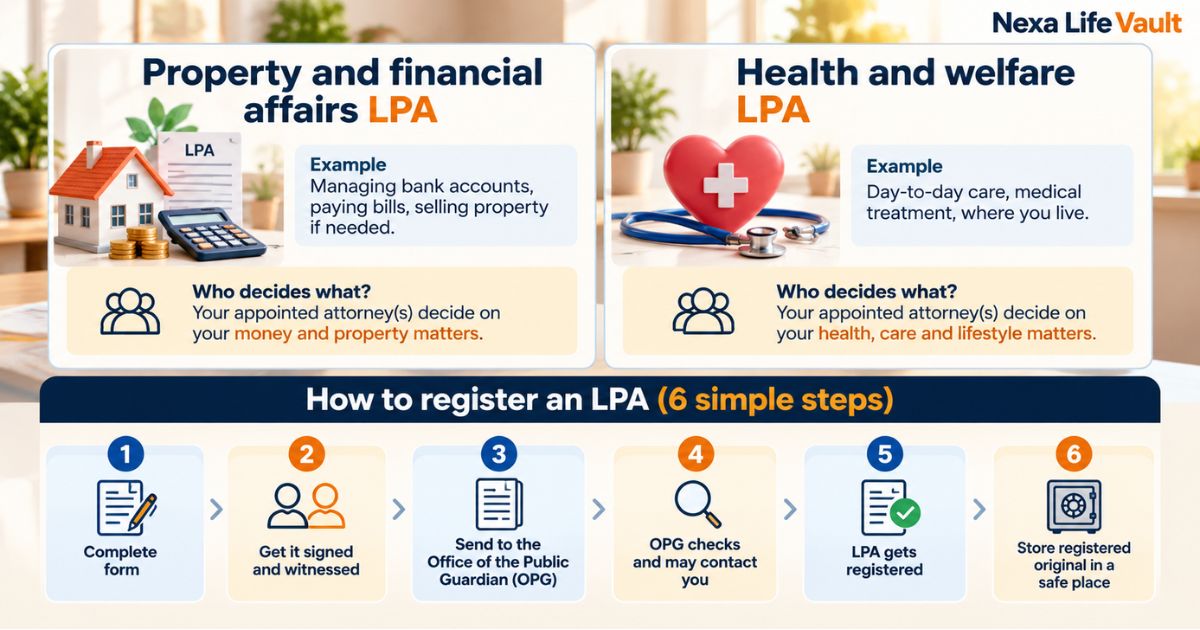
You can make one type or both. They are separate documents, each with its own form and registration. The health and welfare vs property and financial affairs LPA choice comes down to what you want your attorney to decide.
| Feature | Property and financial affairs LPA | Health and welfare LPA |
|---|---|---|
| What it covers | Money and property decisions, such as paying bills, managing bank accounts or selling a home | Personal care and medical decisions, such as daily routine, treatment and where you live |
| When it can be used | Once registered. You can allow use while you still have capacity, or limit it to when you lack capacity | Only once registered and you lack capacity to decide for yourself |
| Typical example | Your daughter pays your care home fees from your account | Your son agrees to a treatment plan with your doctors |
| Special choice on the form | Instructions or preferences about how finances are handled | You decide whether your attorney can make decisions about life-sustaining treatment |
Many people make both and name the same attorneys, but you can choose different people for each. For example, you might trust a sibling with your health decisions and an accountant friend with your money.
Verify with the official source (GOV.UK, types of LPA) before acting, as the rules on when each type can be used are set by law and guidance.
What lasting power of attorney documents do you need in the UK?
Before you send anything to the OPG, gather these items. Think of this as your LPA registration documents checklist.
- The LPA form itself. You can fill it in online through GOV.UK, then print it, or use paper forms. Always use the current version from GOV.UK, because forms are updated from time to time.
- Your details. Full name, address and date of birth as the donor.
- Attorney details. Names, addresses and dates of birth for each attorney, plus any replacement attorneys you choose.
- A certificate provider. This is an independent person who confirms you understand the LPA and are not being pressured. They sign a section of the form.
- People to notify. If you name people to be told about your application, they get a notice before registration and have a short window to raise concerns. The online service can create the notice forms for you.
- Signatures and witnesses. The donor, attorneys and certificate provider all sign in the order the form sets out. A wrong order is a common reason for rejection.
- The registration fee, or a fee-reduction application. Some people pay less or nothing, depending on income or benefits. Check the current fee and eligibility on GOV.UK.
- The original form. The OPG expects the original, signed paperwork. A certified copy may be accepted in limited situations.
Verify with the official source (GOV.UK and the Office of the Public Guardian) for current forms, fees, notification rules and who can act as a certificate provider.
How does LPA registration work with the Office of the Public Guardian?
The process for Office of the Public Guardian LPA registration is the same for both types. Here is the usual order:
- Complete the LPA form, online or on paper.
- Send notices to anyone you named as people to be told, if you chose any.
- Sign and witness the form in the correct order.
- Post the original form and the fee, or fee-reduction form, to the OPG.
- Wait. The OPG checks the application and registers it if everything is in order.
- Receive the registered LPA back and store it safely.
You can apply to register yourself while you have capacity. Your attorneys can also apply, and you will be told if they do. If the form has mistakes, the OPG may send it back or ask for changes, which adds weeks. Current processing times are published by the OPG, so check them rather than relying on old figures.
Pro tip: Register your LPA as soon as it is signed, not "when it is needed". If the OPG finds a mistake, you can fix it while you still have capacity. If you lose capacity first, you may not be able to make a new one.
Verify with the official source (GOV.UK, "Register a lasting power of attorney") before acting, especially for notification periods, processing times and what happens if there are errors.
Which documents should you keep after your LPA is registered?
Once the OPG registers your LPA, the paperwork you hold becomes your working file. Keep these together:
- The registered original LPA for each type you made.
- Certified copies, if you have ordered them for banks or care providers.
- The OPG's registration letter or confirmation.
- A note of who the attorneys, replacement attorneys and certificate provider are, with phone numbers and email addresses.
- Any written wishes you want your attorneys to read, kept as a separate document.
- Details of any older enduring power of attorney, if one still exists.
- Your fee receipt or fee-reduction paperwork.
Attorneys will often be asked for proof of identity and address by banks, so it helps to know where their own ID documents are, too. You can also ask the OPG about certified copies and about sharing a summary of the LPA with organisations that need to check it.
Verify with the official source (GOV.UK, "Use a lasting power of attorney") for how attorneys prove their authority to banks and other organisations.
How should you store lasting power of attorney documents safely?
Safe storage means two things: protected from loss or damage, and reachable by the right people at the right time. Many families manage the first and fail the second.
Common options include:
- A home fireproof box. Cheap and handy, but only useful if attorneys know where it is and can open it.
- A solicitor's safe storage. Often secure, but your attorneys need to know which firm holds it.
- A shared folder of certified copies. Good for day-to-day use, as long as the original is stored separately.
- A secure digital vault. Useful for scans, contact notes and checklists, so everything is searchable and shareable from your phone.
Common mistake: Keeping the only copy in a locked drawer, with the key and the location known only to the donor. If the donor loses capacity, nobody can get in. Tell at least one attorney, and write the location down.
A scan is a handy backup, but it does not replace the registered original. Banks and care providers decide for themselves what they accept, so ask each one before you assume a scan or photocopy is enough.
Who should know where your LPA documents are?
Your attorneys come first. If you named replacement attorneys, they should know too, as they may need to step in. Share the location of the originals and the contact list, not necessarily every detail of your finances.
Think about a real case. Amira in Leeds made both LPAs for her mother, then moved to Manchester for work. When her mother was admitted to hospital, Amira's brother, a named replacement attorney, needed the health and welfare LPA the same afternoon. Because Amira had texted him the storage location a year earlier, he found it in ten minutes.
Also tell your solicitor, if you used one, and the person who will deal with your estate. An LPA ends when the donor dies, so your executor and your will are a separate matter. Make sure both sets of papers are easy to find, without mixing up what each document does.
How Nexa Life Vault helps
The Legal Vault in Nexa Life Vault is built for documents like these: registered LPAs, certified copy scans, OPG letters, your will and any related legal papers, all in one place instead of scattered across drawers and inboxes.
With Nominee & Executor Access, you can choose the people who should be able to reach those documents when it matters, so your attorneys are not hunting for a key or a folder. Files are protected with AES-256-GCM encryption, with a separate key for each file.
A digital copy does not replace your registered original, and organisations decide what copies they accept. Think of the vault as the place that tells people where everything is and gives them what they need to start.
Conclusion
Good lasting power of attorney documents UK families rely on are complete, registered and easy to find. Gather the form details, register early, keep the registered original safe, and tell your attorneys where it is. A calm week now saves a frantic one later. Store your LPA and share with attorneys using Nexa Life Vault.
Related reading: Power of attorney documents guide.
Frequently Asked Questions
Vishal Singh
Full-Stack Developer & Systems Contributor
Full-stack developer at NexaLifeVault specializing in secure web applications, data encryption standards, and digital legacy preservation systems.
Share this post
Comments (0)
No comments yet. Be the first to comment!