Property Registry Documents Explained: Sale Deed, Mutation and Encumbrance Certificate
Learn what a sale deed, mutation entry and encumbrance certificate prove, how a sale deed differs from a title deed, and which property registry documents to check before you pay.
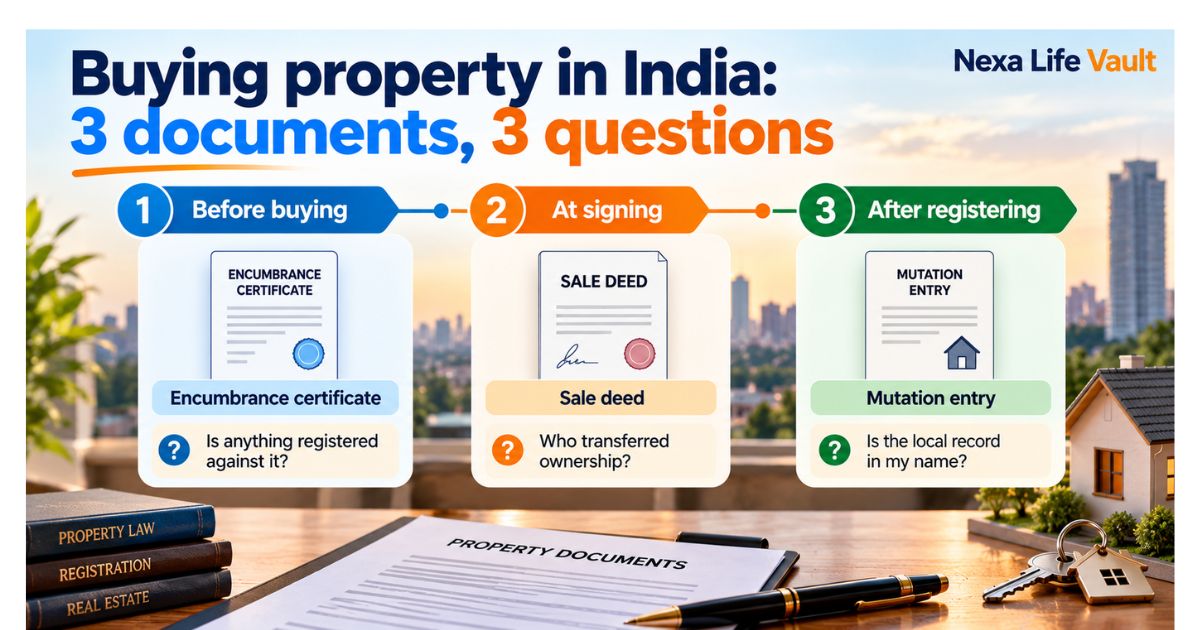
The key property registry documents are the sale deed, which transfers ownership; the mutation certificate, which updates the local revenue or municipal record in your name; and the encumbrance certificate, which shows whether the property has registered loans or transfers against it. Check all three, plus the earlier ownership papers, before you pay.
Say you find a flat you like and pay a token amount. Then you ask for the papers, and the seller hands you a photocopy of an old agreement and a property tax receipt. That is not enough. Before any serious money moves, you need to read three records: the sale deed, the mutation entry and the encumbrance certificate. This article explains what each one proves, how they differ from a title deed, and what to check before you buy.
Last updated: October 2026. This is general information, not legal, tax or financial advice.
What are property registry documents?
Property registry documents are the papers created or updated in government offices when a property is bought, sold or transferred. In India, the sale of land or a building is registered at the sub-registrar office. A separate record update then happens with the local revenue or municipal authority.
Together, these papers show who owns the property, who pays tax on it, and whether anyone else has a registered claim over it.
Names and procedures change from state to state. What one state calls mutation, another may call a jamabandi entry, khata transfer or name transfer. Verify with the official source (your state's registration department and land records portal) before acting.
What is a sale deed?
A sale deed is the registered legal document that transfers ownership of a property from the seller to the buyer. It names both parties, describes the property, states the price and carries the stamp duty and registration details.
When you read one, look for the survey or plot number, boundaries, area, the registration number and date, the sub-registrar's seal and the witnesses' details. Also check that it refers to the seller's own earlier deed.
What is a title deed?
A title deed is not one fixed paper. It is the everyday term for the document, or set of documents, that proves who owns a property. In practice it means your sale deed plus the earlier deeds showing how the property reached the seller.
What is a chain of title?
The chain of title is the sequence of ownership documents from an earlier owner down to the current seller. Each deed should connect to the next without gaps. A missing link, such as an owner who appears from nowhere, is a red flag worth raising with a lawyer.
What is a mutation certificate?
Mutation is the update of the local land or property record so that your name replaces the seller's. The proof you receive is often called a mutation certificate or mutation order. It shows that the revenue or municipal office accepts you as the new owner for tax and record purposes.
Mutation does not create ownership. The registered sale deed does that.
What is an encumbrance certificate?
An encumbrance certificate (EC) is an official statement from the sub-registrar office listing the registered transactions on a property for a period you choose, such as sales, mortgages or gifts. A "nil" EC means no registered transaction was found for that period.
It may not show unregistered agreements or every court dispute, so treat it as one check among several.
What is stamp duty?
Stamp duty is a state tax paid on the sale deed. The rate and the way it is calculated depend on the state and the type of property. The payment is recorded on the deed, so check it before you accept any copy.
Sale deed vs title deed: what is the difference?
People mix up these two terms all the time. The sale deed is a single document. The title deed is the wider proof of ownership that includes it.
| Point | Sale deed | Title deed |
|---|---|---|
| What it is | One registered document that transfers ownership | General term for the papers that prove ownership |
| Number of papers | One per sale | Usually several, covering past owners too |
| Who creates it | Seller and buyer, registered at the sub-registrar office | Built up over time from each earlier transfer |
| What it shows | That this seller sold to this buyer on this date | That the seller has a clear line of ownership |
| Where to find it | Your own records; a certified copy from the sub-registrar office | Seller, previous owners, lender or the registration office |
When a seller says "I have the title deed," ask which papers they mean. Often it is only the latest sale deed. Ask for every deed in the chain.
How do the three documents work together?
Each document answers a different question, and each comes at a different point in the purchase.
- Before you buy: read the seller's sale deed and earlier deeds, and get an encumbrance certificate. These tell you whether the seller owns the property and whether a registered loan or transfer sits on it.
- At signing: the new sale deed is signed, stamp duty is paid, and the deed is registered at the sub-registrar office.
- After registration: you apply for mutation with a copy of the registered deed, so the revenue or municipal record shows your name.
- Afterwards: property tax bills and utility records move to your name, and you keep fresh copies of everything.
Skipping the last two steps is where many owners get stuck. Years later, the tax bill still arrives in the previous owner's name, and a bank asks for a record you never applied for.
Which documents should you check before buying property?
Ask for all of these, and compare the names, survey or plot numbers and area across every paper. This list covers the main documents to check before buying property. For the full version, see our property documents checklist.
- The seller's registered sale deed, in original or as a certified copy.
- All earlier deeds in the chain of title.
- A recent encumbrance certificate for the period your lender or lawyer asks for.
- The latest mutation entry or property record extract, such as a 7/12 extract, khata or patta, depending on your state.
- The latest property tax receipt, with no dues pending.
- For a flat: the society's no-objection certificate (NOC), share certificate and maintenance dues statement.
- For a building: the approved plan and the occupancy or completion certificate.
- For an under-construction project: the builder's RERA registration number, checked on your state's RERA website.
- If the seller has a home loan: the bank's no-dues letter and proof that the original papers are released.
- The seller's ID, such as Aadhaar and PAN, matched to the names on the deeds.
Common mistake: checking the sale deed and stopping there. A neat deed can sit next to a mutation record that still shows a different owner, or an EC that lists a mortgage the seller never mentioned. Lay the three documents side by side and read the names, survey numbers and dates line by line. Any mismatch is a reason to pause and ask questions.
How do you get a mutation certificate and an encumbrance certificate?
The process differs by state and by whether the property is urban or rural, so treat this as a general outline.
For an encumbrance certificate: apply to the sub-registrar office, or on your state's online registration portal if it offers the service. You will need the property details (survey or plot number, village or locality, area) and the period you want covered. A fee applies, and it varies by state.
For mutation: apply to the local revenue office for land, or the municipal corporation or local body for urban property. You will usually submit the registered sale deed, your ID proof, the latest tax receipt and a filled application. Some offices publish a notice and allow objections before updating the record, so the timeline can vary.
Verify with the official source (your state's registration department, revenue department or municipal body) before acting, since forms, fees and time limits change.
If you hired a lawyer, keep their written opinion, the agreement to sell and any loan papers together with the deed. A Legal Vault is a sensible place for those.
How Nexa Life Vault helps
Property papers are the kind of documents you need once every few years, and always in a hurry. When a bank asks for the deed or a buyer asks for your EC, a scattered pile of folders costs you days.
Home Vault gives you one place for your sale deed, mutation order, encumbrance certificate, tax receipts and society documents. Smart Document Alerts can remind you before dates that matter, such as a home insurance renewal, so they do not slip past you.
Your files are protected with AES-256-GCM encryption and per-file keys, and they are decrypted only in server memory for authorised requests. A digital copy is a handy reference. Keep the original registered documents safe too, because a digital copy does not replace them.
Explore the Home Vault to see how it fits your property records.
Conclusion
Property registry documents are your proof that a purchase is clean and complete. The sale deed shows the transfer, the mutation entry puts your name in the local record, and the encumbrance certificate shows what is registered against the property. Check them side by side before you pay, then keep the papers where you can find them in minutes. Store property papers safely in your Home Vault today.
Frequently Asked Questions
Vishal Singh
Full-Stack Developer & Systems Contributor
Full-stack developer at NexaLifeVault specializing in secure web applications, data encryption standards, and digital legacy preservation systems.
Share this post
Comments (0)
No comments yet. Be the first to comment!