Home Loan Documents Checklist in India: Salaried and Self-Employed
Planning a home loan in India? Use this checklist of documents for salaried and self-employed applicants, plus property papers and sanction-stage paperwork.
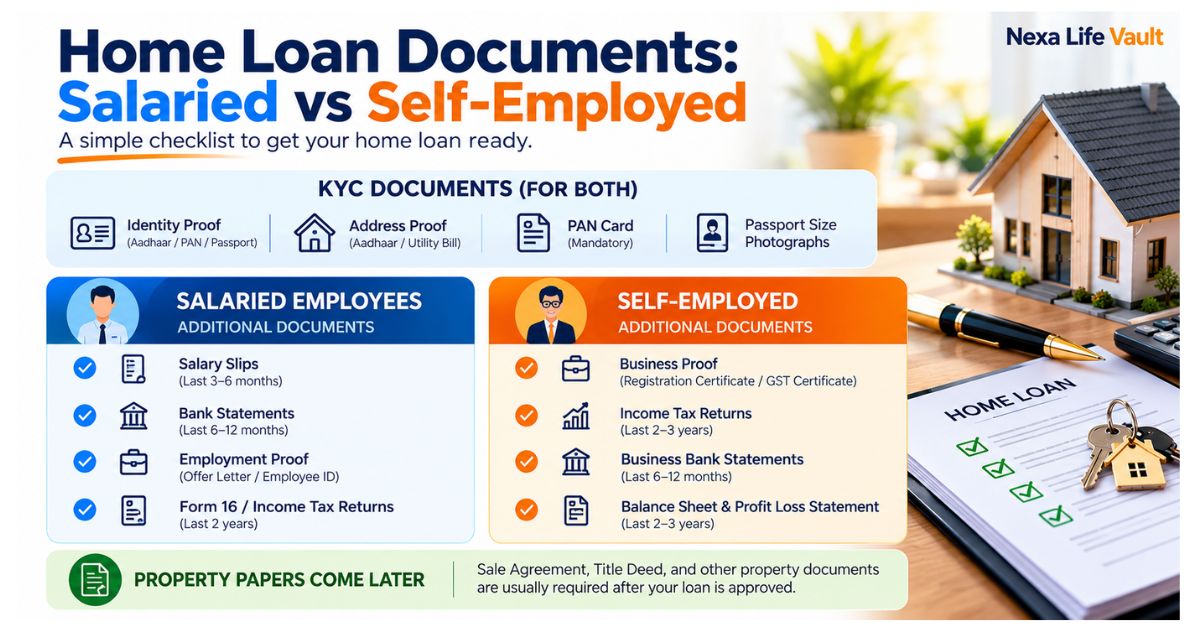
A home loan documents checklist in India covers four groups: identity and address proof (Aadhaar, PAN), income proof (salary slips and Form 16 for salaried applicants; ITRs and business financials for self-employed), bank statements, and property papers. Lenders may ask for more, so confirm the final list with your bank before applying.
Last updated: October 2026
Most home loan delays do not come from a "no". They come from one missing page: a salary slip that is not the latest, a bank statement that does not match your ITR, or an address proof with an old address. Get the papers right first and the bank's checks move faster. Below is a clear checklist split for salaried and self-employed applicants, followed by the property papers and loan sanction documents that come later.
What documents do you need for a home loan in India?
Every applicant submits a core set of papers, whether you earn a salary or run a business. These are the basic documents for home loan eligibility checks. Co-applicants, such as a spouse or parent, usually submit the same set.
- Filled-in loan application form with recent passport-size photographs.
- PAN card.
- Aadhaar card or another officially valid ID your lender accepts.
- Address proof, such as Aadhaar, passport or a recent utility bill, as your lender allows.
- Recent bank statements of the account where your income is credited.
- Income proof (different for salaried and self-employed, covered below).
- Statements of any running loans or credit cards, if the lender asks.
- A cheque or payment for the processing fee, if the lender asks for one.
Lenders check your credit history using your PAN, so keep your name and date of birth consistent across all papers.
Verify with the official source (your lender's website or branch, and RBI's website for lending rules) before acting.
What is the home loan documents checklist for salaried applicants?
If you draw a salary, the bank wants proof that the income is regular and that it reaches your account. Use this table as your working list.
| Document | What it shows the lender | Quick tip |
|---|---|---|
| Recent salary slips | Monthly gross pay, deductions and take-home pay | Ask HR for stamped or system-generated copies if needed |
| Form 16 | Salary paid and tax deducted (TDS) in a financial year | Match the figures with your ITR |
| Salary account bank statements | Salary credits, spending pattern, EMIs already running | Download them from net banking in PDF |
| Income Tax Return (ITR) with acknowledgement | Income you declared to the tax department | Keep the filed copy and the acknowledgement together |
| Form 26AS or AIS | Tax credits and income reported against your PAN | Download from the Income Tax portal if the lender asks |
| Appointment letter or employee ID | That you are employed and for how long | Useful if you changed jobs recently |
| Existing loan statements | Current EMIs and repayment record | Ask the lender for a fresh statement before applying |
Example: Neha moved to a new company two months ago. Her new employer has issued only two salary slips. Her bank may ask for her appointment letter, and possibly some documents from her previous job, to see the full employment picture. Having the old Form 16 ready saved her a second round of paperwork.
What documents do self-employed applicants need for a home loan?
Banks cannot rely on a salary slip here, so they look at several years of filed returns and the business's own accounts. The second table lists what is usually asked. Professionals such as doctors, architects and chartered accountants are generally treated as self-employed too.
| Document | What it shows the lender | Quick tip |
|---|---|---|
| ITRs with computation of income | Income and tax paid over several years | File pending returns before you apply |
| Profit and loss account and balance sheet | Business turnover, profit, assets and liabilities | Many lenders want these certified or audited by a chartered accountant |
| Business bank statements (current account) | Cash flow and regular business receipts | Keep personal and business statements ready |
| Personal bank statements | Drawings, savings and EMIs | Explain large one-off credits in a short note |
| Business existence proof | That the business is real and running | GST registration, Udyam registration, shop licence, partnership deed or incorporation papers, as applicable |
| GST returns (if registered) | Sales reported to the tax authorities | Make sure turnover is consistent with your ITR |
| Professional registration or qualification certificate | Your right to practise (for professionals) | Carry a copy of the current registration |
| Existing loan statements | Current EMIs and repayment record | Include business loans as well |
Verify with the official source (the Income Tax Department's portal, incometax.gov.in, and your lender) for how many years of returns and which financial statements are needed.
Which property documents will the lender ask for?
Your personal papers prove you can repay. The property papers prove the asset is clean enough to be mortgaged. Lenders often start their legal and technical checks only after your income is cleared, so do not be surprised when a new list arrives.
Commonly requested papers include:
- Sale agreement or allotment letter (builder-buyer agreement for a new flat).
- Title documents showing the chain of ownership.
- Approved building plan and, where applicable, completion or occupancy papers.
- NOC from the society or builder, where applicable.
- Latest property tax receipts and utility bills.
- Encumbrance certificate, if the lender asks for one.
We cover these in detail, with what each one proves, in our property documents checklist, so we will not repeat it here.
What are loan sanction documents, and what happens after approval?
Once the lender approves your application, you move from collecting papers to signing them. The loan sanction documents are what you receive and sign at this stage.
- Sanction letter: states the approved loan amount, interest rate type, tenure and the conditions you must meet.
- Loan agreement: the legal contract between you and the lender.
- Repayment instructions: forms or mandates for paying EMIs from your bank account, depending on the lender.
- Property documents for the mortgage: the lender checks and holds the required papers as security.
- Disbursement request: asks the lender to release the money to the seller or builder, often in stages for an under-construction property.
Read the conditions in the sanction letter before you sign anything. If a condition is unclear, such as a deadline or a required insurance, ask the lender to explain it in writing.
Verify with the official source (your lender's final sanction letter and agreement) because terms, fees and mandates differ by lender.
How do you prepare your home loan file step by step?
- Get the lender's checklist in writing. Do this before you gather anything. Lists differ by bank and by applicant type.
- Download statements and returns. Pull bank statements, Form 16, ITR acknowledgements and Form 26AS or AIS from official portals.
- Cross-check details. Name spelling, date of birth, address and PAN should match on every paper.
- Name your files clearly. Use names like "PAN-Neha", "Salary-Slip-Sep" and "ITR-Latest-Ack" so nothing is mistaken for something else.
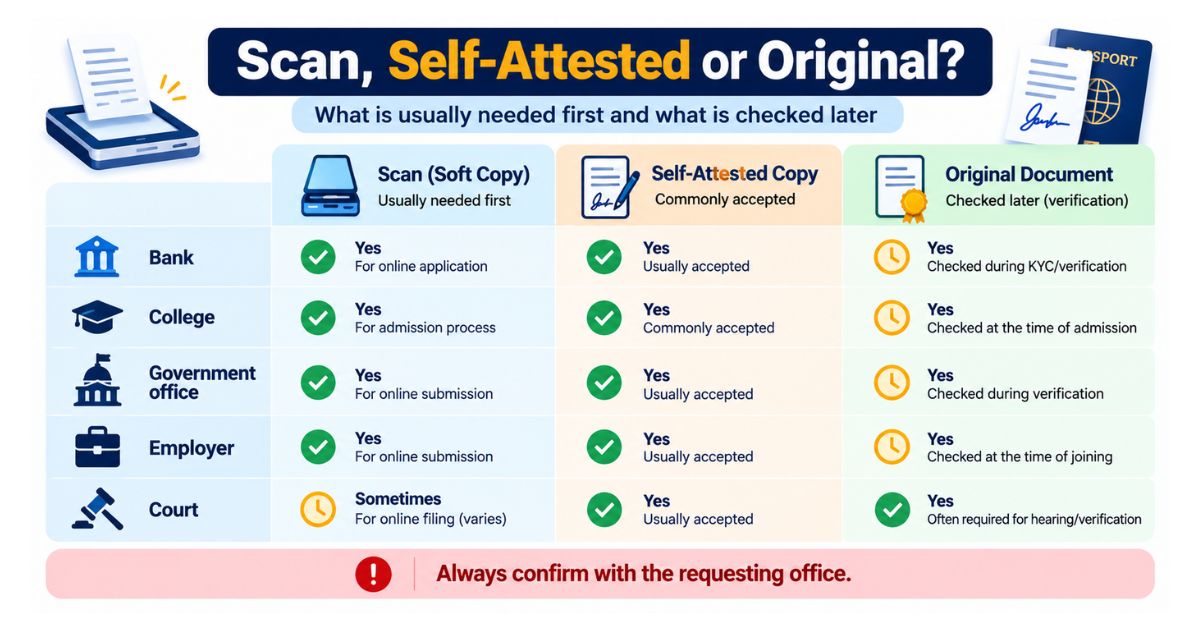
- Keep originals within reach. Banks may ask to see originals for verification even when you upload copies.
- Store everything in one place. Keep income and tax papers together in your Finance Vault, so you are not searching email threads when the lender asks for a missing page.
How Nexa Life Vault helps
A home loan creates a paper trail that lasts for years: the sale agreement, sanction letter, loan agreement, tax receipts and insurance papers. Our Home Vault keeps these property and loan records together, instead of scattered across email, WhatsApp and a file at home.
With Smart Document Alerts, you can set reminders for renewal dates, such as your home insurance, so a lapse does not catch you off guard. Your files are encrypted with AES-256-GCM using per-file keys.
Keep in mind that a lender may still ask to see originals, and we do not promise that a digital copy will be accepted for every legal purpose. The vault is a place to stay organised, not a replacement for official verification.
Conclusion
A good home loan documents checklist saves you weeks of back-and-forth. Know which list applies to you, match the details across every paper, and keep property and sanction records handy for later. Gather the basics today, ask your lender for its final list, and prepare your loan file in a vault so every page is ready when the bank asks.
This is general information, not legal, tax or financial advice.
Ayush Singh
Software Engineer & Security Systems Writer
Software engineer and tech writer focused on digital security, system reliability, and user-friendly document organization workflows.
Share this post
Comments (0)
No comments yet. Be the first to comment!