Rent Agreement and Tenant Documents: What Landlords and Tenants Should Keep
Missing rent receipts and lost agreements cause most rental disputes. Here is a simple checklist of the rent agreement documents landlords and tenants should each keep, from deposit receipts to police verification.
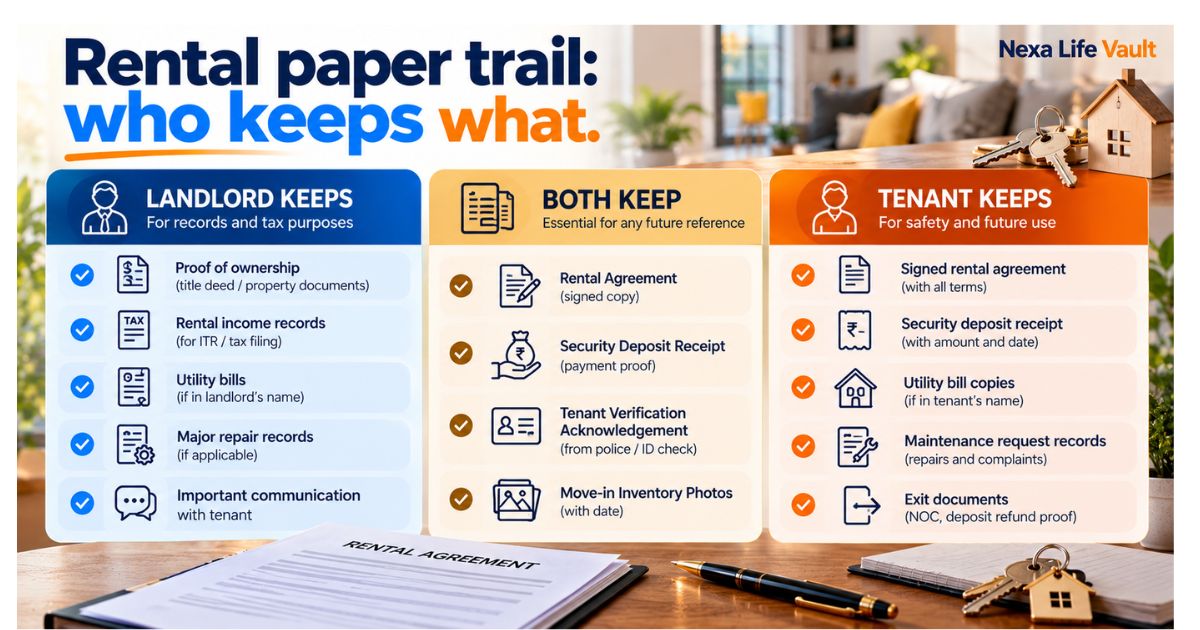
For rent agreement documents, both sides should keep the signed agreement, ID and address proof of each party, the landlord's ownership proof, the security deposit receipt, monthly rent receipts, the police verification acknowledgement, and the move-in inventory. Keep them until the tenancy ends and the deposit is settled.
Most rental disputes are not about big things. A deposit that never came back. A rent hike nobody agreed to in writing. A tenant who says he paid in March, and a landlord who says he did not. In each case, the person with the paper trail usually wins. This post lists the rent agreement documents each side should keep, with a table you can copy.
Which rent agreement documents should you keep?
The table below shows what each side should hold. Some items are needed by both, because the same paper protects each of you in a different way.
| Document | Landlord keeps | Tenant keeps |
|---|---|---|
| Signed rent agreement (with stamp paper or registration papers, if applicable) | Yes | Yes |
| Aadhaar and PAN copies of the other party | Yes (tenant's) | Yes (landlord's) |
| Property ownership proof (sale deed, allotment letter or similar) | Original | Copy |
| Security deposit receipt | Copy | Original |
| Monthly rent receipts or payment proof | Copies | Originals |
| Police verification acknowledgement | Yes | Yes |
| Move-in inventory and photos | Yes | Yes |
| Society NOC or maintenance receipts | Yes | If you pay them |
| Notices, renewal letters and written messages about changes | Yes | Yes |
| Final settlement and deposit refund proof | Yes | Yes |
Think of this as one shared folder with two owners. If either of you cannot produce an item from the list, the other person's copy often becomes the only proof.
What should the rent agreement itself include?
A rent agreement is only as useful as its details. Before signing, check that it names the following:
- Full names and addresses of the landlord and tenant, and the full address of the property.
- Monthly rent, due date and payment method (bank transfer, UPI, cheque).
- Security deposit amount and the conditions for refund.
- Start date, tenure and renewal terms, including any yearly rent increase.
- Notice period for both sides if either wants to leave or end the tenancy.
- Who pays electricity, water, maintenance, and property-related charges.
- Rules on subletting, repairs, and use of the property (residential or commercial).
- Lock-in period, if any, and penalties for leaving early.
Many landlords use an 11-month agreement, but whether an agreement must be registered, and how much stamp duty applies, depends on your state and the length of the lease. Verify with the official source (your state's registration and stamp department or the local sub-registrar office) before acting.
Tenant documents checklist: what should a tenant keep?
As a tenant, your job is to prove three things later: what you agreed to, what you paid, and what condition the home was in. Your tenant documents checklist:
- Signed agreement. Keep a scan of every page, including annexures and the inventory list.
- Deposit receipt. A bank transfer record is good. A signed receipt that says "security deposit" is better.
- Rent receipts. Collect one for every month, even if you pay by transfer.
- Landlord's ID and PAN copy. You may need the PAN when claiming house rent allowance (HRA) from your employer.
- Move-in photos and video. Walk through each room and record cracks, stains, damp patches and working fittings.
- Utility and maintenance receipts. These show what you paid and when. Our post on utility bills and home records management covers how to keep them in order.
- Notice and exit papers. Keep your notice letter, the handover note, and proof the deposit came back.
Example: Meera moved out of a Pune flat after two years. The landlord deducted a repainting charge. Because she had dated move-in photos showing the walls were already faded, the deduction was dropped after one message. Without the photos, it would have been her word against his.
Landlord documents: what should a landlord keep?
Landlord documents serve a different purpose. You are protecting the property, your rental income record, and your legal position if something goes wrong. Keep these:
- Ownership papers. Sale deed, property tax receipts and society documents. Tenants and banks may ask for copies.
- Tenant's ID and photo. Aadhaar, PAN or another valid ID, plus a recent photograph and workplace details.
- Signed agreement and any renewals. Store the original safely.
- Deposit and rent records. Bank statements showing each credit, with the matching receipt copy.
- Police verification acknowledgement. This shows you reported the tenant as your local rules require.
- Inventory list and condition photos. Include fans, geysers, modular kitchen items and anything else you provided.
- Repair bills. Keep invoices for work you paid for during the tenancy.
- Income and tax records. Rent is income, and it belongs in your ITR. Property tax payments and loan interest certificates (if you have a home loan) also belong here. Tenants may also deduct tax at source on rent in some cases, so keep any related certificates.
Rental income and tax-related papers sit naturally with your other money records. If you already track salary slips, ITRs and Form 16, store them together in the Finance Vault.
Why do rent receipts matter?
Rent receipts are the simplest proof that rent was paid on time. For tenants, they support HRA claims. Employers usually ask for receipts and the landlord's PAN, and the exact requirement depends on current tax rules. For landlords, receipts show a clear history if a tenant later disputes dues.
A good receipt includes the tenant's name, the landlord's name, the property address, the month, the amount, the payment mode and a signature. If rent is paid by bank transfer, save the statement entry as well.
What is police verification, and who keeps the paper?
Police verification is the process in which a landlord reports a new tenant's details to the local police. Many states and cities require it, and some have online forms. Rules and forms differ from place to place. Verify with the official source (your state police or city police website, or the local police station) before acting.
Usually the landlord starts the process, but the tenant has to supply ID, photos and sometimes a previous address. Both sides should keep the acknowledgement or receipt number. If a tenant is ever questioned about their address, that paper helps. If a landlord is asked whether the tenant was reported, it helps just as much.
What should you do at move-in and move-out?
The paper trail has two key moments. Here is a simple order of steps for each.
At move-in
- Sign the agreement and exchange ID copies.
- Pay the deposit and collect a receipt.
- Walk through the home together with a written inventory and date-stamped photos.
- Start the police verification.
- Save everything in one folder the same day.
At move-out
- Send written notice within the period stated in the agreement.
- Do a joint walk-through and compare it with the move-in photos.
- Clear utility bills and get a written no-dues note.
- Settle the deposit, and keep proof of any deduction and the refund.
- Archive the full set. Do not delete anything yet.
How long should you keep rent agreement documents?
Keep them at least until the tenancy ends and the deposit is fully settled. After that, hold on to rent receipts, the agreement and payment records for as long as you may need them for tax or any dispute. Tax-related records are often kept for several years, but the right period depends on your situation. Verify with the official source (the Income Tax Department or a chartered accountant) before deleting tax-linked papers.
How Nexa Life Vault helps
Rental papers are home papers, so the Home Vault is the natural place for them. You can store the agreement, receipts, inventory photos and verification acknowledgement in one place, instead of across email, WhatsApp chats and a drawer.
Smart Document Alerts can remind you before an agreement's end date or renewal date, so you are not scrambling when the 11 months run out. Your files are protected with AES-256-GCM encryption, with a separate key for each file. That does not replace keeping original signed copies where your state requires them.
Conclusion
Good rent agreement documents will not stop every disagreement, but they settle most of them quickly. Keep the agreement, deposit and rent receipts, verification acknowledgement and inventory photos together from day one. Whether you are the landlord or the tenant, a tidy folder saves weeks of arguing later. Start today: organise rental records in one place and set a reminder for your renewal date.
This is general information, not legal, tax or financial advice.
Frequently Asked Questions
Ayush Singh
Software Engineer & Security Systems Writer
Software engineer and tech writer focused on digital security, system reliability, and user-friendly document organization workflows.
Share this post
Comments (0)
No comments yet. Be the first to comment!