Child Vaccination Record: How to Store and Track Your Baby's Vaccine Schedule
Learn how to store and track your baby’s vaccine schedule in India, see the age-wise table, and know what to do if you lose the vaccination card.
A child vaccination record is the card or digital certificate that lists every vaccine your baby has received, with dates. In India, keep the original card from the clinic, download the U-WIN certificate if your child is registered, and store a photo or scan in a secure place so you can track each due date.
Your baby's vaccines come in small steps over many months, and the paper card has to survive all of it. It travels in nappy bags, gets handed to grandparents and goes missing during house moves. Yet schools, new doctors and travel paperwork often ask for it later. A few simple habits now will save you many phone calls.
What is a child vaccination record and what does it contain?
It is the running list of every vaccine your child has had. Government health centres record doses in the Mother and Child Protection (MCP) card. Many private clinics give their own booklet or a printed chart instead.
A complete entry should show:
- The vaccine name and dose number (for example, Pentavalent-2)
- The date it was given
- The clinic or hospital stamp, or the health worker's signature
- The date the next dose is due
On the first visit, check that your child's name and date of birth match the birth certificate. A spelling mismatch looks small today. It can cause real trouble at school admission or when you apply for a passport.
What is the baby vaccine schedule in India?
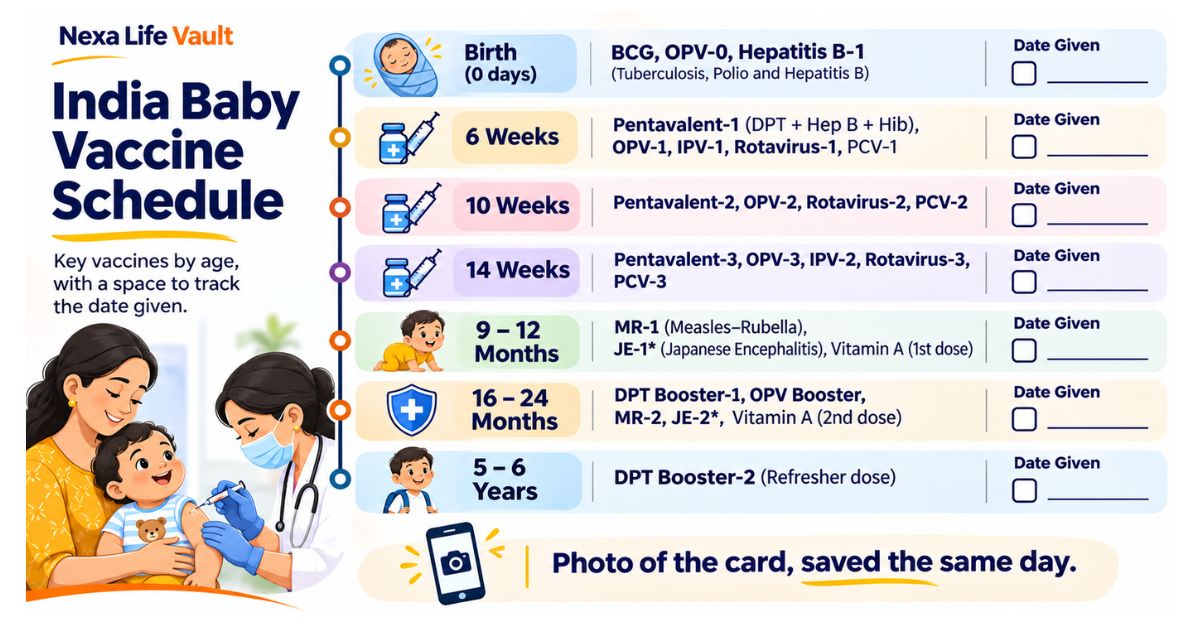
Government centres follow the National Immunisation Schedule under the Universal Immunisation Programme (UIP). This is the vaccine schedule India parents see on most clinic walls:
| Age | Vaccines under UIP | Good to know |
|---|---|---|
| At birth | BCG, OPV-0 (oral polio), Hepatitis B birth dose | Usually given before you leave the hospital |
| 6 weeks | OPV-1, Pentavalent-1, Rotavirus-1, fIPV-1, PCV-1 | Pentavalent covers diphtheria, pertussis, tetanus, hepatitis B and Hib |
| 10 weeks | OPV-2, Pentavalent-2, Rotavirus-2 | Second dose of the primary series |
| 14 weeks | OPV-3, Pentavalent-3, Rotavirus-3, fIPV-2, PCV-2 | Completes the primary series |
| 9–12 months | MR-1 (measles-rubella), JE-1, PCV booster, Vitamin A (first dose) | JE is given in areas where Japanese encephalitis is common |
| 16–24 months | MR-2, JE-2, DPT booster 1, OPV booster | Check the JE dose with your local centre |
| 5–6 years | DPT booster 2 | Some state charts say "up to 7 years" |
| 10 years | Td (tetanus and diphtheria) | Listed in some state schedules |
Three points before you copy this into your own notes.
States can differ. Some doses, like JE, depend on where you live, and state charts do not always match line for line.
UIP is not the only schedule. The Indian Academy of Pediatrics (IAP) publishes its own schedule, and it recommends vaccines beyond the UIP list. Your paediatrician may follow it. Ask which one they use and whether any extra vaccines suit your child.
Cost depends on where you go. UIP vaccines are free at government health centres. Private clinics charge for them.
Verify with the official source (the Ministry of Health and Family Welfare's UIP schedule, or your child's doctor) before acting on any date.
How do you keep a child vaccination record safe and up to date?
Treat the card like a passport. It gets one home, and one digital backup. Here is a routine that works:
- Ask for the card at the first vaccine. If the hospital gives you a discharge summary with the birth doses, keep it with the card.
- Get every dose written down before you leave. Look for the date, the vaccine name and a stamp or signature. Blank rows are hard to fix months later.
- Photograph the card the same day. Do it in the waiting area, while the clinic stamp is still fresh in your mind.
- Register your child on U-WIN if the centre offers it. U-WIN is the government's digital platform for routine immunisation. When a child is registered, parents can download a QR-based certificate using the registered mobile number, and the platform sends SMS reminders for due doses.
- Write the next due date on the first page. Pencil it in the corner or put it in your phone calendar.
- Share a copy with the other parent. If only one of you holds the file, only one of you can answer the clinic's questions.
Pro tip: Name each photo so you can find it in ten seconds, for example "aarav-vaccines-10-weeks-nov-2026". Take the picture flat, in daylight, with the stamp and date fully visible. A blurry or cropped photo is not much help when a clinic asks for proof.
One common mistake is letting every clinic keep its own record. If you switch between a government centre and a private paediatrician, one record ends up with half the doses. Carry the same card to every visit, and make sure each place writes in it.
If you also look after a pet, the same habit applies to animals. Our guide on pet vaccination records and how to store them safely covers it.
What should you do if you lose your child's vaccination card?
A lost vaccination card is stressful, but the information is rarely gone for good. Imagine you move from Ahmedabad to Pune and the card is not in any box. Try these steps in order:
- Check your phone. Look through your gallery, WhatsApp chats and email for a photo of the card or a message with dose dates.
- Check U-WIN. If your child was registered, you may be able to download the certificate with your registered mobile number.
- Call the place that vaccinated your child. Government centres and many clinics keep their own register entries, so ask them to confirm the doses and dates.
- Ask the hospital where your child was born. The birth doses (BCG, OPV-0 and Hepatitis B) were probably recorded there.
- Talk to your paediatrician before any dose is repeated or skipped. Do not rebuild the schedule from memory. Doctors have catch-up plans for missed or undocumented doses.
Rules for replacement cards and duplicate certificates vary by state and centre. Verify with your local health centre or the U-WIN portal before acting.
Is a digital vaccination card enough?
A digital vaccination card is a very useful backup, but treat it as a copy and not a replacement. The U-WIN certificate is QR-based and designed to be digitally verifiable. A photo of your paper card is only a photo.
Whether a school, hospital or embassy accepts a digital copy is their decision. Some will want to see the original card, so keep it safe even after you have scanned it.
Your own scans also have a clear job. They protect you on the day the paper card is lost, wet or torn, and they let you answer a doctor's question from your phone.
How can you track due dates without missing one?
The schedule above has a pattern: birth, then 6, 10 and 14 weeks, then 9 to 12 months, then 16 to 24 months. After that the gaps are long, and long gaps are where doses slip.
Use more than one reminder. Add each due date to your phone calendar the day a dose is given. Keep the U-WIN SMS reminders switched on if your child is registered. And ask the clinic to say the next date out loud before you leave, then compare it with what they wrote.
If a dose is late, call the clinic. Do not restart the series yourself. Doctors can usually continue from where the child left off. The right plan depends on the vaccine and your child's age.
How Nexa Life Vault helps
Your Health Vault gives your baby's vaccination records a single, searchable home. You can add a photo of the MCP card, the U-WIN certificate and the hospital discharge summary, then find them again with AI-powered search. Each file is protected with AES-256-GCM encryption and its own key.
Smart Document Alerts send expiry and renewal reminders, so they suit documents that carry a date you need to act on. For routine vaccine due dates, keep using your paediatrician's advice and the U-WIN SMS reminders as well. Birth certificates and ID copies can sit in your Family Vault.
Conclusion
A good child vaccination record is simple: one original card, one digital copy and the next due date written down. Do this at every visit and the record stays complete. Start with your latest card today, then store it in your Health Vault. Store vaccine records with Nexa Life Vault, and have them ready whenever a school or doctor asks.
This is general information, not medical advice. Follow your paediatrician's guidance for your child's schedule.
Frequently Asked Questions
Nishi Naik
Product & Digital Legacy Writer
Product and technology writer passionate about digital estate planning, family data privacy, and secure information lifecycle management.
Share this post
Comments (0)
No comments yet. Be the first to comment!