How to Get Attested and Apostilled Copies of Education Certificates in India
Sending the wrong version of your degree can cost you weeks. Learn how attestation differs from apostille, which route your destination needs, and the stage-by-stage checklist for Indian education certificates.
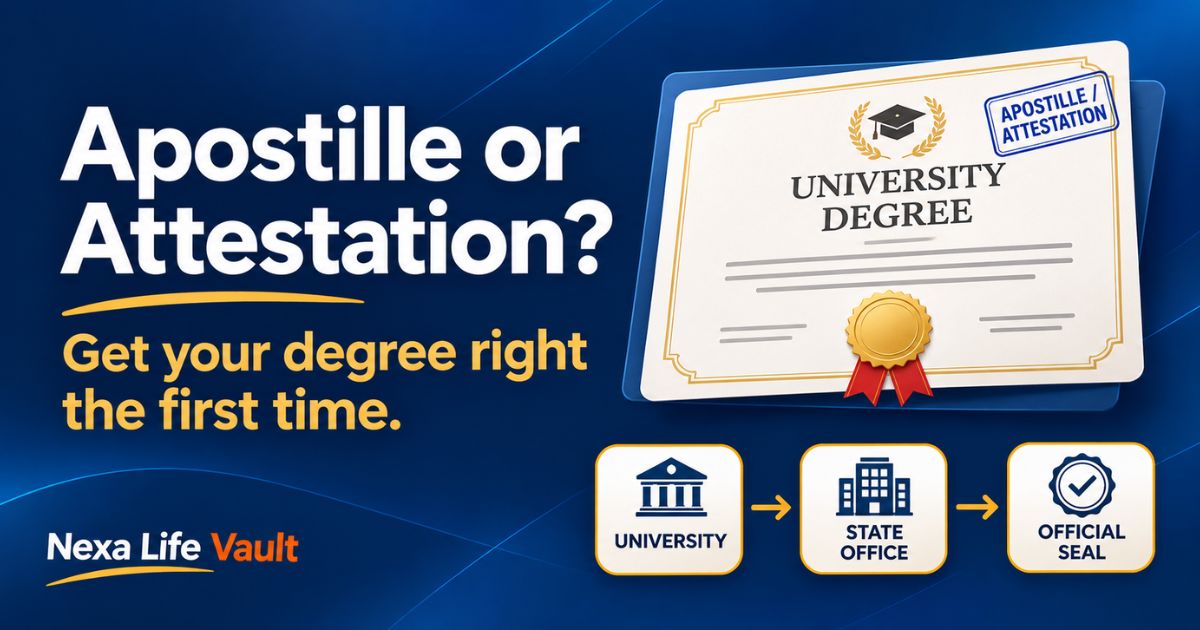
To get an apostille for an education certificate in India, first have your university or board verify the document, then have the state education (HRD) department authenticate it. Next, submit it for an MEA apostille. If your destination is not a Hague Convention country, you need MEA attestation and embassy legalisation instead.
A university in Europe, a visa officer or an employer abroad may ask for your degree to be “attested” or “apostilled”. Send the wrong version and the file comes back, often after weeks. An apostille education certificate from India follows a fixed order of checks, and each stage has its own office. This checklist shows the difference between the two terms, the stages in order, and the mistakes that cause rejections.
This is general information, not legal, tax or financial advice. Government processes change, so verify with the official source (the Ministry of External Affairs apostille page at mea.gov.in) before acting.
What is the difference between attestation and apostille?
Attestation means an official confirms that the signature, seal or stamp on your document is genuine. For Indian education certificates this happens in layers: first the issuing university or board, then the state government, then the Ministry of External Affairs (MEA).
Apostille is a single certificate that MEA attaches to a public document under the Hague Apostille Convention of 1961. It confirms the signature and seal on the document are genuine. Countries that belong to the Convention accept it without asking for further embassy legalisation. India is a member, and MEA is the authority that issues it.
Neither one checks whether your marks are correct. That is the university’s job. Both only confirm that the people who signed and stamped the paper were authorised to do so.
| Point | Attestation route (non-Hague countries) | Apostille route (Hague countries) |
|---|---|---|
| Final authority in India | MEA attestation | MEA apostille |
| Embassy step | Usually yes, at the destination country’s embassy or consulate | Generally no |
| Where it works | Countries outside the Convention | Countries that are Convention members |
| Stages | University or board, state, MEA, embassy | University or board, state, MEA |
| What it proves | Signatures and seals are genuine | Signatures and seals are genuine |
What does “attested marksheet” actually mean?
People use “attested marksheet” for three different things. It can be a photocopy you signed yourself, a photocopy certified by a gazetted officer, or a marksheet that went through university, state and MEA stages. For study or work abroad, the third meaning is usually what an embassy or university wants. Ask the requesting office in writing which level it needs.
Do you need an apostille or embassy attestation for your destination?
This is the first question to settle, because it decides your whole route. Check whether your destination country is a member of the Hague Apostille Convention. The Hague Conference on Private International Law (HCCH) keeps a status table of members, and MEA lists countries that are not members.
Then ask your university, employer or visa authority what they accept. Get the answer by email so you have it on record.
Example: Neha has an offer from a university in Europe. The offer letter asks for an “apostilled degree and transcripts”. She checks the country, sees it follows the Convention, and skips the embassy step. Her friend Arjun is heading to a country outside the Convention. His file needs MEA attestation and then the embassy’s own stamp. Same degree, different routes.
Apostille education certificate India: the stage-by-stage checklist
The order matters. A later office will not process a document that has skipped an earlier stage. Here is the full flow at a glance:
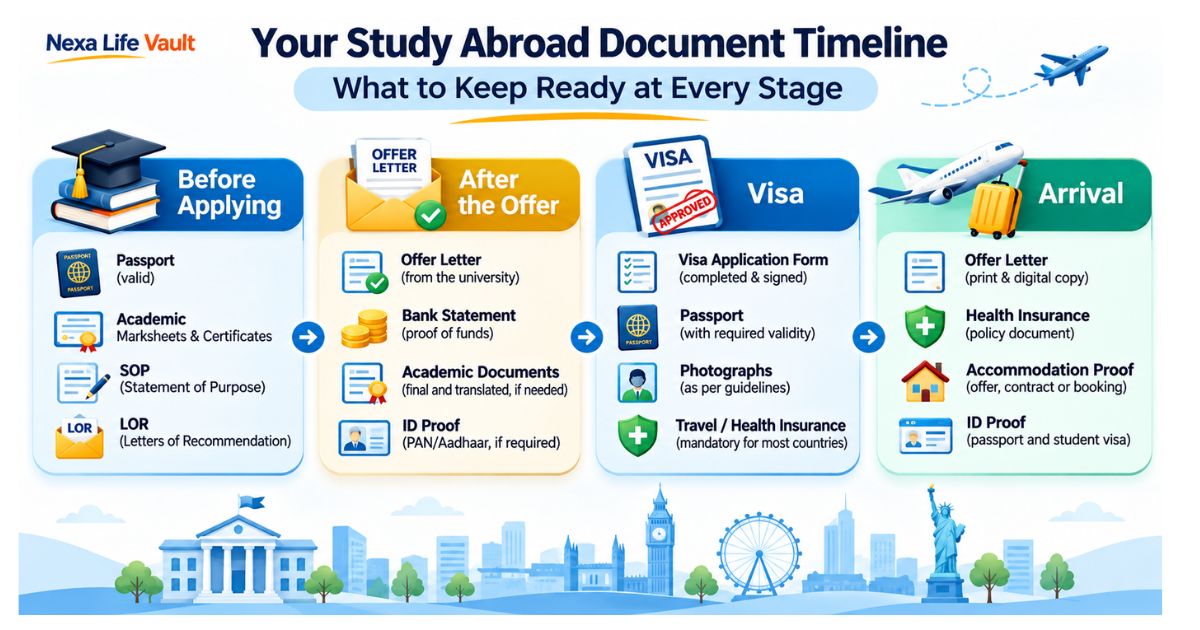
- Prepare your originals and your destination’s requirements.
- Get verification from your university or board.
- Get state authentication from the education (HRD) department.
- Submit to MEA for apostille, or attestation if your destination is outside the Convention.
- Get embassy legalisation only if your destination needs it.
- Check, scan and store the final set.
Stage 1: Prepare before you apply
- Original degree certificate, provisional certificate if the degree is not yet issued, and all semester or year marksheets.
- Photocopies of every page, front and back.
- A government photo ID such as your Aadhaar or passport, since service providers and offices usually ask for ID.
- The written requirement from the university, employer or embassy: which documents, how many sets, and whether they want apostille or attestation.
- Name check: your name should match across your certificate, marksheets and passport. If it does not, sort that out first.
Stage 2: Get your university or board to verify
- Contact your university’s examination or verification section, or your school board for Class 10 and 12 papers.
- Ask whether the university verifies the document with a stamp, a verification letter, or through an online system.
- Ask if your university or board is on the e-Sanad portal, the government’s online route for attestation and apostille. It only works for documents held in a digital repository, so confirm before you try it.
- Keep the receipt and any reference number.
Stage 3: Get state authentication
- For educational documents, MEA expects them to be authenticated first by the designated education department of the state or union territory where they were issued. This is commonly called HRD attestation.
- Find your state’s current procedure. Some states have published their own standard procedures or online portals, so check the state education department’s website rather than relying on an old guide.
- Submit the university-verified documents and collect them with the state stamp or signature.
Stage 4: Submit to MEA
- MEA does not take documents directly from individuals. It works through authorised outsourced service providers, and its website lists them.
- If your documents are covered by e-Sanad, you apply online and do not send paper.
- For a Hague destination, MEA attaches the apostille. For a non-Hague destination, MEA attests the document.
- Pay the official MEA fee and any service provider charge. Keep both receipts.
Stage 5: Embassy legalisation (non-Hague countries only)
- Check the destination country’s embassy or consulate in India for its own rules, forms and appointment process.
- Some embassies also ask for a translation. Ask before you pay for one.
Stage 6: Check, scan and store
- Check that spellings, dates and the number of documents are right before you leave the counter or open the courier pack.
- Make sure the apostille or attestation stays attached to the document it belongs to.
- Scan every page, including the back, and keep a labelled digital copy. If you are travelling, keep it alongside your passport and visa papers, for example in your Travel Vault.
Common mistake: Getting the degree apostilled but not the marksheets, or the other way round. Many universities ask for both. Another frequent one is having a photocopy processed when the office wanted the original, or the reverse. Read the requirement letter line by line and count the documents before you start.
Pro tip: Scan each document after every stage, before it leaves your hands. Name the files like “degree-stage2-university-verified” so you can prove the order if an office asks, and so a lost courier does not cost you the whole file.
How long does it take and what does it cost?
Time and cost vary by university, state, route and the service provider you use. A university with a slow verification desk can take longer than the MEA stage itself. Some states are quicker than others, and documents covered by e-Sanad may move faster than paper files.
Costs usually have three parts: the university’s fee, the state’s fee, and the MEA fee, plus any service provider or courier charge. Do not trust a figure from an old blog post. Ask each office for its current fee, and check the MEA website for the official one. If you have a deadline, such as a university enrolment date or a visa appointment, start early and leave room for a rejection and a second try.
Verify with the official source (MEA apostille page at mea.gov.in, and your state education department) before acting.
What can go wrong with degree attestation for abroad?
Most rejections come from small, avoidable problems.
- Skipped stage. MEA needs the state authentication first. Going straight to MEA with a university-verified document will not work for educational papers.
- Name or spelling mismatch. A middle name on the degree but not on the passport can cause questions later.
- Wrong route. Apostille for a non-Hague country, or an embassy stamp for a Hague country, wastes money and weeks.
- Old documents. If your university has merged, renamed or closed, contact the current authority early and ask what they can issue.
- Missing translation. Some destinations want a translation of the document or the apostille. Ask the requesting office before you finish.
How Nexa Life Vault helps
Attested papers pile up fast: a degree, several marksheets, receipts at each stage and the email that says which version you need. Keep them in one place and you spend less time hunting during an application.
The Education Vault in Nexa Life Vault is built for these records. With AI-powered search, you can find a specific file, such as your attested transcript, when a university portal asks for it, without scrolling through folders. Files are protected with AES-256-GCM encryption and per-file keys, and are decrypted only in server memory for authorised requests.
Digital copies help you stay organised, but the embassy, university or employer decides what it accepts. Keep your originals safe, and follow the requesting office’s rules.
Conclusion
An apostille education certificate for India-issued degrees comes down to two decisions and one order. Decide whether your destination uses apostille or embassy attestation, confirm what documents are needed, and then follow the stages from university to state to MEA without skipping any. Once your set comes back, scan it and keep it organised. Store attested copies safely in your Education Vault.
Frequently Asked Questions
Ayush Singh
Software Engineer & Security Systems Writer
Software engineer and tech writer focused on digital security, system reliability, and user-friendly document organization workflows.
Share this post
Comments (0)
No comments yet. Be the first to comment!