GST Documents Every Small Business Should Keep (and For How Long)
Which GST documents should a small business keep, and for how long? Get a clear checklist and a retention table based on the 72-month rule.
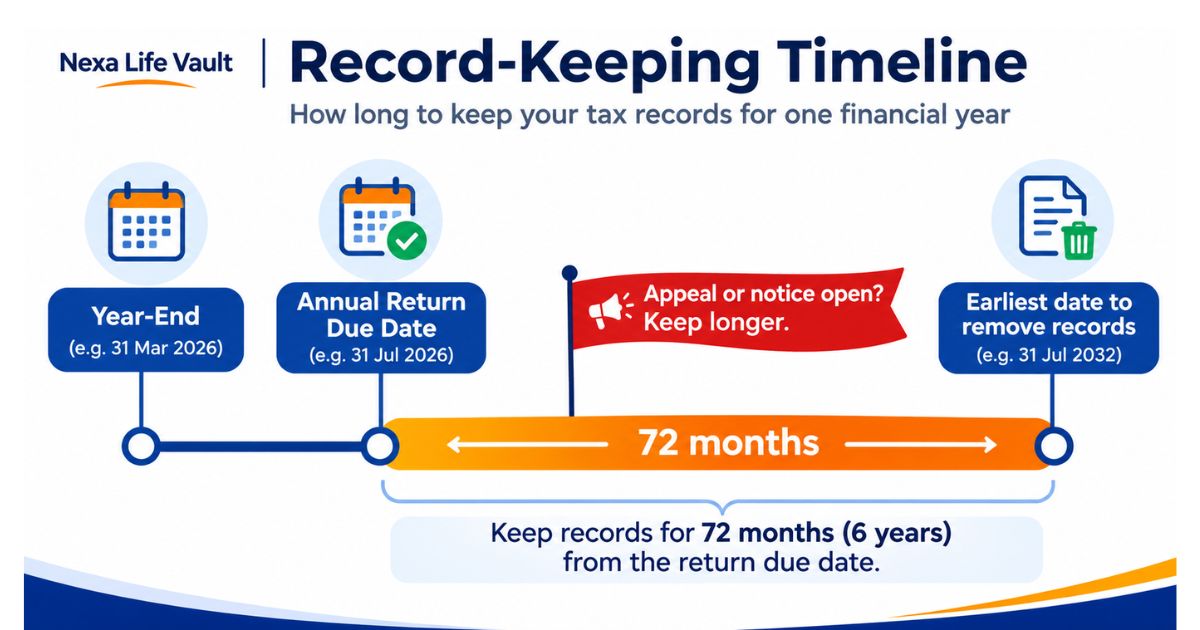
Keep your GST invoices, credit and debit notes, returns, payment challans and books of account for at least 72 months from the due date of the annual return for that financial year. If an appeal or investigation is pending, keep the related records for one year after it ends, or the 72 months, whichever is later.
A query about a purchase from five years ago can reach you long after you have forgotten the supplier’s name. Many small business owners in India find out the hard way that the invoice sits in an old phone gallery, or in a drawer at a shop they have since left.
This article lists the GST documents to keep, the retention period that applies, and a simple way to stay organised. It reflects the CGST Act as we understand it today. Rules change, so check the official sources named below.
How long do you have to keep GST records?
Section 36 of the CGST Act, 2017 sets the period. If you are a registered person who must maintain books of account and records under Section 35, you must keep them until 72 months (six years) after the due date of the annual return for the year those records relate to.
The clock does not start on the invoice date. It starts from the due date of the annual return for that financial year. So the real holding period is usually longer than six years from the day you issued or received the document.
Example: if the annual return due date for a financial year is 31 December 2025, then 72 months from that date takes you to 31 December 2031. Always use the due date notified for that year, because due dates have been extended in some years.
There is one more rule that catches people out. If you are part of an appeal, revision or other proceeding, the law asks you to keep the records linked to that matter for one year after the final disposal, or for the 72 months, whichever is later.
Verify with the official source (the CGST Act and Rules on the CBIC website, and the GST Portal at gst.gov.in) before acting.
Which GST documents to keep?
Section 35 and the CGST Rules list what a registered person has to maintain. In practice, most small businesses end up with six groups of documents. Use this as a working checklist and adjust it for your scheme (regular, composition, or other) and your line of business.
Sales records: your GST invoices records
- Tax invoices for every taxable sale, including the PDF or printed copy you gave the customer
- Bills of supply, if you supply exempt goods or services or are under the composition scheme
- Credit notes and debit notes, with the reason and the original invoice number
- Delivery challans for goods sent but not yet invoiced
- E-way bills for movement of goods, where applicable
- E-invoice details (the IRN and QR code), if e-invoicing applies to your business
Purchase records and input tax credit
- Supplier tax invoices for goods and services you bought
- Bill of entry and related papers for imports
- Self-invoices and payment vouchers for purchases under reverse charge
- Your monthly GSTR-2B downloads, which show the credit available to you
- Proof that you paid the supplier, such as a bank statement line or UPI confirmation
Your GST return records
- Filed copies of the returns that apply to you, such as GSTR-1 and GSTR-3B for regular taxpayers
- The acknowledgement (ARN) for each filing
- The annual return, and the reconciliation statement if it applies to you
- Returns and statements specific to your scheme, if you are not a regular taxpayer
Tax payment records
- Payment challans for tax paid in cash
- Snapshots or downloads of your electronic cash, credit and liability ledgers
- Refund applications and the orders that followed
Registration records and official communication
- Your GST registration certificate and any amendments
- Notices, reminders and show-cause notices received through the portal or by post
- Your replies, with proof of submission
- Orders, appeals and related papers
Books of account
- Sales and purchase registers
- Stock records, if you deal in goods
- Ledgers and bank statements that support your entries
For a closer look at storing day-to-day bills, see our guide on how to store invoices and receipts. For the wider set of paperwork a company needs beyond GST, read business documents every company needs.
What is the GST record retention period for each document?
The table below turns the rule into a quick reference. Section 36 sets one common period for books of account and records. Where the law does not give a separate period for a document, the table says so and suggests a sensible habit instead.
| Document | Retention period | Basis |
|---|---|---|
| Tax invoices and bills of supply (issued) | 72 months from the due date of the annual return for the year | Sections 35 and 36, CGST Act |
| Supplier invoices and import papers | 72 months from the due date of the annual return for the year | Sections 35 and 36, CGST Act |
| Credit and debit notes | 72 months from the due date of the annual return for the year | Sections 35 and 36, CGST Act |
| Delivery challans and e-way bills | 72 months from the due date of the annual return for the year | Sections 35 and 36, CGST Act and Rules |
| Filed returns and ARN acknowledgements | 72 months from the due date of the annual return for the year | Sections 35 and 36, CGST Act |
| Payment challans and ledgers | 72 months from the due date of the annual return for the year | Sections 35 and 36, CGST Act |
| Stock registers and books of account | 72 months from the due date of the annual return for the year | Sections 35 and 36, CGST Act |
| Records tied to an appeal, revision or proceeding | 1 year after final disposal, or the 72 months, whichever is later | Proviso to Section 36, CGST Act |
| GST registration certificate and amendments | No separate period in Section 36. Keep while registered, and after cancellation for as long as the related records are held | Good practice |
| Notices and your replies | Keep with the records for the year they concern, and longer if the matter is open | Good practice |
This is general information, not legal, tax or financial advice. Verify with the official source (CBIC and the GST Portal) before acting, and speak to a chartered accountant or GST practitioner for your own case.
Common mistake: counting six years from the invoice date and shredding on that basis. The period runs from the due date of the annual return for that financial year, so an invoice from April may need to stay for much longer than six years. Also check whether any notice, appeal or audit touches that year before you delete or discard anything.
Can you keep GST records only in digital form?
The CGST Act allows a registered person to keep accounts and records in electronic form, as long as the rules on authenticity and backup are followed. You also need to be able to produce them when an officer asks. A blurry phone photo that nobody can find is a weak position to be in.
If you go digital, keep a few habits in place:
- Scan at a readable quality, with all four edges visible
- Name files the same way every time, for example 2025-26_Purchase_SupplierName_InvoiceNo
- Keep a backup in a second location
- Keep original paper copies where the law or your tax professional says you should
Whether a digital copy is accepted in a particular situation is a legal question. Ask your tax professional rather than assuming.
Where should GST records be kept?
The Act expects books of account to be kept at your principal place of business, and at each additional place of business shown in your registration. If you moved your shop, added a godown or work from a new address, update your registration and make sure records are reachable from the declared place. Confirm the current requirement in the CGST Rules.
What happens if you cannot produce your GST records?
If you cannot show records during a scrutiny or audit, an officer may treat it as a failure to maintain them. That can lead to tax being worked out on the information available, and penalties can apply. Missing purchase invoices can also make it hard to defend input tax credit you have already claimed.
Imagine you run a hardware shop and receive a notice that questions credit claimed on a purchase made three years ago. If the supplier invoice, the GSTR-2B entry and the bank payment proof sit in one folder, you can answer in an afternoon. If they are spread across WhatsApp, a drawer and an old laptop, the same notice can eat a week.
What is a simple yearly routine for GST document storage?
You do not need a complicated system. This routine takes a short time each month and a longer sitting once a year.
- Each month, after filing: save the GSTR-1 and GSTR-3B copies, both ARNs, the GSTR-2B download and the payment challan in one folder for that month.
- Each month: match supplier invoices against GSTR-2B and file any missing ones with a note.
- Each quarter: file credit notes, debit notes and e-way bills against the invoices they relate to.
- After the annual return: save the filed annual return and any reconciliation papers, then note the retention end date for that year.
- Once a year: list the years whose retention period has ended. Before removing anything, check for open notices, appeals or audits.
- Always: keep notices and your replies with the year they relate to, not in a separate pile.
How Nexa Life Vault helps
Business paperwork is easier to defend when it sits in one place, sorted by year. The Business Vault in Nexa Life Vault is built for this kind of record keeping. You can keep GST returns, invoices, challans and notices together, instead of scattered across email, phone galleries and folders.
Smart Document Alerts can remind you before something expires or needs renewal, so a registration renewal or a follow-up does not slip past you. Your files are protected with AES-256-GCM encryption, with a separate key for each file.
Nexa Life Vault helps you organise and find your records. It does not replace professional advice, and we cannot promise how any authority will treat a digital copy.
Conclusion
The rule behind GST documents to keep is simple: hold your invoices, returns, challans and books for 72 months from the annual return due date, and longer if a dispute is open. The hard part is finding the paper years later. Sort each month’s records as you file, and note when each year’s period ends. Ready to start? Organise business records in one place.
Frequently Asked Questions
Ayush Singh
Software Engineer & Security Systems Writer
Software engineer and tech writer focused on digital security, system reliability, and user-friendly document organization workflows.
Share this post
Comments (0)
No comments yet. Be the first to comment!