Schengen Visa Documents Checklist for Indian Applicants (2026)
Applying for a Schengen visa from India? Here is the full document checklist, a step-by-step timeline from planning to appointment day, and the common mistakes that delay applications.
Your Schengen visa documents checklist should include a valid passport, a signed application form, photographs, travel insurance, flight and stay bookings, proof of income and funds, and proof that you will return to India. Each consulate can add items, so check your destination country’s official checklist before your appointment.
An unsigned form or a missing bank statement can cost you an appointment slot, and slots fill quickly before summer and year-end travel. This page gives you the full list, a timeline from the day you decide to travel, and the mistakes that trip people up most. It covers the standard short-stay tourist visa. Last updated: November 2026.
What are the Schengen visa requirements for India?
Indian passport holders need a visa to enter the Schengen Area for a short stay. A short stay means up to 90 days in any 180-day period. You apply to the country where you will spend the most nights. If you split your time equally, you apply to the country you enter first.
In India, most countries take applications through VFS Global centres. A few use their own embassy or another service provider. Either way, you submit documents and give fingerprints and a photo in person, unless your biometrics are already on file from an earlier application.
Every country publishes its own checklist for India. The core list is similar, but the details differ. Germany, France, Italy and Spain, for example, may ask for slightly different supporting papers. Verify with the official source (the embassy or VFS Global India page of your destination country) before acting.
What goes in your Schengen visa documents checklist?
Use this list as a base. Then compare it line by line with your destination country’s checklist.
Core documents everyone needs
- Visa application form. Fill it in completely and sign it. Applicants under 18 need a parent or guardian’s signature.
- Passport. It should have been issued within the last 10 years, have blank pages, and stay valid for a set period after you plan to leave the Schengen Area. Bring old passports too, especially those with earlier Schengen or other international visas.
- Photographs. Recent, in the size and format the consulate specifies. Photo rejection is one of the easiest problems to avoid.
- Appointment confirmation and fee receipt. Keep the printout or a clear screenshot.
- Aadhaar or other address proof. Some consulates ask for proof of residence in the jurisdiction where you apply.
Travel documents
- Travel insurance. It must cover your whole stay in the Schengen Area. More on this below.
- Flight reservation. A round-trip itinerary showing entry and exit. Many consulates prefer a reservation over a paid ticket at this stage.
- Accommodation proof. Hotel bookings for the full stay, or an invitation letter if you are staying with family or friends.
- Day-by-day itinerary and cover letter. A short letter stating your purpose, dates and cities. Some consulates list this as a standard item.
Money and ties to India
- Bank statements. Usually the last three to six months, with your name, account number and bank stamp or signature. Salary credits should be clearly visible.
- Income tax returns (ITR) and Form 16. They show a stable income over time. Self-employed applicants should add ITR acknowledgements.
- Employment proof. A leave approval or no-objection certificate (NOC) from your employer, your latest payslips, and a letter stating your designation and joining date.
- Business proof if you are self-employed. Company registration, GST registration where applicable, and recent business bank statements.
- Family and property ties. Marriage certificate, children’s birth certificates, or property papers. These are not always mandatory, but they support the case that you will return.
Documents that depend on your situation
Students add a bonafide certificate from their college and a no-objection letter. Retirees add pension statements. A parent’s or sponsor’s bank statements and a sponsorship letter apply if someone else pays for your trip. For children travelling with one parent or alone, add a notarised consent letter and a birth certificate. Your consulate’s checklist says exactly which of these it wants.
Common mistake: Priya booked a non-refundable hotel in Paris and a ticket in her own name, then found out she was applying through the Italian consulate because she would spend more nights in Italy. She had applied to the wrong country and lost her slot. Work out your longest-stay country first, then book anything.
What travel insurance do you need for Schengen?
Travel insurance for Schengen is a standard requirement for a short-stay visa. The policy must cover medical emergencies, hospital treatment and repatriation, and it must be valid across all Schengen countries for your entire stay. Under EU visa rules, the minimum medical cover is set at a fixed amount, so check that your policy meets it.
Check three things on the policy before you pay. The dates must match your itinerary, including entry and exit days. The territory must say Schengen states or Europe. Your name and passport number must match your passport exactly.
Insurance papers also matter after the visa is issued, when you are travelling. Our travel insurance documents guide explains what to keep, what to carry, and what to do if you need to claim. Verify the current minimum cover with the official source (the EU Visa Code or your consulate’s checklist) before acting.
Which documents do you carry on appointment day?
Your visa appointment documents are the full file, not just the form. Carry originals and a set of photocopies. Many centres want the papers in the order given on their checklist, so print the checklist and tick items off.
- Passport (and old passports)
- Printed, signed application form
- Appointment confirmation
- Photographs
- Insurance, flight and hotel documents
- Bank statements, ITRs and employment papers
- Any extra papers from the consulate’s checklist
At the centre you will have your fingerprints and photo taken, and your documents will be checked and sent to the consulate. The consulate decides, not the application centre. A counter officer cannot promise approval, and the consulate may ask for more documents later.
For a wider packing and paperwork list that covers the trip itself, see our travel documents checklist.
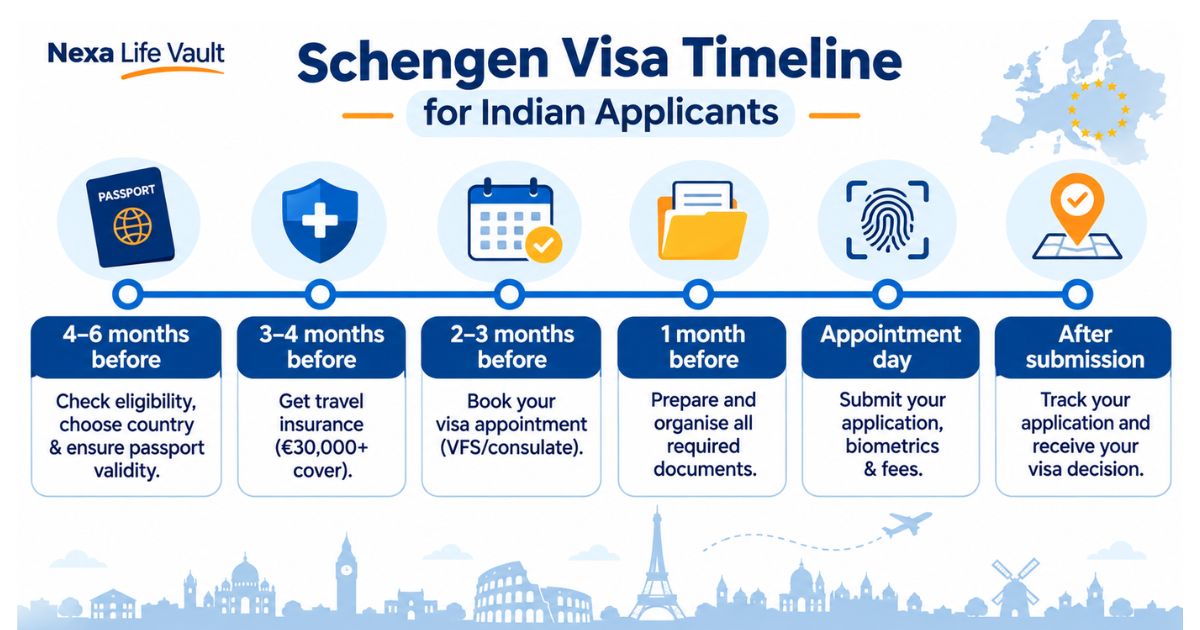
What is the timeline for a Schengen visa application?
Start earlier than you think you need to. Rules on the earliest and latest application dates exist, and they differ from the date you want to leave. Summer (April to June) and year-end (November to January) are the busiest periods, so appointment slots can be scarce for popular countries.
| When | What to do |
|---|---|
| 4–6 months before travel | Pick your main destination. Check passport validity and blank pages. Read the official checklist. Start checking for appointment slots. |
| About 3 months before | Make refundable flight and hotel reservations. Get an insurance quote. Ask your employer for the leave letter or NOC. |
| 6–8 weeks before | Book your appointment. Fill in the form. Collect bank statements, payslips and ITR copies. |
| 1–2 weeks before the appointment | Buy insurance dated to your itinerary. Print and sort the file. Scan every page as a backup. |
| Appointment day | Submit documents, give biometrics, pay fees, keep the receipt and tracking number. |
| After submission | Track your application. Respond quickly if the consulate asks for something extra. Avoid non-refundable bookings until the decision. |
Processing times vary by consulate and season. Do not plan around the shortest time you have heard of. Verify the application window and processing time with the official source (your destination country’s embassy or VFS page) before acting.
What mistakes delay a Schengen visa?
Most delays come from small errors, not big ones. These are the ones we see most often.
- Dates that do not match. Flights, hotels and insurance should show the same entry and exit dates. A one-day gap raises questions.
- Bank statements with unexplained large deposits. A big credit just before you apply can look like borrowed money. Keep a short explanation, with proof, ready.
- Cover letter that contradicts the itinerary. If the letter says Rome and Florence, the hotels should too.
- Expired or nearly expired documents. Passports and insurance policies are the usual culprits.
- Photocopies only. Bring originals where the checklist asks for them.
Pro tip: Make one folder per application with the same items in the same order as the consulate’s checklist. Put a printed copy of that checklist on top, with a tick next to each item. It saves time at the counter and makes it obvious what is missing the night before.
How Nexa Life Vault helps
A visa file is a pile of documents with different dates: passport, insurance, bookings, statements. They are easy to lose track of, especially if you travel more than once a year.
The Travel Vault gives you one place to store your passport copies, old visas, insurance policies and bookings. With Smart Document Alerts, you can set renewal and expiry reminders, so you are told before your passport or travel insurance runs out, not after.
Your original documents are still what the consulate checks, and digital copies are for your own preparation and backup. Stored files use AES-256-GCM encryption with per-file keys. It is a tidy way to keep your file ready for the next trip too.
Conclusion
A good Schengen visa documents checklist is only useful if you start early and check it against your consulate’s own list. Gather papers over several weeks, keep dates consistent, and carry both originals and copies. This is general information, not legal, tax or financial advice. Prepare your visa folder in the Travel Vault so everything is in one place on appointment day.
Frequently Asked Questions
Shailesh Nagar
Cloud Infrastructure & Security Contributor
Technology specialist at NexaLifeVault focusing on cloud infrastructure, data resilience protocols, and modern digital asset management.
Share this post
Comments (0)
No comments yet. Be the first to comment!