What to Do When Someone Dies in the UK: A Step-by-Step Document Checklist
Not sure what to do when someone dies in the UK? This step-by-step checklist covers registering the death, using Tell Us Once, who to notify, and the documents you’ll need at each stage.
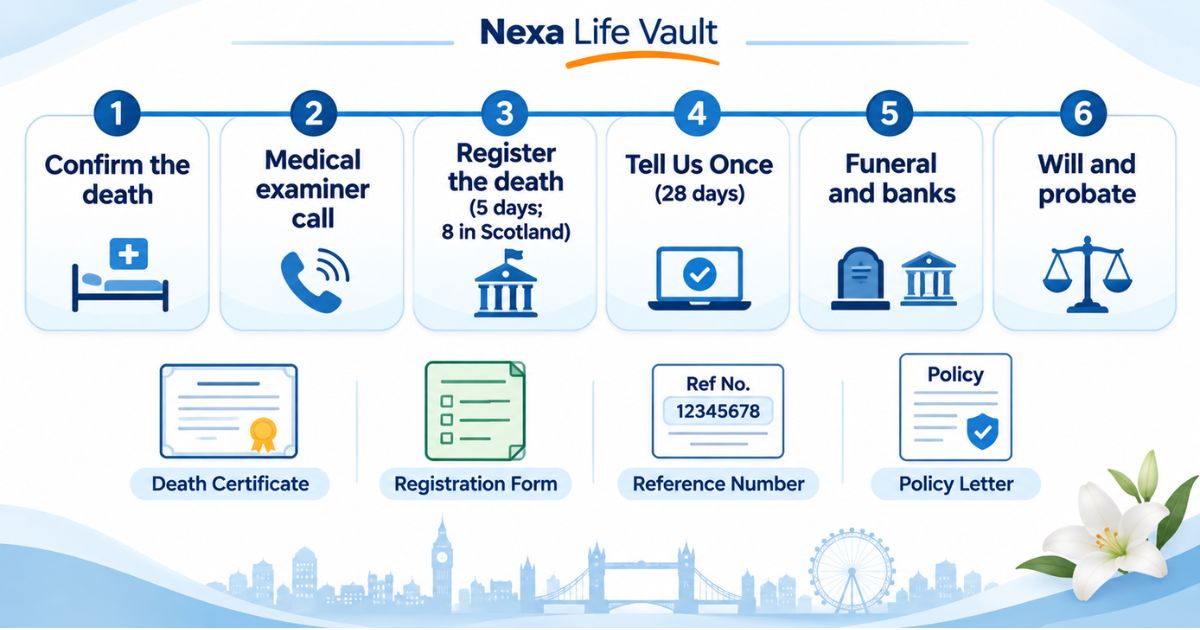
When someone dies in the UK, first get a medical professional to confirm the death. Then register the death at a register office within five days of the medical examiner's call (eight in Scotland). Next, use Tell Us Once to notify government bodies, arrange the funeral, and contact banks, insurers and pension providers.
Losing someone is hard enough without a pile of forms. The trouble is that several tasks have deadlines, and most of them ask for paperwork you may not know where to find. This checklist puts the steps in order, names the documents each one needs, and shows who you have to contact yourself. Work through it one step at a time. You do not have to do everything this week.
What to do when someone dies in the UK: the timeline at a glance
- Straight away: get the death confirmed by a doctor or paramedic and tell close family.
- Within days: wait for the medical examiner's office to contact you, then book an appointment at a register office.
- Within five days of that call (eight in Scotland): register the death and collect the paperwork you need for the funeral.
- Within 28 days of registering: use Tell Us Once before your reference number expires.
- Around the same time: arrange the funeral and contact banks, insurers and pension providers.
- In the following weeks: find the will, value the estate and check whether you need probate.
The sections below explain each step. Rules differ slightly between England, Wales, Scotland and Northern Ireland, so the differences are flagged as we go.
What should you do in the first few hours?
What happens first depends on where the person died.
- In hospital, a hospice or a care home: staff will look after the person and contact you. You will usually be told how and when to collect the paperwork.
- At home, expected death: call their GP practice. The GP can normally issue the medical certificate of cause of death if they have been treating the person.
- At home, unexpected death: call 999. The police will usually attend, and the death may be reported to a coroner.
Once a doctor has confirmed the death, you can take your time before choosing a funeral director to move the body. Tell close family and friends when you feel able to. Nothing else on this list needs to happen in the first hour.
How do you register a death in the UK?
Registering a death is a legal requirement. In England and Wales, a doctor first sends the medical certificate to the medical examiner, who checks the cause of death. The medical examiner's office then contacts you, and from that point you have five days to register. Weekends and bank holidays count. In Scotland the limit is eight days. If you need longer, tell the register office as soon as you know.
A relative usually registers the death. You can use any register office, but going to the one covering the area where the person died means you can normally leave with the documents the same day. Most offices need an appointment, so phone ahead. You can search for your local office on GOV.UK.
What documents do you take to the register office?
The registrar will tell you exactly what to bring, but it helps to have these ready:
- The medical certificate of cause of death, or confirmation from the medical examiner's office that it has been sent.
- The person's full name, date and place of birth, and last address.
- Their occupation, and the full name and occupation of a spouse or civil partner, if they had one.
- If you have them: their birth certificate, marriage or civil partnership certificate, passport, driving licence, NHS number and a recent proof of address.
Do not worry if you cannot find everything. Tell the registrar what is missing, and they will say whether it matters.
What do you get after registering?
You will receive a certificate for burial or cremation, often called the green form, which the funeral director needs. You can also buy official copies of the death certificate. Ask about the current fee and how to pay when you book.
What if a coroner is involved?
A death is reported to a coroner if, for example, it was sudden, the cause is unknown or unclear, or the person had not recently been seen by a doctor. The coroner may decide no investigation is needed, in which case the medical examiner will contact you to confirm you can register. If an investigation or inquest goes ahead, registration may be delayed. You can still use Tell Us Once by asking the coroner for an interim death certificate, then asking the registrar for a reference number.
Pro tip: Order more death certificate copies than you think you need when you register. Banks, insurers, pension providers and some other organisations may each ask for an original. Ordering later is possible, but it adds delay at a stage when you are already waiting on other people. Check the current fee per copy with the registrar.
How does Tell Us Once work?
Tell Us Once lets you report a death to most government organisations in one go, instead of phoning each department. The registrar gives you a unique reference number when you register the death. You then use that number online or by phone.
Two rules catch people out. First, the number must be used within 28 days or it expires. Second, you can use the service only once, so decide which organisations to notify before you start.
What do you need for Tell Us Once?
- The person's surname, date of death and your reference number.
- Their UK passport number, driving licence number and any vehicle registration numbers.
- Their National Insurance number, if they received or paid into a public sector pension.
- Details of any benefits, State Pension or council services they received.
- Name and address of the spouse or civil partner, next of kin, and executor or administrator. You need permission to share these details.
- If they died in a hospital, care home or hospice: the name and address of the place, and whether they had been there 28 days or longer.
Tell Us Once covers people who lived in England, Scotland or Wales. Northern Ireland has a separate process through nidirect. If the person lived abroad permanently, you contact each organisation yourself.
Who do you need to notify after a death?
Tell Us Once covers government bodies and some public sector pensions. Everyone else you contact yourself. This table shows the split.
| Who | What they deal with | How to tell them |
|---|---|---|
| HMRC | Personal tax, Child Benefit and tax credits | Tell Us Once. Contact HMRC separately if the person was self-employed or owned a business. |
| DWP | State Pension, Universal Credit and other benefits | Tell Us Once |
| DVLA | Driving licence, vehicle keeper and vehicle tax | Tell Us Once. Tell DVLA separately if you sell the vehicle or keep it in your name. |
| Passport Office | UK passport cancellation | Tell Us Once |
| Local council | Council Tax, Housing Benefit, Blue Badge, electoral register | Tell Us Once |
| Public sector pension schemes (for example Civil Service, Local Government, NHS) | Stopping future pension payments | Tell Us Once, for the schemes it covers |
| Banks, building societies and mortgage lenders | Accounts, loans, joint accounts | Contact each one yourself |
| Personal and workplace pension providers | Pension pots, death benefits | Contact each one yourself. GOV.UK has a pension contact search. |
| Insurers | Life, home, car and travel policies | Contact each one yourself |
| Utilities, landlord, TV Licensing | Bills, tenancy, contracts | Contact each one yourself |
| Student Loans Company, Office of the Public Guardian, Land Registry or property records | Loan cancellation, power of attorney or deputy records, property ownership | Contact each one separately if relevant |
Verify with the official source (GOV.UK, "What to do after someone dies") before acting, as the list of organisations can change.
What documents do you need to arrange the funeral?
Anyone close to the person can arrange the funeral. Most people use a funeral director, who will ask for the green form from the registrar. Before you decide anything, look for:
- The will, which may include funeral wishes.
- Any pre-paid funeral plan paperwork.
- Life insurance or burial insurance policies that may help with costs.
- Documents for a burial plot, if the family already owns one.
If money is tight, GOV.UK has guidance on help with funeral costs. Check whether you qualify before you commit to a price.
How many death certificate copies do you need?
There is no fixed number. Count the organisations that will want an original, such as each bank, insurer and pension provider, then add one or two spare. Some organisations accept a photocopy or a scan, so ask before you send the original. Keep a list of where each copy went so you can chase it up later.
What comes after the first few weeks?
Once the immediate steps are done, the longer job begins: dealing with the estate. That means finding the will, listing assets and debts, and checking whether you need a grant of probate before you can deal with property, money and possessions. You also need to check if Inheritance Tax is due. Rules and thresholds change, so read the GOV.UK guidance on valuing the estate and applying for probate before acting.
If your own tax, benefits or right to live in the UK depended on the person who died, check how this changes for you. GOV.UK covers partners, children and visa holders separately.
This is general information, not legal, tax or financial advice.
How Nexa Life Vault helps
Most of the delay after a death comes from not knowing where documents are. Imagine a daughter who knows her dad had a pension and an insurance policy but cannot find either letter. She loses days just searching.
The Family Vault gives your family one place to store the records people look for at exactly this point: IDs, certificates, policy details and contact lists. With Nominee & Executor Access, you can choose who gets access to those records, so the person doing the paperwork is not guessing. Wills and probate papers can sit in the Legal Vault.
A digital copy may not be accepted in place of an original, so confirm with each organisation what it needs.
Prepare now so your family is not searching later
Knowing what to do when someone dies in the UK is easier when the paperwork is already in one place. Start with the records your family would need first: IDs, pension and insurance details, and the will. Prepare your family's records today, so the people you love can focus on each other instead of on finding documents.
Frequently Asked Questions
Pratyush Kumar
Technology Lead & Digital Transformation Strategist
Technology leader and digital transformation strategist writing about secure enterprise data architecture, privacy-first engineering, and next-generation vault solutions.
Share this post
Comments (0)
No comments yet. Be the first to comment!