How to Store Important Documents in the UK: Digital Vault vs Fireproof Safe vs Filing Cabinet
Not sure how to store important documents in the UK? Compare a digital vault, a fireproof safe and a filing cabinet, and see why keeping originals in a safe and copies in a secure vault works best.
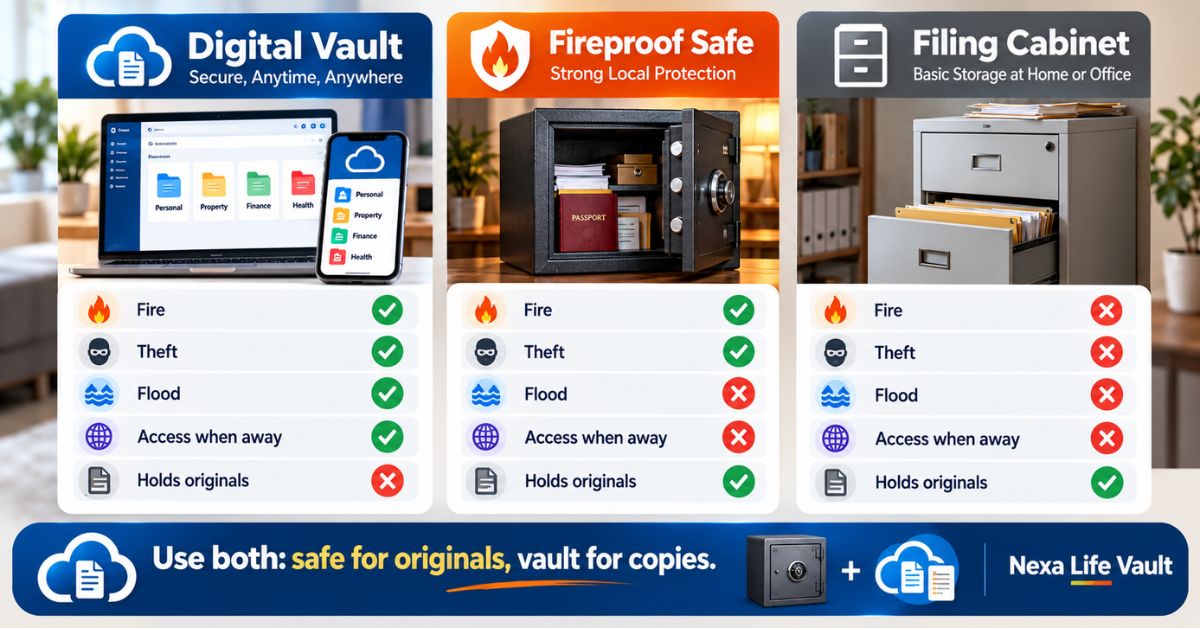
The best way to store important documents in the UK is to use two layers. Keep originals such as your passport, birth certificate and property deeds in a fireproof safe or locked cabinet, and keep digital copies in a secure online vault. The safe protects the paper from fire and theft. The vault protects you if the paper is lost.
Knowing how to store important documents in the UK sounds easy until you need a P60 for a mortgage, a V5C for a car sale, or a boiler certificate for a buyer, and the folder is nowhere to be found. Most people use a drawer, a box file or a phone camera roll. Each option has gaps. This guide compares three common ways to store documents at home and shows how to combine them.
Which documents are worth storing safely?
Not every piece of paper needs a safe. Sort what you have into two groups: papers that are hard or slow to replace, and papers you need often.
Hard or slow to replace:
- Passports and the original birth and marriage certificates
- Property deeds, mortgage paperwork and tenancy agreements
- Wills, lasting powers of attorney and letters of wishes
- Pension and life insurance policy documents
- Vehicle logbook (V5C) and driving licence details
Needed often, so easy access matters:
- Payslips, P60s and tax correspondence from HMRC
- Home, car and travel insurance schedules
- Warranties, receipts and boiler or gas safety certificates
- NHS letters, vaccination records and prescription details
- Bank, utility and council tax statements used as proof of address
For a longer checklist, including what to keep and what to shred, read our guide on home documents you should keep.
How do a digital vault, a fireproof safe and a filing cabinet compare?
Each option solves a different problem. The table shows where each one is strong and where it falls short.
| What matters | Digital vault | Fireproof safe | Filing cabinet |
|---|---|---|---|
| Fire | Not affected by a fire at home | Good protection if the fire rating is genuine | Usually little protection |
| Theft | Not affected by a break-in | Good, especially if bolted down | Weak, even with a lock |
| Flood or leaks | Not affected | Depends on the model | Poor, paper soaks up water |
| Access when away | Yes, from a phone or laptop | No, you must be there | No, you must be there |
| Sharing with family | Easy if set up properly | Needs a key or code | Needs a key |
| Holds original paper | No, copies only | Yes | Yes |
| Main weakness | Weak passwords or no backup plan | Limited space, cost, one location | Fire, theft and water |
| Verdict | Best for access and backup | Best for originals | Fine for low-risk paper |
Verdict: use both. A safe keeps the original. A digital vault keeps a copy you can reach anywhere. Neither does the other's job.
Is a filing cabinet enough?
A filing cabinet is good for organising everyday paperwork. Labelled folders for utilities, insurance and bank statements make it easy to find things in seconds.
The problem is protection. A standard cabinet is built for storage, not for fire, flood or theft. A burglar can carry a small cabinet away or force the drawer open, and paper inside gets damaged quickly if a pipe bursts above it. Use a cabinet for the paper you could replace with a phone call, and move anything irreplaceable somewhere safer.
Is a fireproof document safe worth it in the UK?
For originals, yes, usually. If you own a home, hold a will, or keep passports for the whole family, a fireproof document safe is a sensible purchase. It guards against the two risks that hurt most: fire and theft.
When you shop for a fireproof document safe in the UK, check these points:
- Independent testing. Look for a fire rating that was tested by a recognised body, not just a claim on the box. Ratings state how long the safe holds up and at what temperature.
- What the rating protects. Some safes are designed for paper only. Phones, USB sticks and hard drives often need a different type of protection.
- Fixing it down. A small safe that is not bolted to a wall or floor can simply be carried off.
- Size. Buy bigger than you think. Document collections grow.
- Insurance. Some home insurers have conditions on safes and cash or valuables limits. Check your policy documents.
A safe still has limits. It sits in one place, you must be physically there to open it, and it will not help if you need a document while travelling.
Are digital copies of documents a good backup?
Digital copies of documents solve the access problem. Scan or photograph each page, store the file somewhere secure, and you can pull up a policy number, a certificate or a letter from anywhere.
Two cautions. First, a phone camera roll is not a vault. Photos get deleted, phones get lost, and nothing is organised. Second, a digital copy does not replace the original for every purpose. Banks, solicitors, the Passport Office and other bodies may still ask to see the paper original or a certified copy. Check what the organisation asking for the document accepts before you throw anything away.
How to store important documents UK households can rely on: a step-by-step plan
This plan takes an afternoon and costs little. Do it once, then maintain it.
- Gather everything. Pull papers from drawers, the loft, the car and old bags. Put them on one table.
- Sort into three piles. Irreplaceable originals, documents you need often, and paper you can shred or recycle.
- Put originals in the safe. Passports, certificates, deeds, wills and powers of attorney go in. Use plastic wallets or an envelope for each person.
- Scan everything that matters. Use a scanner app or a flatbed scanner. Check that every page is readable and the corners are not cut off.
- Name files clearly. Use a pattern such as "Car-Insurance-2026-Renewal" so you can find files without opening them.
- Upload copies to a digital vault. Keep them organised by area of life, such as home, car and health.
- Tell one trusted person. Make sure a partner, relative or executor knows where the originals are and how to reach the digital copies.
- Review once a year. Add new papers, remove old ones and check that the safe key or code still works.
What goes wrong with home document storage?
Three short scenarios show how things go wrong.
The flood. A washing machine hose splits while a family is away for the weekend. The filing cabinet in the utility room is soaked. Insurance schedules and warranties are pulp. If they had digital copies, the insurer's claim form takes ten minutes instead of weeks of chasing.
The break-in. A burglar takes a laptop and a box file from a wardrobe. The box held passports, bank statements and a tenancy agreement. Now the family has to replace documents and deal with identity risk. A bolted-down safe would have kept the originals out of reach.
The emergency. A parent has a sudden hospital stay and an adult child needs the policy number for their travel insurance and the GP's details. The papers are in a locked drawer and the parent cannot say where the key is. Shared, organised digital copies would have saved hours of stress.
Common mistake: storing the digital copy and the original in the same place, such as a USB stick inside the safe, or a scanned file on a laptop kept in the same room. If that room burns or floods, you lose both. Keep at least one copy somewhere off-site, such as a secure online vault.
What should you never keep only as a digital copy?
Keep the original paper of anything that is official, signed or hard to reissue. That includes your passport, birth and marriage certificates, wills, powers of attorney, deeds and signed contracts.
For documents where the rules may differ depending on the organisation, such as proof of address, tax records or medical records, check with the body that asks for them. Verify with the official source, such as GOV.UK, HMRC or your solicitor, before you rely on a digital copy or destroy paper. Retention periods for tax and business records are set by the authorities and can change.
How Nexa Life Vault helps
If you want a digital home for your backups, the Home Vault is designed for the paperwork that comes with running a household: property papers, insurance schedules, warranties and service records.
The most useful feature for this topic is Smart Document Alerts. Add an expiry or renewal date to a document, such as home insurance or a boiler service, and the vault reminds you before it lapses. That turns a folder of scans into something that works for you rather than sitting idle.
Files are protected with AES-256-GCM encryption and per-file keys. You can see everything the platform offers on the features page. A digital copy does not replace your original paper, so keep the safe for that.
Conclusion
The answer to how to store important documents UK households can trust is not one box or one app. Put originals in a fireproof safe, keep organised digital copies in a secure vault, and set reminders for renewals. That mix covers fire, theft, loss and the moment you need a document while away from home. Start with one afternoon of sorting. Start Free – digitise your backups.
This is general information, not legal, tax or financial advice. Verify with the official source (GOV.UK, HMRC or your solicitor) before acting.
Frequently Asked Questions
Nishi Naik
Product & Digital Legacy Writer
Product and technology writer passionate about digital estate planning, family data privacy, and secure information lifecycle management.
Share this post
Comments (0)
No comments yet. Be the first to comment!