Track Insurance Policies in One Place: A Simple Guide for Indian Families
Life, health, motor and home policies are easy to lose track of. Here is a simple way to list them all, set renewal reminders and find forgotten policies, with a free tracker template.
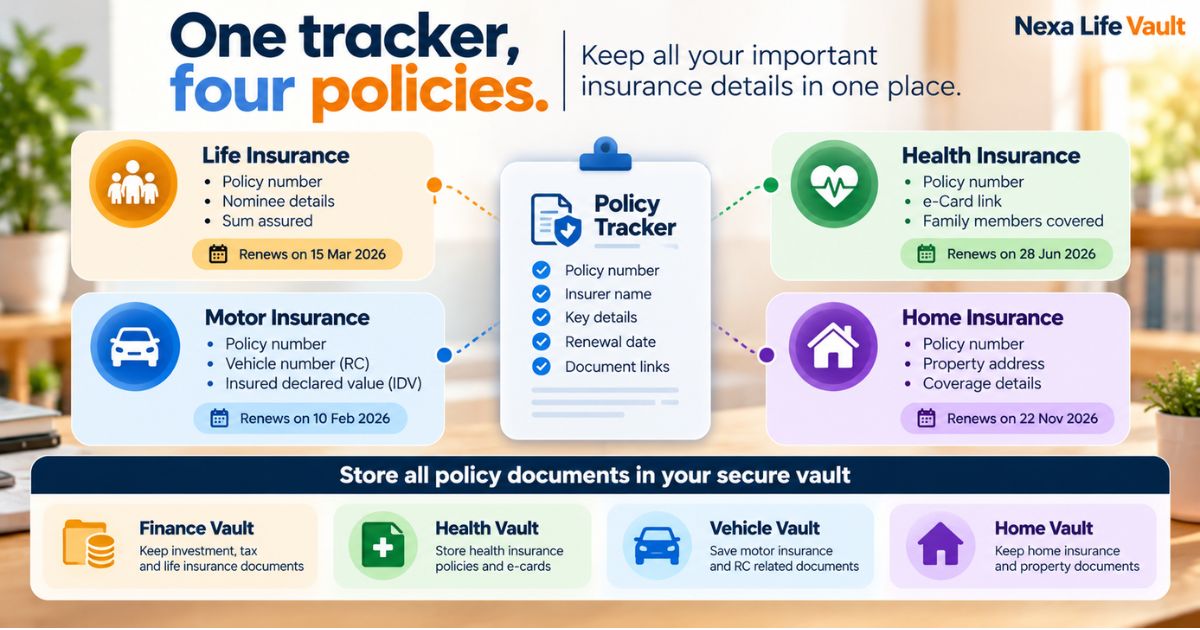
To track insurance policies in one place, list every life, health, motor and home policy in a single tracker. Record the insurer, policy number, cover amount, premium, renewal date and nominee, then store the policy documents beside it and set reminders before each renewal. Review it once a year.
Most families hold four or five policies bought over many years, through different agents, banks and apps. Papers sit in a cupboard. Renewal emails land in an old inbox. Then a claim comes up, and nobody is sure which policy covers what. This guide shows you what to write down for each policy, how to find the ones you have forgotten, and how to get reminders before anything lapses. A free tracker template is included.
Why do people lose track of their insurance policies?
Policies are bought at different times for different reasons. A term plan through an agent at 28. A health policy from your employer, plus another you bought yourself. A bike policy renewed online. A home policy that came with a loan.
Each one has its own insurer, its own portal and its own renewal date. Nothing connects them.
Here is how that goes wrong. Rohan renewed his car policy online every year. After he changed his email address, the reminder went to the old inbox. He found out the policy had lapsed only after a small accident.
The bigger risk is quieter. If something happens to you, your family may not know a policy exists. A forgotten policy is as useless as no policy at all.
What details should you record for each policy?
You do not need every clause. You need the facts that help you renew on time, claim quickly and find the paperwork.
| Detail | Why it matters |
|---|---|
| Insurer name and customer care number | You know who to call without searching |
| Policy number | Needed for every renewal, claim and service request |
| Policy type and plan name | Separates life, health, motor and home cover |
| Who or what is insured | Family member names, vehicle registration number or home address |
| Sum assured or cover amount | Shows whether your cover still fits your life |
| Premium amount and due date | Helps you avoid a lapse |
| Renewal or maturity date | The date your reminders are built around |
| Nominee | Tells your family who the benefit goes to |
| Agent or branch contact | A real person who can help with queries |
| Document location | Points to the policy PDF, premium receipts and e-card |
How do you track insurance policies in one place, step by step?
- Gather every policy you can find. Check cupboards and old files. Search your email for "policy", "premium" and "renewal". Look at bank statements for regular payments to insurers. Do not forget group cover from your employer.
- Make one master list. One row per policy. Use the template below.
- Fill in details from the policy schedule. This is the first page or section of the policy that lists your cover, dates and premium.
- Scan or download each policy document. Give files clear names, such as "Health_Family_InsurerName_March".
- Keep documents and the list together. A tracker with no documents behind it only solves half the problem.
- Set renewal reminders. More on this in the next sections.
- Tell one trusted person. A spouse, parent or sibling should know where everything is.
- Review once a year. Update cover amounts, nominees and contact details.
Is there a free insurance policy tracker template?
Yes. Copy the table below into Excel or Google Sheets. It works as a simple insurance policy organizer, and you can add rows as you find more policies. The entries in square brackets are placeholders for you to replace.
| Type | Insurer | Policy number | Insured | Cover amount | Premium and due date | Renewal date | Nominee | Documents saved? | Reminder set? |
|---|---|---|---|---|---|---|---|---|---|
| Life | [Insurer] | [Number] | [Your name] | [Sum assured] | [Amount, date] | [Maturity or premium date] | [Name] | [Yes / No] | [Yes / No] |
| Health | [Insurer] | [Number] | [Family members] | [Sum insured] | [Amount, date] | [Renewal date] | [Name] | [Yes / No] | [Yes / No] |
| Motor | [Insurer] | [Number] | [Vehicle registration no.] | [Insured value] | [Amount, date] | [Expiry date] | [Name] | [Yes / No] | [Yes / No] |
| Home | [Insurer] | [Number] | [Property address] | [Cover amount] | [Amount, date] | [Renewal date] | [Name] | [Yes / No] | [Yes / No] |
Keep premium receipts with each row. You may need them when you file your ITR. Tax treatment of premiums depends on current rules, so verify with the Income Tax Department (incometax.gov.in) before acting.
What should you note for life, health, motor and home policies?
Each type of cover has its own details worth capturing.
Life insurance
Write down the policy term, the premium paying term and the maturity date. Note the nominee and check it after big life events such as marriage or the birth of a child. Keep the policy document or e-policy, and note where any original paper is stored.
Health insurance
Record whether the plan is individual or a family floater, and who is covered. Save the health e-card and note the insurer's cashless hospital list or helpline. Also note your waiting periods and sub-limits, which vary by policy.
If your main cover comes from your employer, ask HR what happens to it if you change jobs. Group cover usually depends on your employment, so a personal policy may be worth considering. Check this with your insurer or employer.
Motor insurance
Note the vehicle registration number and whether the policy is third-party only or also covers own damage. Keep a copy of the RC next to the policy. Record your no-claim bonus status if your policy mentions one. Also track the PUC certificate, which has its own expiry date.
In India, third-party motor cover is required by law for vehicles used on public roads. Verify with IRDAI (irdai.gov.in) and the Ministry of Road Transport and Highways (morth.nic.in) before acting.
Home insurance
Write down the property address and what the policy covers: the building, the contents, or both. If you have a home loan, check your loan agreement to see whether your lender requires cover and in what form.
Pro tip: Set two reminders for each policy, not one. Make the first early enough to compare options, fix any document problem or update your nominee. Make the second close to the due date as a final check. A single reminder that arrives on the last day leaves no room to fix anything.
How do you find forgotten insurance policies?
Forgotten insurance policies usually show up in one of five places:
- Bank statements: look for yearly or monthly debits to insurance companies.
- Email: search old inboxes for "premium receipt", "policy document" and "renewal notice".
- Loan papers: home and vehicle loans often come with linked insurance.
- Your employer: ask HR for group cover details.
- Family and agents: parents, spouse and old agents often remember policies you do not.
If you still suspect gaps, contact the insurer's customer care with your identity details and ask them to check for policies in your name. Some policies are also held in electronic form through an insurance repository. Verify with IRDAI (irdai.gov.in) how to find and use these accounts.
How do you set a policy renewal reminder that works?
A good policy renewal reminder does three things. It reaches you early, it names the exact policy, and it takes you straight to the document.
A plain calendar alert only does the first. When it fires, you still have to hunt for the policy number and the file. That is where people give up and postpone.
Do not rely only on the insurer's own reminders either. Emails go to spam, phone numbers change and messages get missed. If you use auto-debit, check your mandate and bank balance before each due date, since a failed payment can still lead to a lapse.
How can one vault show you the full picture of your insurance?
Insurance rarely lives in one place because the things it protects do not. Your health cover belongs with your medical records. Your car policy belongs with the RC. Your home policy belongs with your property papers.
Picture a family setup. The health policy and e-card sit in the Health Vault, next to prescriptions and reports. The motor policy and RC sit in the Vehicle Vault. The home policy sits in the Home Vault with the property papers.
Cross-Vault Intelligence in Nexa Life Vault is built to link related documents across vaults. So a policy is not an isolated PDF. It sits next to the things it protects. When a claim comes up, you are not opening five apps to piece the story together.
How Nexa Life Vault helps
The Finance Vault is the natural home for your insurance tracker. Store each policy document and premium receipt there, and note the renewal date against each one.
Then Smart Document Alerts do the remembering. They send expiry and renewal reminders, so you hear about a policy before it lapses instead of after.
Digital copies help you find details fast. Check with your insurer whether it needs originals or its own forms for a claim.
Frequently asked questions
How do I find insurance policies I have forgotten?
Start with bank statements and look for recurring payments to insurers. Search your email for words like policy, premium and renewal. Check old files, your employer's HR portal and any loan papers. Ask family members and agents too. If you still find gaps, contact the insurer's customer care with your identity details and ask them to look up policies in your name.
What is the best way to track policy renewal dates?
Keep one master list with the renewal date of every policy, and set reminders before each date. A calendar alert is a start, but it does not hold the document. A system that stores the policy beside the reminder lets you act at once, compare options and renew without hunting for the policy number.
Should I keep paper copies of my insurance policies?
Keep the originals of life policies and any document your insurer asks you to hold safely, and store scanned copies in a secure place for quick access. Rules and insurer requirements differ, so check with your insurer whether it needs originals for a claim. A digital copy is mainly for finding details fast, not a replacement for official requirements.
Who should know about my insurance policies?
At least one trusted adult, usually your spouse or a family member, should know that the tracker exists and where to find it. They do not need your passwords daily, but they should know the insurers, policy numbers and nominees. Review nominee details after life events such as marriage or the birth of a child.
How often should I review my insurance policies?
Review them once a year, ideally a month before your busiest renewal. Check that cover amounts still fit your life, nominee names are current, and contact details with the insurer are correct. Also review after big changes such as a new job, a new vehicle, a house purchase or a new baby.
Conclusion
A policy you cannot find is a policy you cannot use. Take one evening: gather every life, health, motor and home policy, fill in the template and note your renewal dates. Then you can track insurance policies in one place instead of in five inboxes and a cupboard. Add your policies and renewal alerts in Nexa Life Vault today, and tell one family member where to look.
This is general information, not legal, tax or financial advice. Verify with IRDAI (irdai.gov.in) and your insurer before acting.
Frequently Asked Questions
Shailesh Nagar
Cloud Infrastructure & Security Contributor
Technology specialist at NexaLifeVault focusing on cloud infrastructure, data resilience protocols, and modern digital asset management.
Share this post
Comments (0)
No comments yet. Be the first to comment!