How Long Should You Keep Documents? A Retention Guide for India
Not sure which papers to keep and which to shred? This India retention guide shows how long to keep bank statements, ITR files, salary slips and property documents, with a simple master
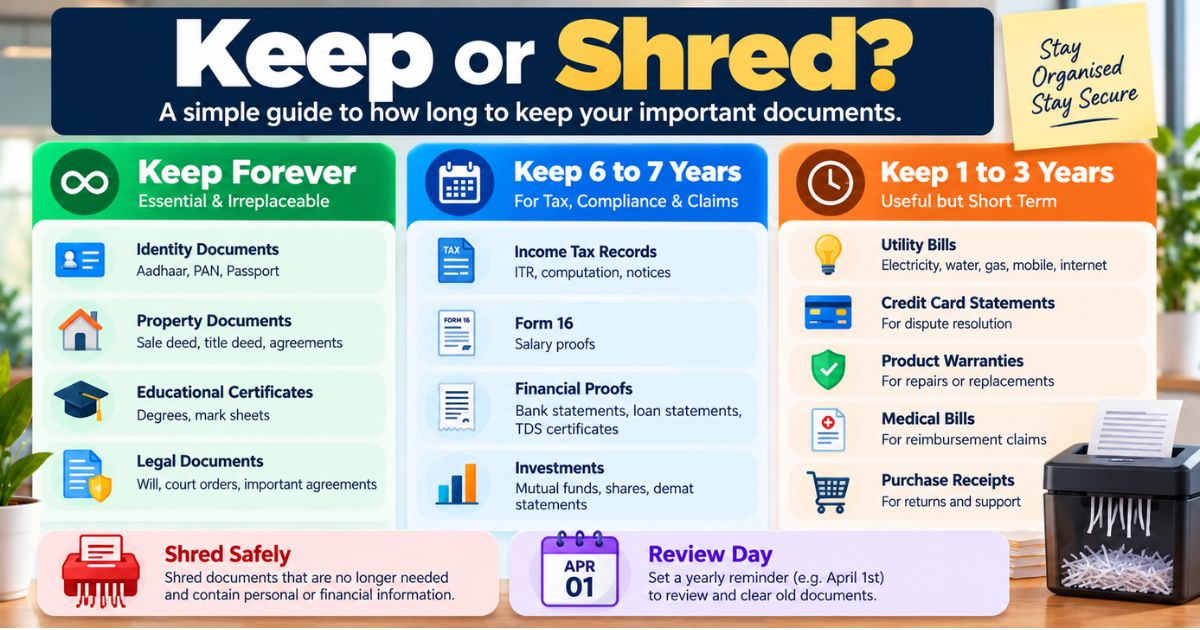
How long to keep documents in India depends on the type. Keep most bank statements, salary slips and bills for 3 to 7 years, ITR papers for at least 6 to 7 years, and property, identity, insurance and legal records permanently or until the policy or case ends. Check the table below before you shred anything.
Most of us either keep every piece of paper in a cupboard or throw things out in a cleaning spree and regret it later. Both cost you. A missing sale deed or an old Form 16 can delay a loan, a visa or a tax reply by weeks. This guide gives you a clear keep-for period for each common document, the reason behind it, and a safe way to dispose of what you no longer need.
This is general information, not legal, tax or financial advice. Rules can change, so confirm with the official source named in each section.
How long to keep documents: the master table
Use this table as your starting point. The periods are practical norms followed by many households, not fixed legal limits, except where a section says otherwise. When in doubt, keep the document longer.
| Document | Keep for | Why |
|---|---|---|
| Aadhaar, PAN, passport, voter ID | Permanently (while valid or in use) | Core identity proof for almost every application |
| Bank statements and passbooks | 3 to 7 years | Back up income, deposits and ITR claims |
| Fixed deposit receipts | Until maturity, then 3 to 7 years | Proof of interest income and TDS |
| ITR, acknowledgement and computation | At least 6 to 7 years | Needed if the tax department asks questions about a past year |
| Form 16, Form 16A, Form 26AS / AIS | Same period as the ITR | Proof of TDS and income for that year |
| Tax-saving proofs (80C, 80D, rent receipts, HRA) | Same period as the ITR | Support the deductions you claimed |
| Salary slips | At least 3 years; last 6 to 12 slips of each job longer | Loans, visas and tax matching |
| Offer, appointment, relieving and experience letters | Permanently | Proof of your work history |
| PF / EPF and gratuity records | Permanently | Needed for claims, transfers and retirement |
| Mutual fund, share and demat statements | Until sold, then 6 to 7 years | Capital gains and cost of purchase |
| Loan agreement and EMI statements | Until closure | Dispute protection while the loan runs |
| Loan closure letter and NOC | Permanently | Proof the loan was cleared |
| Credit card statements | 1 to 3 years | Dispute and spending records |
| Sale deed, title deed, property papers | Permanently | Proof of ownership, needed at every sale or transfer |
| Property tax receipts and society NOC | Permanently, or at least 7 years | Proof of dues paid and ownership history |
| Utility bills (electricity, gas, water, broadband) | 1 to 3 years | Address proof and billing disputes |
| Life and health insurance policies | Life of the policy, plus claim period | Needed to claim and to renew |
| Medical reports and discharge summaries | Permanently for major illness; 3 to 5 years for routine | Help doctors and insurers see your history |
| Vehicle RC, insurance and PUC | RC while you own the vehicle; others until renewed | Legal proof of ownership and cover |
| Education certificates and marksheets | Permanently | Jobs, admissions and visas |
| Marriage certificate, wills, legal orders | Permanently | Rights, inheritance and name-change proof |
| Warranty cards and purchase bills | Until the warranty ends | Repair and replacement claims |
Why do keep-for periods differ so much?
Ask three questions about any paper in your hand:
- Does it prove who I am or what I own? If yes, keep it permanently. This covers ID, title deeds, degrees and certificates.
- Does it support a tax return, loan or insurance claim? If yes, keep it until that matter is fully closed, then add a safety margin of a few years.
- Is it just a record of a routine payment? If yes, a short period is usually enough, such as one to three years for utility bills.
Take Meera, who sold a flat in 2024. Her buyer's bank asked for the original purchase agreement from 2012, the society NOC and every property tax receipt. She found all of them because she had never thrown away property papers. Her neighbour had discarded his and spent weeks getting duplicates.
How long should you keep bank statements?
If you are asking how long to keep bank statements, a safe answer for most people is three years at minimum and six to seven years if the account shows income that you declared in your ITR. Statements are your proof of where money came from, which matters if you ever have to explain a large deposit or a property purchase.
Keep these longer than the rest:
- Statements showing the sale or purchase of property, gold or shares.
- Statements showing a gift or a loan from family, along with a written note of the amount.
- Savings account statements for accounts you are closing. Download the final statement before the account is shut.
Most banks let you download statements from net banking, but the number of past years available varies. Do not assume you can fetch an old statement later. Download yearly and store it.
For how many years should you keep ITR papers?
The question "keep ITR for how many years" has no single answer that fits everyone, because the time limit within which the tax department can revisit a past year has been revised over the years and depends on the case. Many people keep the return, the acknowledgement, Form 16 and all proofs for at least six to seven years. If your income was complicated, keep them longer.
Keep these together, year by year, in one folder:
- The filed ITR and the ITR-V or e-verification acknowledgement.
- Form 16 from each employer and Form 16A for other TDS.
- Form 26AS or the Annual Information Statement for that year.
- Proofs for deductions: premium receipts, home loan interest certificate, rent receipts.
- Capital gains workings and contract notes, if you sold shares or property.
Verify with the official source before acting: check the current time limits and the rules that apply to you on the Income Tax Department's website (incometax.gov.in) or with a Chartered Accountant. For a deeper walkthrough, see our tax documents storage guide.
Common mistake: People keep the ITR but throw away the proofs behind it. The return alone does not prove a deduction. If you claimed HRA, 80C or 80D, the rent receipts and premium certificates are what count. Store proofs in the same folder as the return for that year.
How long should you keep salary slips?
On how long to keep salary slips, three years is a reasonable minimum, and you should hold on to them until the matching ITR period is over. Salary slips help you match what your employer reported with what appears in your tax records.
Some slips are worth keeping beyond that:
- The last six to twelve slips from every employer you leave. Banks and visa offices often ask for recent proof of income, and an old employer's HR team may not respond quickly.
- The slip that shows a big change, such as a promotion, a bonus or a hike.
- Slips from a job where you later had a PF or gratuity issue.
Never throw away your offer letter, appointment letter, relieving letter or experience letter. These prove your work history for the rest of your career. Keep them in your Job Vault or an equivalent folder. If you run a business and hold staff records, read our employee records retention checklist, which covers the employer side.
Which documents should you never throw away?
Some papers are hard or slow to replace, so treat them as permanent:
- Sale deed, title deed, allotment letter, property tax receipts and society documents. Keep these in your Home Vault or equivalent folder.
- Birth, marriage and death certificates.
- Degree certificates and marksheets.
- Loan closure letters and NOCs.
- Wills, court orders, adoption papers and legal agreements.
- PF, gratuity and pension papers.
- Major medical records, such as surgery reports and discharge summaries.
Duplicates exist for many of these, but getting one can mean applications, fees, police reports or long waits. A few minutes of storing the original safely is cheaper.
When should you shred documents?
Shred a document when its keep-for period is over, nothing open depends on it, and no one is likely to ask for it. Run this check before you shred any paper:
- Find the document in the master table above and check its period.
- Confirm that no loan, insurance claim, tax query, court case or dispute is linked to it.
- Check that a family member does not need it, for example for a joint account or a shared property.
- If the paper has any lasting value, scan it first and store the scan safely.
- Destroy it with a cross-cut shredder. Do not tear it by hand and put it in the bin.
Papers that carry your Aadhaar number, PAN, account number, signature or address are the ones fraudsters look for. Avoid handing them to a scrap dealer as they are. If you do not own a shredder, tear them into small pieces in separate batches or use a shredding service.
Pro tip: Pick one day each year, for example right after you file your ITR, as your "review day". Sort the year's papers into three piles: keep permanently, keep for a set number of years, and ready to shred. Write the shred-by year on the folder so you never have to guess.
Is a scanned copy enough?
A scan is a good backup, and it makes sharing easy. But whether a scan is accepted depends on who is asking. Banks, courts, registrar offices and government departments may insist on originals or attested copies. Keep the original of any title deed, certificate or legal paper even after you scan it. Ask the office concerned what it accepts.
How Nexa Life Vault helps
Knowing how long to keep documents only helps if you can find them in the first place. The Finance Vault in Nexa Life Vault gives your bank statements, ITR files, Form 16 and investment records one organised place, so each year's tax papers sit together instead of across email, WhatsApp and old folders.
Smart Document Alerts are built for expiry and renewal reminders. They suit papers with real end dates, such as insurance policies and fixed deposits, so a renewal does not slip past you. Your files are protected with AES-256-GCM encryption, with a separate key for each file.
A digital copy is a convenient backup. Keep originals of important legal papers and check what each office accepts.
Conclusion
Knowing how long to keep documents saves you from two costly habits: hoarding everything and shredding too soon. Keep identity, property, education and legal papers for good. Hold tax and money records for six to seven years. Clear out routine bills after one to three years. Start with this year's ITR folder today, then sort the rest on your next review day. Set up your Finance Vault on Nexa Life Vault and keep every year's papers in one place.
Frequently Asked Questions
Ayush Singh
Software Engineer & Security Systems Writer
Software engineer and tech writer focused on digital security, system reliability, and user-friendly document organization workflows.
Share this post
Comments (0)
No comments yet. Be the first to comment!