Legal Heir Certificate vs Succession Certificate: What's the Difference?
Legal heir certificate vs succession certificate: learn who issues each, what each one allows, and which you need to claim a loved one's assets in India.
A legal heir certificate is a revenue-office document that names the family members who are a deceased person's legal heirs. A succession certificate is a court order that lets a named heir collect the deceased's debts and securities, such as bank deposits. The first proves who the heirs are; the second gives the authority to claim.
Legal heir certificate vs succession certificate is a question many families face a few weeks after a death, standing at a bank counter while a clerk asks for a paper they don't have. The two names sound alike, and different offices use them differently. This article explains what each one does, who issues it, what you need to apply, and how to decide which one you need.
Last updated: October 2026. This is general information, not legal, tax or financial advice. Rules differ by state and by institution.
What is a legal heir certificate?
A legal heir certificate is an official paper that lists the people who are the legal heirs of someone who has died. It usually names the spouse, children and sometimes parents, along with each person's relationship to the deceased.
It is issued by a local revenue authority, not a court. Depending on your state, that may be the tahsildar, a revenue officer or a municipal office. Some states use a different name, such as "family member certificate" or "surviving family member certificate".
Think of it as proof of who is in the family. It does not, on its own, move money or property to anyone. Employers, pension offices and some banks accept it to confirm who the heirs are.
Example: Meera's father, a retired clerk, passes away. The pension office asks the family for a document naming his heirs before it will update the records. That is a job for a legal heir certificate.
Verify with the official source (your state revenue department or e-District portal) before acting.
What is a succession certificate?
A succession certificate is issued by a civil court. It is governed by the Indian Succession Act, 1925. It gives the person named in it the authority to collect debts and securities that were owed to the deceased, such as bank balances, fixed deposits, shares and mutual fund units.
The court does not simply hand it over. The applicant files a petition, the court publishes a notice so that anyone who objects can come forward, and a judge decides. The applicant pays a court fee, which depends on the state and the value involved. The court may also ask for a surety or indemnity bond.
Example: Rohan's mother dies without a will. She had a savings account, a fixed deposit and some shares, but never named a nominee. The bank will not release the money on the family's word alone. It wants court-backed authority, and that is what a succession certificate provides.
Verify with the official source (the Indian Succession Act, 1925 on India Code, and your district court or eCourts portal) before acting.
Legal heir certificate vs succession certificate: what are the key differences?
| Point | Legal heir certificate | Succession certificate |
|---|---|---|
| Issued by | Local revenue authority (tahsildar or equivalent) | Civil court (district judge) |
| What it does | Names the legal heirs and their relationship to the deceased | Authorises a named person to collect the deceased's debts and securities |
| Typical use | Pension, employer dues, service benefits, some bank and insurance claims | Bank deposits, fixed deposits, shares, mutual funds and similar dues |
| Process | Application with documents, local inquiry, officer's decision | Court petition, public notice, hearing if anyone objects |
| Cost and time | Usually lower and quicker; varies by state | Court fee plus often a lawyer's fee; usually slower |
| Protection against disputes | Lighter; it is an administrative record | Stronger; the court hears objections before issuing it |
In short, one tells an office who the family is, and the other tells an institution it can safely pay a particular person.
Who needs which certificate?
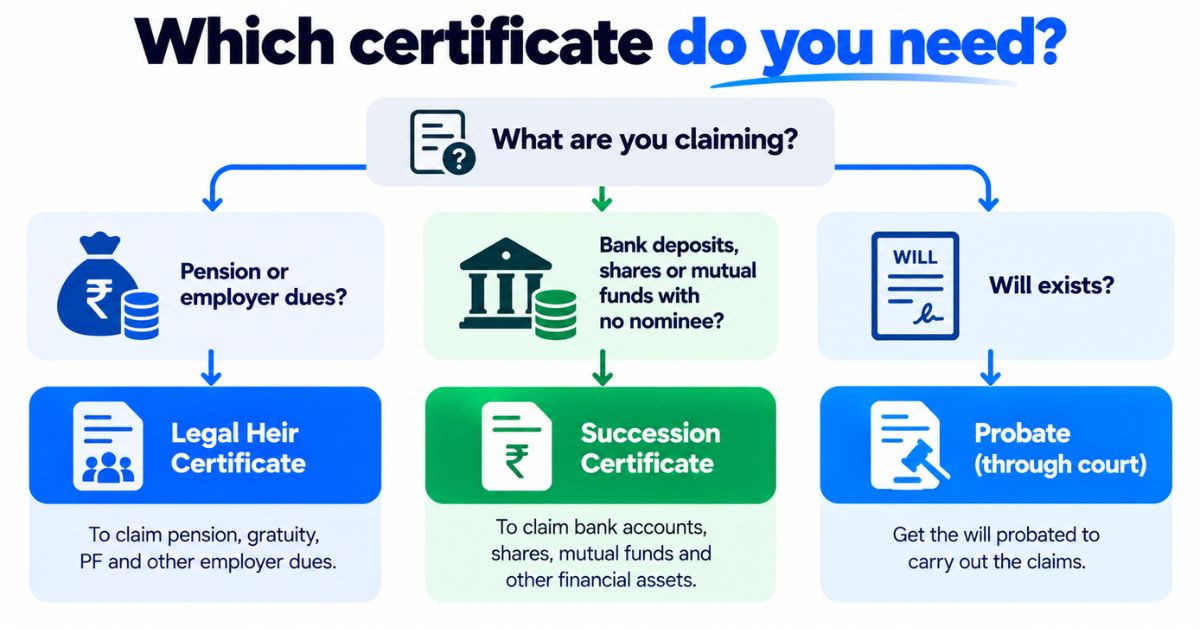
The answer depends on what you are claiming and who is holding it. Work through this list in order:
- Claiming a pension, provident fund or other employer dues? Start with a legal heir certificate. The department will usually tell you the format it wants.
- Claiming bank deposits, fixed deposits, shares or mutual funds with no nominee, or with a disputed nominee? You will likely be asked for a succession certificate.
- Claiming a small bank balance? Many banks set their own limits. Below a certain amount they may accept simpler papers, such as a legal heir certificate, an affidavit and an indemnity bond. Ask the branch for its written policy.
- Is there a registered or unregistered will? You may need a different route, such as probate, instead of a succession certificate. The rules depend on the will, the place and the religion of the deceased.
- Claiming land or a house? Property usually moves through mutation in revenue records and the sub-registrar's process. Heir proof may be one of the supporting papers, but state rules vary.
- Still unsure? Ask each institution in writing which document it accepts. Then apply for that one.
What documents do you need for a legal heir certificate?
The list changes from state to state, so treat this as a typical set rather than a fixed rule. Most offices ask for:
- The death certificate of the deceased
- The applicant's Aadhaar and address proof
- Identity proofs of the other heirs, such as Aadhaar or PAN
- Proof of relationship, such as a ration card, school records or a family record
- A filled application form and recent photographs
- An affidavit or self-declaration listing all heirs
- Sometimes, witness statements or a local inquiry by a revenue inspector
These are the legal heir certificate documents that cause the most delay when missing. The death certificate is the first one to sort out. You can get it from the local municipal or registrar office that records deaths. Order several copies at the start.
If your family has not yet gathered its core papers, our guide to important documents for loved ones shows what to collect and where to keep it.
How do you apply for a succession certificate in India?
This process is slower than the legal heir route, because it goes through a court. The broad steps look like this:
- Get the death certificate. You will attach it to the petition.
- List the assets and the heirs. Write down each bank account, deposit, share holding and other debt or security you want covered, along with every legal heir.
- Draft the petition. Most families hire an advocate for this. The petition gives details of the death, the family, and the assets.
- File it in the right court. This is usually the district court that has jurisdiction. Pay the court fee.
- Wait for the notice period. The court issues and publishes a notice so that anyone with an objection can respond.
- Attend the hearing if there is a dispute. If nobody objects, the process is usually simpler.
- Collect the certificate. Ask for certified copies, since each institution may keep one.
The time taken depends on the court, how busy it is and whether anyone objects. Do not rely on a fixed number of weeks quoted online. Ask your advocate for an estimate for your court.
Verify with the official source (your district court or the eCourts portal) before acting.
What about a will, a nominee or probate?
These three often get mixed up with the two certificates.
A will says who should receive what. If one exists, the route to claiming assets can change. Some wills need probate, which is a court's approval of the will. Others may not. Keep the original safe and let a trusted person know where it is. Our post on how to store a will safely covers this.
A nominee is the person named with a bank, insurer or fund to receive the money. A nominee can often receive the payout directly, which may reduce the need for either certificate. But nominee rules differ by institution and asset type, and a nominee is not always the final owner of the money. Ask the institution how it treats nominees.
Probate relates to wills and is separate from a succession certificate. A succession certificate is usually sought where there is no will, or where the claim is limited to debts and securities.
Verify with the official source (a qualified advocate and the relevant court) before acting, because the rules depend on the facts.
How Nexa Life Vault helps
Estate paperwork rarely stalls because of the law alone. It stalls because nobody can find the death certificate, the ID proofs or the property papers. The Legal Vault gives you one place to keep a will copy, family ID documents, property papers and nominee details together.
With Nominee & Executor Access, you choose the people who can reach those documents when the time comes. Your family does not have to search through drawers and old email threads while grieving.
Digital copies help you stay organised and give you something to refer to quickly. Banks, courts and government offices may still ask for originals or certified copies, so check what each one accepts.
Conclusion
The legal heir certificate vs succession certificate question comes down to proof versus authority. One shows who the heirs are, and the other lets a named heir collect certain dues with court backing. Ask each institution which one it needs before you apply. Then keep your estate papers together so your family is not hunting for them later. Organise your estate documents in one place today.
Frequently Asked Questions
Nishi Naik
Product & Digital Legacy Writer
Product and technology writer passionate about digital estate planning, family data privacy, and secure information lifecycle management.
Share this post
Comments (0)
No comments yet. Be the first to comment!