Tax Documents Storage Guide: How to Organize, Store, and Protect Your Tax Records
Learn how to organize, store, and protect your tax documents with this complete guide. Discover recommended tax record retention periods, secure storage methods, digital organization tips, and best practices for managing tax returns, income records, and supporting documents with confidence.
Tax Documents Storage Guide: How to Organize, Store, and Protect Your Tax Records
Tax season comes and goes every year, but your responsibility to maintain accurate tax records continues long after you've filed your return. Proper tax document storage is an essential part of financial organization that helps you prepare for audits, claim deductions, verify income, support major financial transactions, and protect yourself from identity theft.
Keeping tax documents organized is an essential part of long-term financial management. This guide is part of our Wealth Vault, where you'll find expert resources on organizing financial records, managing investments, planning your estate, and building lasting financial security.
Unfortunately, many people either keep every tax-related paper indefinitely or discard important records too soon. Both approaches can create unnecessary problems. A well-organized tax document storage system allows you to quickly locate the information you need while reducing clutter and ensuring compliance with applicable tax regulations.
Whether you're an employee, self-employed professional, freelancer, investor, business owner, or retiree, maintaining organized tax records simplifies financial management throughout the year. This guide explains which tax documents you should keep, how to organize them, the safest storage methods, and practical strategies for protecting sensitive financial information.
Why Tax Document Storage Is Important
Your tax records serve as evidence supporting the information reported on your tax return. If questions arise about your income, deductions, credits, business expenses, investments, or property transactions, organized documentation allows you to respond quickly and accurately.
Proper recordkeeping also makes annual tax preparation faster and less stressful. Instead of searching through piles of paperwork each year, you'll already have everything categorized and readily available.
Beyond tax filing, organized tax documents can be useful when applying for a mortgage, securing a business loan, applying for financial aid, verifying income, or planning your estate.
What Are Tax Documents?
Tax documents are records that support your income, deductions, credits, investments, business activities, and financial transactions reported to tax authorities. These documents may be received from employers, financial institutions, government agencies, insurance providers, investment firms, or generated from your own financial records.
Some tax documents only need to be retained for a limited period, while others should be preserved much longer because they affect future tax calculations or establish ownership of valuable assets.
Essential Tax Documents You Should Keep
1. Filed Tax Returns
Your completed tax return is one of the most important financial documents you own. It provides a comprehensive summary of your annual income, deductions, credits, taxes paid, and overall financial activity.
Each year's tax return should be stored together with the supporting documents used to prepare it. Keeping complete tax files simplifies future tax preparation and provides valuable documentation if questions arise later.
A complete tax return file generally includes:
-
Federal tax return
-
State tax return (if applicable)
-
Electronic filing confirmation
-
Tax payment confirmations
-
Refund documentation
-
Correspondence from tax authorities
2. Income Documents
Income records verify the earnings reported on your tax return. Depending on your employment or business situation, you may receive several different income documents throughout the year.
Common income-related tax documents include:
-
W-2 forms
-
1099-NEC forms
-
1099-MISC forms
-
1099-INT forms
-
1099-DIV forms
-
1099-B forms
-
SSA-1099 benefit statements
-
K-1 forms
These documents should always be retained with the corresponding year's tax return.
3. Deduction and Credit Documentation
If you claim deductions or tax credits, maintaining proper documentation is essential. Receipts and supporting records help verify eligible expenses if they are ever questioned.
Examples include:
-
Charitable donation receipts
-
Medical expense records
-
Education expense statements
-
Student loan interest statements
-
Childcare expense records
-
Energy efficiency improvement receipts
-
Business mileage logs
Keeping organized records throughout the year makes tax filing much easier than gathering documentation at the last minute.
4. Business Tax Records
Business owners, freelancers, and self-employed individuals generally need more extensive tax documentation than traditional employees.
Business tax records often include:
-
Income invoices
-
Expense receipts
-
Payroll records
-
Business bank statements
-
Profit and loss statements
-
Sales tax records
-
Business licenses
-
Vendor payments
Keeping business and personal tax documents separate reduces confusion and improves bookkeeping accuracy.
If your website includes an article about Financial Documents You Must Keep, linking to it here provides readers with additional guidance on organizing important financial records.
5. Property Tax Records
Homeowners should retain documentation related to property purchases, improvements, and taxes. These records may affect future capital gains calculations when the property is sold.
Important property-related tax documents include:
-
Property tax statements
-
Closing disclosures
-
Settlement statements
-
Mortgage interest statements
-
Home improvement receipts
-
Real estate tax payment records
Significant home improvements often increase your property's cost basis, potentially reducing taxable gains when selling your home.
6. Investment Tax Records
Investment income frequently creates additional tax reporting requirements. Organized investment records help ensure accurate reporting while simplifying capital gains calculations.
Investment-related tax documents include:
-
Brokerage statements
-
Dividend reports
-
Capital gains summaries
-
Investment purchase confirmations
-
Investment sale confirmations
-
Foreign tax documentation
Investors should also maintain cost basis documentation until investments are sold and all related tax obligations have been satisfied.
Readers interested in organizing their investment paperwork may also benefit from your related guide on Investment Records Management.
7. Retirement Tax Documents
Retirement accounts generate important tax documents throughout your working years and during retirement.
These records may include:
-
IRA contribution confirmations
-
401(k) contribution records
-
Retirement account distributions
-
Required Minimum Distribution documentation
-
Pension income statements
Maintaining these records helps verify contributions and withdrawals while supporting future tax reporting.
How to Organize Tax Documents
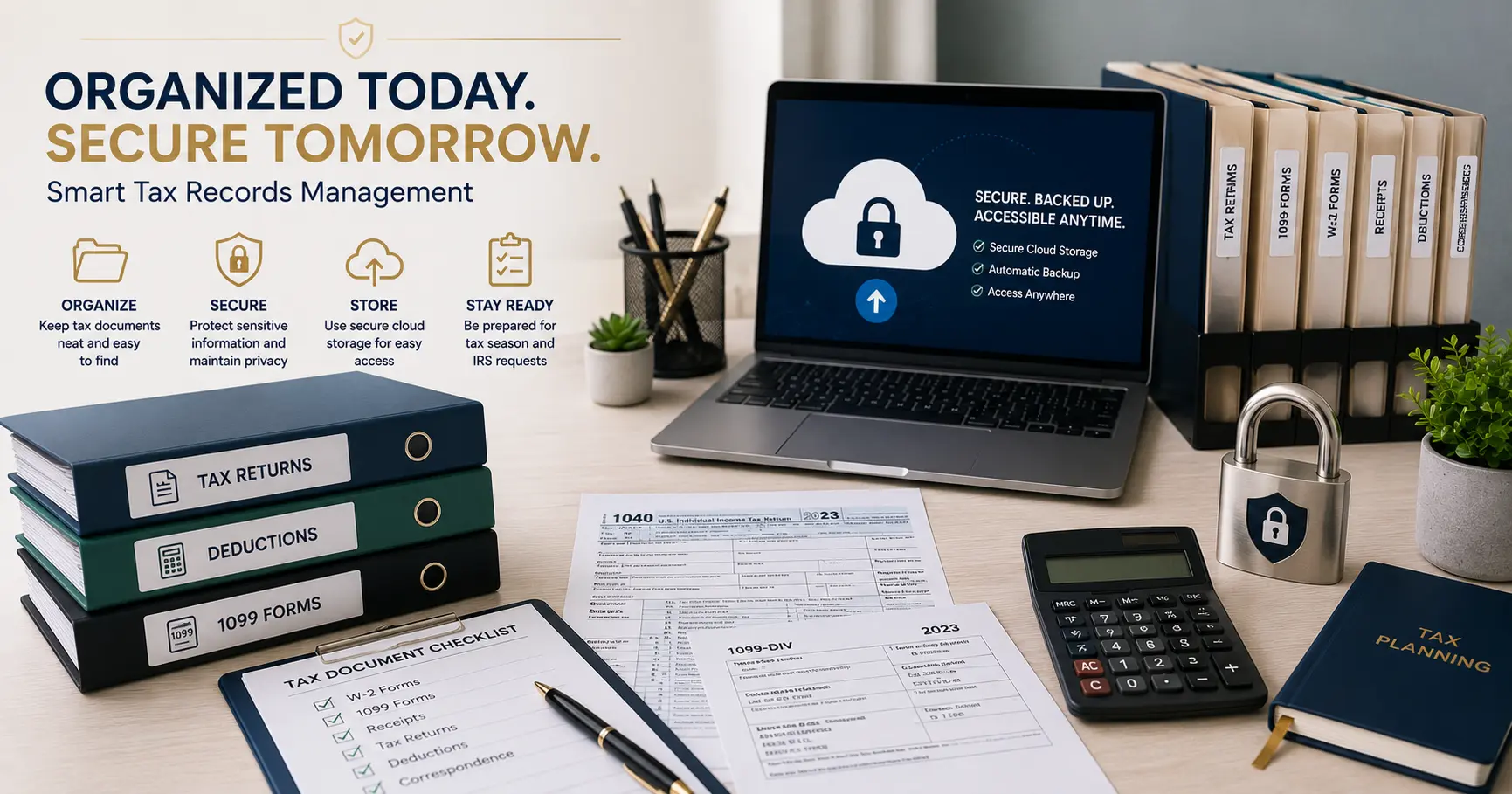
A consistent filing system is the foundation of effective tax document management. Whether you prefer paper files, digital storage, or both, organizing records by category and tax year makes locating information much easier.
Many people also review their tax records alongside their annual financial summary. This provides an excellent opportunity to track your net worth, helping you measure your assets, liabilities, and overall financial progress while making more informed financial decisions.
Consider using folders for categories such as:
-
Tax Returns
-
Income Documents
-
Deductions
-
Business Taxes
-
Property Records
-
Investment Taxes
-
Retirement Documents
-
Tax Correspondence
Within each category, create subfolders by year. For example:
-
2026 Tax Return
-
2026 W-2
-
2026 Investment Income
-
2026 Charitable Contributions
This structure keeps your records organized and significantly reduces the time required to locate documents during tax preparation or financial reviews.
Paper vs. Digital Tax Document Storage
Many financial institutions now provide electronic tax documents, making digital recordkeeping more convenient than ever. However, maintaining a combination of paper and digital records often provides the best balance of accessibility and security.
Original legal documents, signed agreements, and certain official notices may still be worth keeping in paper form, while copies of tax returns, income statements, and supporting documentation can usually be stored securely as digital files.
Using both physical and digital storage also helps protect your records from unexpected events such as hardware failures, accidental deletion, or natural disasters.
Preparing for Tax Season Throughout the Year
One of the best ways to reduce stress during tax season is to organize documents as you receive them rather than waiting until filing deadlines approach.
Create a dedicated folder for the current tax year and immediately file new income statements, receipts, charitable donation records, investment reports, and business expenses. Regular organization prevents paperwork from accumulating and ensures important documents aren't misplaced.
In Part 2, we'll discuss how long to keep tax documents, secure digital storage strategies, cybersecurity best practices, common tax recordkeeping mistakes, an annual tax document checklist, disaster recovery planning, a comprehensive conclusion, authoritative resources, and a professional disclaimer.
How Long Should You Keep Tax Documents?
One of the most common questions taxpayers ask is how long tax records should be retained. The answer depends on the type of document, applicable tax laws, and whether the records relate to property, investments, or business activities.
While some records only need to be kept for a few years, others should be retained much longer because they establish ownership, support tax calculations, or document significant financial transactions.
Tax DocumentRecommended Retention PeriodFiled Tax ReturnsAt least 7 years; many financial professionals recommend keeping copies permanently.W-2 and 1099 FormsAt least 7 years with the corresponding tax return.Receipts Supporting DeductionsAt least 7 years.Business Expense RecordsAt least 7 years.Investment Cost Basis RecordsUntil the investment is sold plus at least 7 years after filing the related tax return.Property Purchase DocumentsKeep while you own the property and for several years after the sale for tax purposes.Mortgage Interest StatementsAt least 7 years.Retirement Contribution RecordsPermanently or for as long as they may affect future tax reporting.IRS or State Tax CorrespondenceKeep with the related tax return permanently.
These are general recommendations. Depending on your financial circumstances, business activities, or local tax regulations, you may need to retain records for longer periods.
Many permanent tax records also play an important role in estate administration. Documents such as previous tax returns, property tax records, and retirement account information may be required when settling an estate. Learn more in our Estate Planning Documents guide.
Best Practices for Digital Tax Document Storage
Digital storage offers convenience, faster document retrieval, and better protection against physical damage when implemented correctly.
Create a dedicated folder for each tax year and organize documents into subfolders based on category.
For example:
-
Tax Returns
-
Income Documents
-
Business Expenses
-
Property Records
-
Investment Records
-
Retirement Documents
-
Tax Notices
Within each folder, use descriptive file names such as:
"2026 Federal Tax Return.pdf"
"2026 Form W-2.pdf"
"2026 Charitable Contributions.pdf"
"2026 Brokerage 1099-B.pdf"
Consistent naming conventions make searching for documents significantly easier in the future.
How to Secure Tax Documents
Tax documents contain highly sensitive personal and financial information, including Social Security numbers, account numbers, addresses, income details, and tax identification numbers. Protecting these records is essential for reducing the risk of identity theft and financial fraud.
Consider the following security practices:
-
Enable multi-factor authentication for tax preparation and financial accounts.
-
Use strong, unique passwords for all financial platforms.
-
Encrypt digital tax files before storing them.
-
Back up important documents to secure cloud storage and an encrypted external drive.
-
Store paper documents in a fireproof and waterproof safe.
-
Limit access to trusted family members or authorized advisors.
-
Keep antivirus software and operating systems updated.
Following these practices helps ensure your records remain protected against cyber threats, accidental deletion, and physical damage.
Paper vs. Digital Storage: Which Is Better?
Both paper and digital storage have advantages. Paper records provide original documentation that may be required in certain legal situations, while digital records offer easier access, better searchability, and convenient backup options.
For most individuals, a hybrid approach works best. Store original signed documents and official notices in a secure physical location while maintaining encrypted digital copies for everyday use.
Regularly verify that digital backups are complete and accessible, especially before disposing of any paper copies.
Common Tax Recordkeeping Mistakes
Even organized taxpayers sometimes make mistakes that create unnecessary stress during tax season.
Common mistakes include:
-
Throwing away tax records too early.
-
Keeping receipts without organizing them by year.
-
Mixing personal and business expenses.
-
Failing to retain investment cost basis records.
-
Not backing up digital files.
-
Ignoring tax notices from government agencies.
-
Using weak passwords for cloud storage.
Developing a consistent filing system and reviewing it annually can help avoid these issues.
Creating an Annual Tax Document Review
Once you've filed your tax return, take time to review and organize your records for the year.
An annual review helps ensure that your documentation remains complete and accurate while reducing next year's workload.
During your review:
-
Download electronic tax documents.
-
Verify that all income forms have been received.
-
Organize receipts by category.
-
Store filed tax returns with supporting documents.
-
Back up digital files.
-
Securely shred documents that have exceeded their retention period.
-
Update your filing system for the new tax year.
Tax Document Checklist
Before considering your tax records fully organized, confirm that you have access to:
-
Filed tax returns.
-
W-2 and 1099 forms.
-
Business income records.
-
Expense receipts.
-
Property tax documents.
-
Mortgage interest statements.
-
Investment tax forms.
-
Retirement account tax records.
-
Charitable donation receipts.
-
Tax payment confirmations.
-
Correspondence from tax authorities.
This checklist helps ensure you have the documentation necessary for tax preparation, audits, financial planning, and future reference.
Disaster Recovery Planning for Tax Records
Unexpected events such as fires, floods, theft, or hardware failures can result in the loss of important financial records. Creating a disaster recovery plan helps protect your tax documents from permanent loss.
Maintain at least two secure backups of your digital records—one in encrypted cloud storage and another on an encrypted external drive. Store original paper documents in a fire-resistant and waterproof safe, and periodically verify that digital backups remain accessible.
Preparing in advance ensures your records remain available when you need them most.
Conclusion
Effective tax document storage is about more than staying organized. It helps protect your financial information, simplifies tax preparation, supports accurate reporting, and provides peace of mind throughout the year.
Whether you're an employee, freelancer, investor, retiree, or business owner, maintaining a structured filing system makes it easier to locate important records, respond to tax inquiries, and plan for future financial decisions.
By understanding which tax documents to keep, how long to retain them, and the safest methods for storing both physical and digital records, you can create a reliable tax record management system that supports your financial well-being for years to come.
Authoritative Resources
For additional guidance on tax record retention and document management, consult resources from the Internal Revenue Service (IRS), the U.S. Securities and Exchange Commission (SEC), the Consumer Financial Protection Bureau (CFPB), and your state or local tax authority. These organizations provide up-to-date information on tax filing requirements, recordkeeping, identity protection, and financial best practices.
Disclaimer
This article is intended for educational and informational purposes only and should not be considered legal, tax, or financial advice. Tax document retention requirements vary based on your country, state, personal financial circumstances, and applicable laws. Before making decisions regarding tax records, deductions, business documentation, or investment reporting, consult a qualified tax professional, certified public accountant (CPA), financial advisor, or attorney for advice tailored to your situation.
Frequently Asked Questions
cmp6hs57y000oc2bxnj5buqzv
Editorial Contributor
Author and technology contributor at NexaLifeVault.
Share this post
Comments (0)
No comments yet. Be the first to comment!