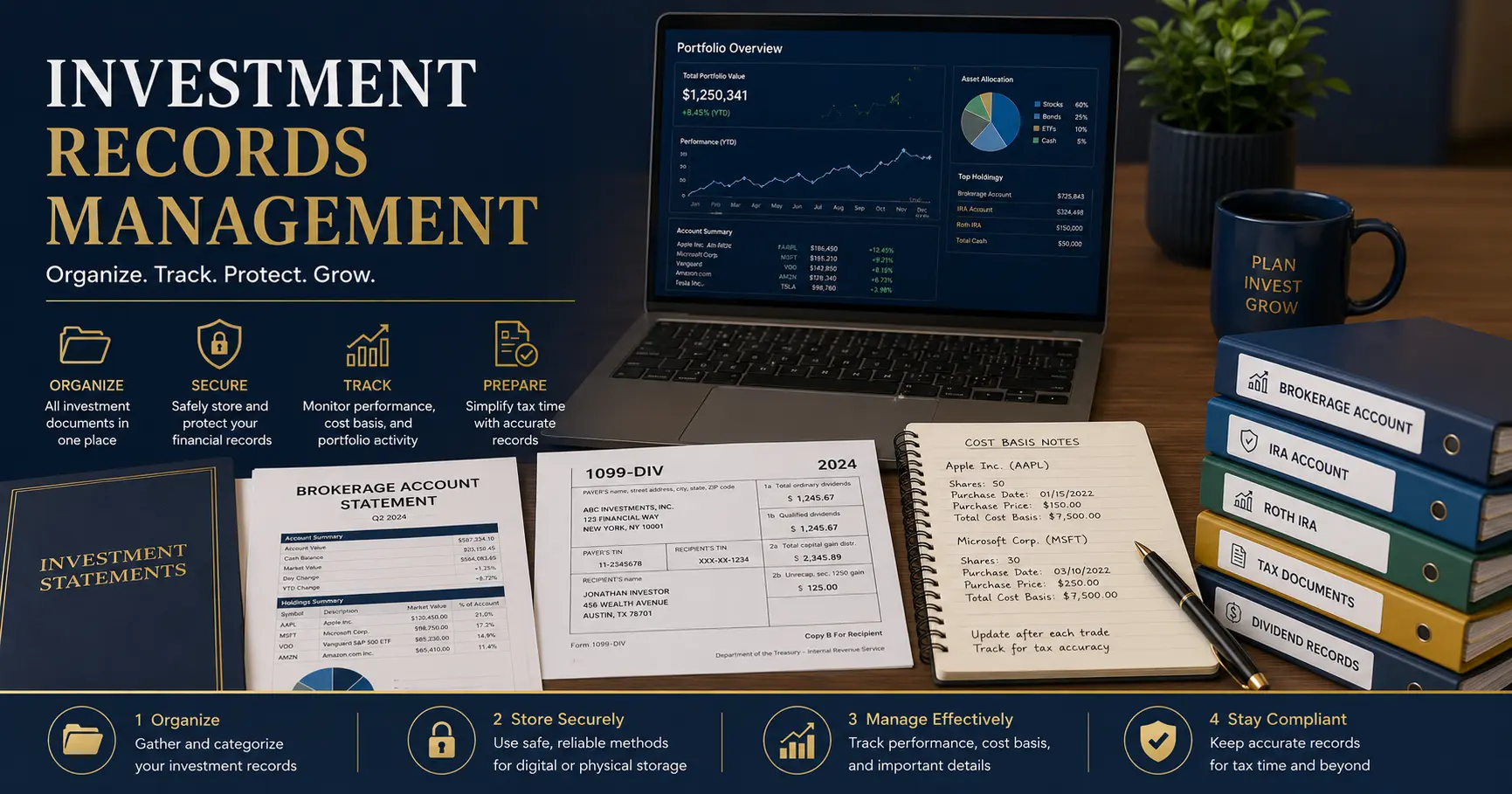
Investment Records Management
Learn how to organize, manage, and protect your investment records with this complete guide. Discover best practices for storing brokerage statements, trade confirmations, tax documents, retirement account records, and portfolio reports to improve financial planning, simplify tax filing, and safeguard your investments.
Successful investing isn't just about choosing the right stocks, mutual funds, ETFs, or retirement accounts. Equally important is maintaining organized investment records that help you monitor performance, prepare taxes, verify ownership, and make informed financial decisions throughout your investing journey.
Many investors focus on growing their portfolios but overlook the importance of proper record management. Missing brokerage statements, misplaced tax documents, or incomplete purchase records can create unnecessary challenges during tax season, portfolio reviews, estate planning, or even when transferring investments to another financial institution.
An effective investment records management system ensures that every important document is organized, secure, and easily accessible whenever you need it. Whether you're a beginner investor or someone managing multiple investment accounts, maintaining accurate financial records improves decision-making and helps protect your long-term wealth.
In this guide, you'll learn which investment documents you should keep, how long to retain them, practical organization methods, secure storage strategies, and best practices for maintaining accurate investment records throughout every stage of your financial journey.
Quick Answer: Investment records management is the process of organizing, storing, protecting, and maintaining documents related to your investments, including brokerage statements, trade confirmations, dividend records, tax forms, retirement accounts, and portfolio reports to support better financial planning and compliance. Table of Contents Why Investment Records Matter Types of Investment Records Brokerage Statements Trade Confirmations Tax Documents Digital Storage Best Practices Checklist FAQs
Why Investment Records Management Matters
Every investment you make generates valuable financial information. Purchase confirmations, account statements, dividend reports, capital gains summaries, and annual tax documents all contribute to your complete investment history.
Without an organized system, tracking portfolio growth, calculating investment returns, or preparing taxes becomes far more difficult than necessary.
Well-maintained investment records provide several important benefits:
-
Track long-term portfolio performance.
-
Calculate capital gains and losses accurately.
-
Simplify annual tax preparation.
-
Verify investment ownership.
-
Support estate planning and wealth transfer.
-
Monitor asset allocation over time.
-
Reduce the risk of missing important financial information.
Investment record management is one important part of a complete personal finance strategy. Within our Wealth Vault, you'll also find practical guides on organizing financial documents, tax records, estate planning, and tracking your net worth.
As your investment portfolio grows, reviewing historical statements becomes increasingly valuable. Past investment decisions, dividend history, and account performance can reveal patterns that help improve future investment strategies.
Organized investment documentation also makes it much easier to work with financial advisors, accountants, and tax professionals. Instead of searching through years of emails and downloaded PDFs, you'll have immediate access to the records they need.
What Are Investment Records?
Investment records include every document that helps verify ownership, monitor performance, report taxes, or support financial planning activities. These records create a complete history of your investment journey and should be maintained throughout the life of your investments.
Depending on your investment portfolio, your records may include documents from brokerage firms, retirement account providers, banks, mutual fund companies, employers, and tax authorities.
Keeping these records organized not only improves financial management but also reduces stress during tax filing, account transfers, or estate administration.
Types of Investment Records You Should Keep
Every investment generates important financial documents throughout its lifecycle. From the day you purchase an investment until you eventually sell it, each record contributes to your financial history. Maintaining these documents not only helps you monitor portfolio performance but also simplifies tax reporting, financial planning, and estate management.
Below are the most important investment records every investor should organize and retain.
Brokerage Account Statements
Brokerage statements provide a complete overview of your investment portfolio during a specific period. They summarize account balances, holdings, transactions, dividends received, realized gains or losses, and account activity.
These statements help you:
-
Track portfolio growth over time.
-
Review investment performance.
-
Verify account balances.
-
Identify unexpected transactions.
-
Monitor investment diversification.
Most brokerage firms provide monthly or quarterly statements electronically. Downloading and organizing annual copies ensures you'll always have access, even if you change brokerage firms or close an account.
Maintaining organized brokerage statements also supports your overall net worth tracking, allowing you to accurately calculate your total assets and monitor long-term financial progress.
Trade Confirmations
Every time you buy or sell an investment, your brokerage issues a trade confirmation. This document records essential transaction details such as the purchase date, sale date, security name, quantity, execution price, commissions, and settlement information.
Trade confirmations are particularly valuable because they establish the cost basis of your investments. Cost basis plays a critical role when calculating capital gains or losses during tax reporting.
Although brokerage platforms often retain electronic copies, keeping your own organized records provides an additional layer of security and simplifies future tax calculations.
Dividend and Interest Records
Income generated from investments should also be carefully documented. Dividend payments from stocks and mutual funds, along with interest earned from bonds or savings products, contribute to your annual taxable income and should be retained for future reference.
Common income records include:
-
Dividend payment statements
-
Interest income reports
-
Year-end income summaries
-
Reinvestment confirmations
These documents help verify annual investment income while making tax preparation more accurate and efficient.
Keeping dividend records alongside your annual tax documents also complements a well-organized Tax Documents Storage Guide, ensuring all investment-related tax information is available in one place.
Mutual Fund and ETF Records
Investors who own mutual funds or exchange-traded funds (ETFs) receive several important documents throughout the year. These records provide detailed information about fund performance, distributions, expenses, and account activity.
Examples include:
-
Fund statements
-
Distribution notices
-
Annual reports
-
Prospectus updates
-
Capital gains distributions
-
Dividend reinvestment records
Reviewing these reports regularly helps you understand how each investment contributes to your overall portfolio while identifying opportunities for rebalancing or improving diversification.
Retirement Investment Records
Retirement accounts often represent decades of disciplined investing, making accurate documentation especially important. Whether you invest through employer-sponsored retirement plans or individual retirement accounts, keeping organized records helps monitor long-term progress and verify contribution history.
Important retirement investment records include:
-
401(k) account statements
-
Traditional IRA records
-
Roth IRA statements
-
Pension benefit summaries
-
Employer contribution reports
-
Beneficiary designation forms
-
Account rollover documentation
These records become increasingly valuable as retirement approaches. They assist with withdrawal planning, required minimum distributions (where applicable), beneficiary updates, and estate administration.
Retirement investments should also be reviewed alongside your other long-term financial records. Keeping all major financial documents organized makes future planning much easier. If you haven't already created a complete filing system, start with our guide on Financial Documents You Must Keep to build a strong foundation for managing every aspect of your financial life.
Why Accurate Investment Records Improve Financial Decision-Making
Investment records do more than satisfy tax requirements—they provide valuable insights into your financial behavior. Reviewing historical investment data helps identify successful strategies, evaluate risk tolerance, monitor diversification, and measure progress toward long-term financial goals.
Accurate records also make discussions with financial advisors, accountants, and estate planning professionals far more productive. Instead of relying on estimates or incomplete information, you'll have documented evidence to support informed financial decisions.
As your investment portfolio expands, maintaining detailed records becomes increasingly important. A consistent record management system helps protect your wealth, improve financial organization, and support every stage of your investment journey.
Cost Basis Records and Why They Matter
One of the most important aspects of investment records management is maintaining accurate cost basis records. Cost basis is generally the original purchase price of an investment, adjusted for factors such as stock splits, dividend reinvestments, commissions, or other qualifying adjustments. It plays a critical role in calculating capital gains or losses when you sell an investment.
If your cost basis information is incomplete or inaccurate, you may pay more tax than necessary or face difficulties during tax preparation. Keeping detailed purchase records ensures you can accurately determine your investment returns while remaining compliant with tax reporting requirements.
Your cost basis documentation should include:
-
Purchase confirmations
-
Original purchase price
-
Number of shares purchased
-
Brokerage commissions and fees
-
Stock split adjustments
-
Dividend reinvestment history
-
Transfer documentation between brokerage firms
Although many brokerage firms track cost basis automatically, investors should still retain their own records. Having independent documentation provides an extra layer of security if account information is lost or transferred between institutions.
Investment Tax Documents You Should Keep
Investment income often creates additional tax reporting responsibilities. Every year, financial institutions provide tax forms that summarize dividends, interest income, capital gains, retirement distributions, and other investment-related earnings.
These documents should be stored together with your annual tax records to simplify tax filing and future financial reviews.
Common investment tax documents include:
-
Form 1099-DIV (Dividend Income)
-
Form 1099-INT (Interest Income)
-
Form 1099-B (Broker and Barter Transactions)
-
Capital gains summaries
-
Year-end brokerage tax reports
-
Retirement account distribution statements
-
Foreign investment tax documents (if applicable)
Organizing these documents alongside your yearly tax returns reduces the likelihood of missing important information during tax season. A dedicated Tax Documents Storage Guide can help you establish a consistent filing system for all tax-related paperwork.
Alternative Investment Records
Today's investors often diversify beyond traditional stocks and mutual funds. Alternative investments require additional documentation because they frequently involve more complex ownership structures and reporting requirements.
Examples of alternative investments include:
-
Real estate investment properties
-
Real Estate Investment Trusts (REITs)
-
Cryptocurrency investments
-
Private equity investments
-
Private business ownership
-
Precious metals
-
Collectibles and alternative assets
For these investments, maintain purchase agreements, ownership certificates, appraisal reports, transaction histories, and supporting tax documentation. These records become especially valuable when determining asset values, calculating gains or transferring ownership.
If alternative investments represent a significant portion of your portfolio, consider reviewing them annually alongside your overall financial records. This supports better long-term planning and complements your broaderfinancial document organization
How Long Should You Keep Investment Records?
Investment records should be retained based on both legal requirements and their long-term financial value. Some records can eventually be discarded, while others should be preserved permanently.
Investment DocumentRecommended Retention PeriodPurpose Brokerage StatementsAt least 7 yearsPerformance tracking and tax support. Trade ConfirmationsUntil the investment is sold, plus 7 yearsCost basis verification. Dividend Records7 yearsIncome verification. Capital Gains Reports7 yearsTax reporting. Retirement Account StatementsKeep while the account is active; permanently retain key annual summaries.Retirement planning. Property Investment RecordsFor the life of ownership plus several years after sale.Ownership verification and capital gains calculations. Cryptocurrency Transaction RecordsAt least 7 yearsTax compliance.
While these retention periods are commonly recommended, requirements may vary depending on local laws, tax regulations, and your personal financial circumstances. When in doubt, consult a qualified tax professional before disposing of important financial records.
Physical vs. Digital Investment Records
Modern investors benefit from both physical and digital recordkeeping. Digital storage offers convenience, searchability, and remote access, while physical copies remain valuable for certain legal documents and account agreements.
A balanced record management strategy combines both formats. Keep original legal documents and signed agreements in a secure physical location while maintaining encrypted digital backups of brokerage statements, tax forms, portfolio reports, and investment summaries.
Cloud storage platforms with multi-factor authentication can provide additional protection, but they should never replace local backups entirely. Maintaining multiple secure copies significantly reduces the risk of permanent data loss.
As your investments grow, regularly reviewing these records alongside your overall financial position becomes increasingly important. Combining organized investment documentation with a consistent process to track your net worth gives you a clearer picture of your long-term financial progress and helps identify opportunities for improvement.
Best Practices for Investment Records Management
Managing investment records effectively requires more than simply downloading account statements. A structured record management system helps you monitor portfolio performance, prepare accurate tax returns, respond quickly to financial inquiries, and protect valuable financial information from loss or unauthorized access.
The following best practices can help you build an efficient investment record management system.
Create a Logical Folder Structure
Organize your investment records into clearly labeled categories rather than storing everything in a single folder. This makes locating specific documents much easier.
Your folder structure might include:
-
Brokerage Statements
-
Trade Confirmations
-
Dividend and Interest Reports
-
Tax Documents
-
Retirement Accounts
-
Alternative Investments
-
Annual Portfolio Reviews
Within each category, arrange documents by year so your investment history remains organized as your portfolio grows.
Maintain Both Physical and Digital Copies
While digital storage provides convenience and quick access, some investment documents deserve additional protection through physical copies. Important agreements, account opening documents, or legal ownership records should be securely stored in a fireproof and waterproof safe while encrypted digital copies provide an additional layer of protection.
Review Your Investment Records Annually
At least once each year, review your investment records to ensure they remain complete and accurate. During this review you should:
-
Verify account balances.
-
Download annual statements.
-
Archive older documents.
-
Review beneficiary information.
-
Confirm cost basis records.
-
Remove duplicate files.
An annual review also provides an excellent opportunity to compare your investment growth with your overall financial position. Combining this review with a regular net worth assessment provides a more complete understanding of your financial progress.
Back Up Important Investment Records
Unexpected hardware failures, accidental deletions, cyberattacks, or natural disasters can result in permanent data loss. To reduce this risk, maintain multiple secure backups of important investment records.
A reliable backup strategy typically includes:
-
Encrypted cloud storage.
-
Password-protected external hard drives.
-
Automatic backup software.
-
Secure off-site storage for critical documents.
Common Mistakes Investors Make with Record Management
Even experienced investors sometimes overlook the importance of proper documentation. Avoiding these common mistakes can save considerable time, money, and frustration in the future.
Relying Only on Brokerage Websites
Many investors assume their brokerage will permanently maintain all account records. However, account transfers, closures, or platform changes may limit access to historical documents. Downloading and securely storing your own copies provides greater long-term protection.
Ignoring Cost Basis Documentation
Without accurate purchase records, calculating capital gains may become difficult when investments are sold. Keeping trade confirmations and purchase records helps ensure accurate tax reporting.
Keeping Disorganized Files
Saving investment documents with inconsistent file names or storing them across multiple devices makes future retrieval difficult. A consistent folder structure significantly improves long-term organization.
Not Coordinating Investment and Tax Records
Investment documents and tax records work together. Keeping brokerage tax forms, dividend statements, and capital gains reports alongside your annual tax documents simplifies tax preparation and reduces the risk of missing important information. For additional guidance, refer to our Tax Documents Storage Guide.
Forgetting Estate Planning
Your investment accounts form an important part of your estate. Beneficiary designations should be reviewed regularly and coordinated with your broader estate planning strategy. Maintaining organized investment records also makes it easier for family members or executors to administer your estate in the future. Learn more in our guide to Estate Planning Documents.
Investment Records Management Checklist
Use the following checklist to ensure your investment records remain complete and well organized.
-
Download brokerage statements regularly.
-
Keep trade confirmations for every purchase and sale.
-
Retain dividend and interest records.
-
Organize annual tax documents.
-
Maintain retirement account statements.
-
Track cost basis adjustments.
-
Review beneficiary information annually.
-
Back up important files securely.
-
Protect records using strong passwords and multi-factor authentication.
-
Review your complete investment portfolio every year.
Conclusion
Investment records management is an essential part of long-term financial success. Organized records help you monitor portfolio performance, simplify tax preparation, verify ownership, support estate planning, and make informed financial decisions throughout every stage of your investing journey.
By maintaining a structured filing system, securely storing important documents, and reviewing your records regularly, you can reduce financial stress while improving the accuracy of your financial planning.
Your investment records should never exist in isolation. They work best as part of a comprehensive financial organization strategy that also includes your essential financial documents, tax records, estate planning paperwork, and regular financial reviews. Building this connected system creates a stronger foundation for protecting and growing your wealth over time.
Authoritative References:
-
Internal Revenue Service (IRS) – Guidance on investment taxation and recordkeeping.
-
U.S. Securities and Exchange Commission (SEC) – Investor education resources and account protection.
-
Financial Industry Regulatory Authority (FINRA) – Best practices for maintaining investment records and monitoring brokerage accounts.
Disclaimer: This article is intended for general educational and informational purposes only. It should not be considered financial, investment, legal, tax, or accounting advice. Investment record retention requirements and tax regulations vary by jurisdiction and individual circumstances. Always consult a qualified financial advisor, accountant, tax professional, or attorney before making financial or investment decisions.
Continue Reading
If you found this guide helpful, you may also enjoy these related resources:
Frequently Asked Questions
cmp6hs57y000oc2bxnj5buqzv
Editorial Contributor
Author and technology contributor at NexaLifeVault.
Share this post
Comments (0)
No comments yet. Be the first to comment!