PUC Certificate Validity: How Long It Lasts, the Fine, and How to Keep It Handy
PUC certificate validity for cars and bikes in India, the fine for driving without one, and a simple way to store your PUC and never miss a renewal.
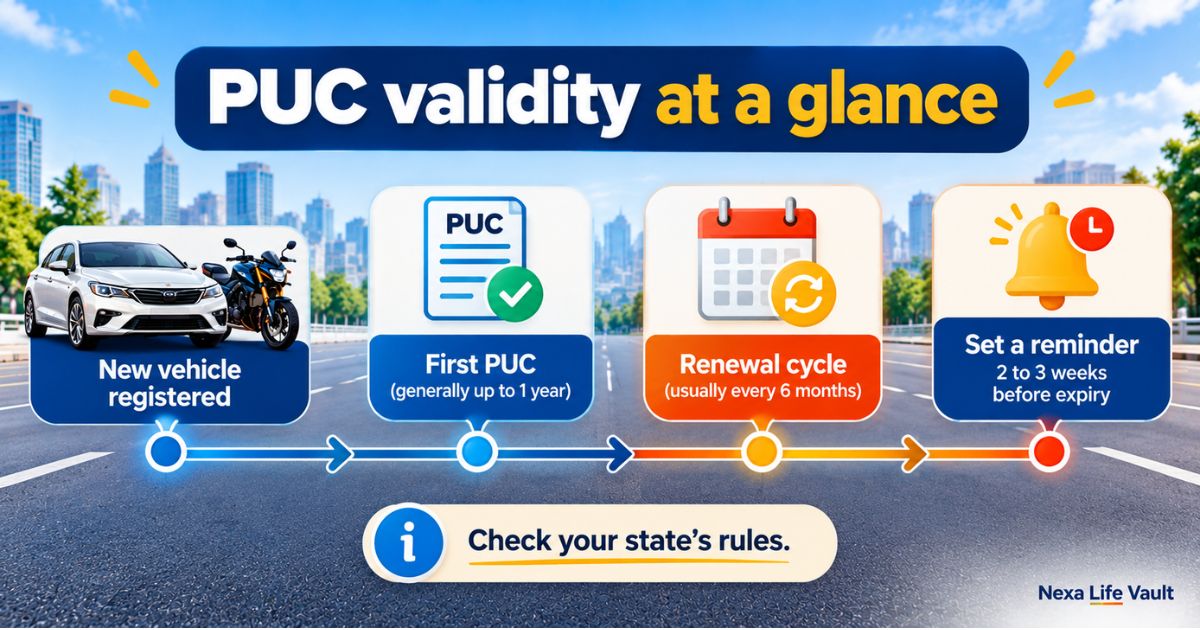
A PUC certificate in India is usually valid for one year for a new vehicle, then needs renewal about every six months, though the exact period depends on your state and the vehicle's emission norm. Driving without a valid one can attract a fine under the Motor Vehicles Act. Check your state transport rules.
This is general information, not legal, tax or financial advice.
You are stopped at a signal, a traffic officer asks for your papers, and you realise your PUC ran out two months ago. It happens more often than people admit. PUC certificate validity is short, the fine can be steep, and the paper slip is easy to lose. This guide covers how long a PUC lasts for cars and bikes, what happens if it lapses, how to get one, and how to keep it where you can find it in seconds.
What is a PUC certificate and who needs one?
PUC stands for Pollution Under Control. It is a certificate that shows your vehicle's exhaust emissions were tested at an authorised centre and found within the permitted limits.
Almost every motor vehicle running on Indian roads needs one. That includes private cars, motorcycles, scooters, autos, taxis, trucks and buses. Electric vehicles are generally treated differently because they have no tailpipe emissions, but rules can vary, so confirm with your state transport department.
The certificate is a slip with your registration number, the test date, the validity date and the emission readings. Most centres now also upload the details to a central database linked to your vehicle's registration (RC) record.
What is the PUC certificate validity for a car or bike?
The simple pattern is a longer validity for a brand-new vehicle and a shorter cycle after that. The table below gives the general picture. It is a guide, not a guarantee for your state.
| Vehicle type | First PUC | Renewal after that |
|---|---|---|
| New private car (petrol, diesel, CNG) | Generally up to 1 year from registration | Usually every 6 months |
| New bike or scooter | Generally up to 1 year from registration | Usually every 6 months |
| Older vehicle (earlier emission norms) | Not applicable | Some states use shorter periods. Check your state notification |
| Commercial vehicle (taxi, truck, bus) | Rules differ by state and category | Check with your RTO |
| Electric vehicle | Generally not required | Confirm with your state |
The date printed on your certificate is the one that counts. If the slip says it expires on a certain date, treat that as final, whatever any table says.
Verify with the official source (the Ministry of Road Transport and Highways, Parivahan portal, or your state transport department) before acting. Validity periods are set by government rules and can be changed.
Is pollution certificate validity different for a car and a bike?
For most purposes, no. Pollution certificate validity for a car and a bike follows the same general logic: a longer first period for a new vehicle, then regular renewals. What changes the rule more is your state, the age of the vehicle and its emission norm (such as BS-IV or BS-VI).
For example, someone who bought a new scooter in Gujarat and a friend who owns a ten-year-old car in another state may have different renewal cycles. Do not copy a friend's dates. Read your own slip.
When does the validity start?
For a new vehicle, the first PUC period is generally counted from the date of registration, and the dealer usually arranges it. For renewals, validity runs from the date of the new test. A common trap is testing a few days after expiry and assuming the old date continues. It does not. A gap means you were driving without a valid PUC for those days.
How do you get a PUC certificate online?
You cannot take the emission test over the internet, because someone has to measure your vehicle's exhaust. So a PUC certificate online really means two things: finding a centre and checking or downloading the record digitally. Here is the usual process.
- Find an authorised centre. Petrol pumps, service stations and dedicated testing centres often offer it. Look for the official authorisation display.
- Carry your RC. The operator needs your registration number, and sometimes your engine and chassis details.
- Get the test done. A probe is placed in the exhaust while the engine runs. It takes a few minutes.
- Collect the slip. Check the registration number, the test date, the validity date and the pass result before you leave.
- Check the digital record. On the Parivahan portal or the mParivahan app, you can often see whether your PUC details have been captured against your vehicle. Features differ by state.
- Save a copy. Photograph or scan the slip right away.
Verify with the official source (the Parivahan portal and your state transport department) before relying on any online service. Which services are available online varies by state.
What if the centre says your vehicle failed?
A failed test usually means the engine needs attention. A service, an air filter change or a tune-up often fixes it. Get the repair done, then retest. Do not shop around for a centre that will "pass anything". An improperly issued certificate can cause trouble for you later.
What is the PUC fine for driving without a valid certificate?
The PUC fine is set under the Motor Vehicles Act, 1988. As amended in 2019, Section 190(2) allows a fine of up to ₹10,000, imprisonment of up to six months, or both, for driving a vehicle that does not meet pollution norms or lacks a valid PUC.
Those are the maximum limits in the law. The amount written on an actual challan can differ by state and by the traffic department's rules. In practice, most people who are stopped deal with a challan and a fine, but you should not count on that.
Verify with the official source (the Motor Vehicles Act as published by the Government of India, and your state traffic police or transport department) before acting. Fines and enforcement methods change, and several states run camera-based or portal-based challan systems.
Common mistake: Many owners keep only the old slip in the glove box, and the printed ink fades after a few months. Then, when an officer asks for it, the date is unreadable. Take a clear photo on the day you get the slip, and keep it somewhere you can search for later.
What else can go wrong if your PUC lapses?
The fine is the obvious cost. There are quieter ones too.
- Repeat challans. If a camera or an officer records your vehicle without a valid PUC, you may get notices from the traffic department.
- Paperwork delays. Some vehicle services and renewals ask you to show a current PUC. Finding it late can hold up your work.
- Selling the vehicle. Buyers and dealers often ask for a clean set of papers. A missing or expired PUC makes the handover messier.
Rules for insurance renewals and RTO services can change, so ask your insurer or RTO what they currently need.
How do you keep your PUC certificate handy?
The best habit is to stop relying on memory. Here is a simple routine that takes under five minutes.
- Photograph the slip the moment you receive it. Make sure the registration number and validity date are readable.
- Name the file properly. Something like "PUC-GJ04-AB1234-valid-till-March-2027" beats "IMG_4521".
- Note the expiry date in one place you check regularly.
- Set a reminder two to three weeks before the expiry date. A week is too tight if the centre has a queue.
- Keep the original slip in the vehicle as well, in case you are asked for a paper copy.
Whether an officer or authority accepts a digital copy can depend on the situation and the state. Check the current rules, and carry the paper slip as a backup.
Verify with the official source (your state transport department or traffic police) before relying on a phone copy.
A short real-life example
Ravi owns a car and a scooter. Both PUCs expired in different months, and he had two slips in two places. He renewed the car's on time and forgot the scooter's. A month later he was fined at a checkpoint. If both certificates had sat in one folder with reminders, he would have caught it. People who own more than one vehicle are the ones who most often miss a date.
How Nexa Life Vault helps
The Vehicle Vault is where you can keep your PUC certificate next to your RC, insurance papers and service records, so everything about one vehicle is in one place. You can open it from your phone when someone asks for a document.
The feature that matters most here is Smart Document Alerts. Add the expiry date when you save the PUC, and you get a reminder before it runs out. That removes the one thing most people forget: the date.
Your files are protected with AES-256-GCM encryption, and each file has its own key. Whether a digital copy is accepted in a given situation is decided by the authority asking for it, so carry the original slip too.
Conclusion
PUC certificate validity is easy to track once you know the pattern: a longer first period for a new vehicle, then regular renewals, with the printed date as the final word. The fine is where forgetting gets expensive. Photograph your slip, note the expiry, and keep a reminder running. Save your PUC with alerts in the Vehicle Vault, and the next renewal will not catch you by surprise.
Frequently Asked Questions
Shailesh Nagar
Cloud Infrastructure & Security Contributor
Technology specialist at NexaLifeVault focusing on cloud infrastructure, data resilience protocols, and modern digital asset management.
Share this post
Comments (0)
No comments yet. Be the first to comment!