What Is a Digital Nominee? How to Give a Trusted Person Access to Your Vault
A digital nominee is the trusted person who can reach your documents when you can’t. Learn how it differs from a bank nominee or executor, who to choose, and how to set one up.
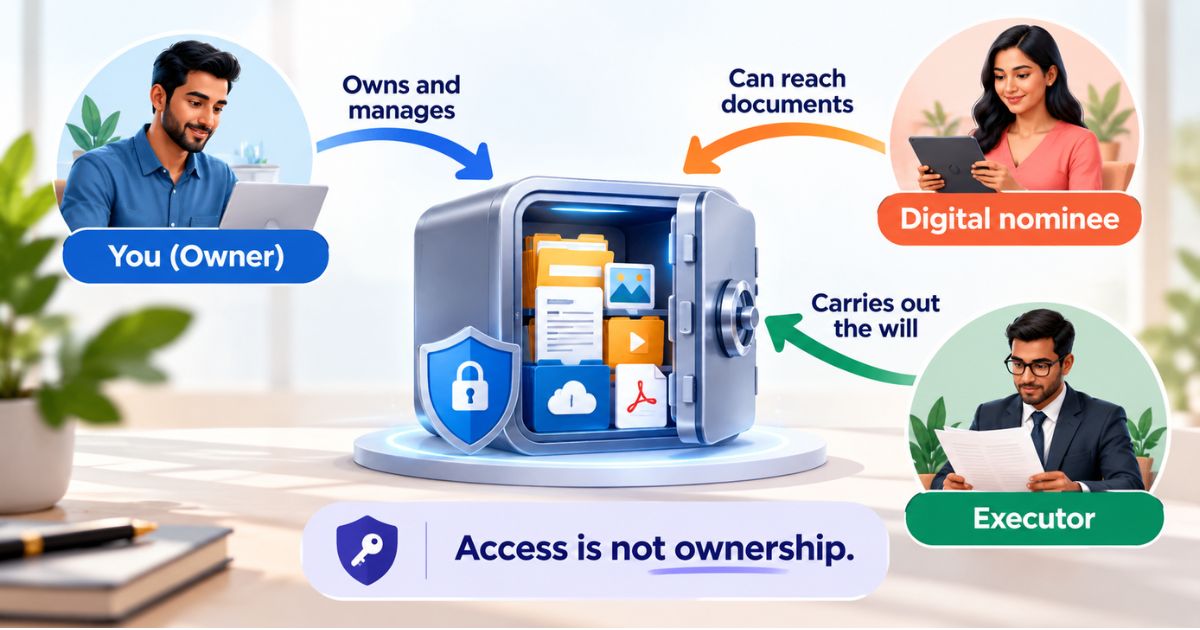
A digital nominee is a trusted person you choose to receive access to your online document vault when you can't open it yourself, for example after your death or during a serious illness. You choose who it is, so your family can find important papers without guessing passwords.
Last updated: October 2026. This is general information, not legal, tax or financial advice.
Most families have one person who knows where everything is: the FD receipts, the LIC policy, the property papers. If that person falls ill or passes away, the rest of the family ends up searching drawers, old emails and phone galleries. A digital nominee fixes that problem. This article explains what a digital nominee is, who to choose, what to share, and how to set one up so your family isn't left guessing.
What does a digital nominee actually do?
A digital nominee is the person who can reach your documents when you can't. Think of it as a spare key, handed to someone you trust, for a locked room that holds your papers.
Some people call this a trusted contact for documents. Others call it emergency access to a vault. The idea is the same: one named person, chosen by you in advance.
A digital nominee gives access to documents. It does not give ownership of your money, property or investments. Those still follow your will and the succession rules that apply to you.
How is a digital nominee different from a bank nominee, executor or legal heir?
These four terms get mixed up often, and the confusion causes real problems later. Here is how they differ.
| Role | What it means | What it covers |
|---|---|---|
| Digital nominee | A person you choose to access your document vault | Documents and records, not ownership |
| Bank or policy nominee | A person named on a specific account, FD, policy or demat account | Receiving the payout from that one asset |
| Executor | A person named in your will to carry out its instructions | Settling the estate as the will directs |
| Legal heir | A person entitled to inherit under your will or the succession law that applies to you | The right to inherit |
Being a nominee on an account does not always mean the person keeps the money. In many cases they receive it on behalf of the legal heirs. The rules differ by asset and can change, so ask your bank, insurer or registrar how it works for each one. Verify with the official source (the institution concerned, or the RBI, IRDAI or SEBI for the relevant asset) before acting.
Why does every family need a digital nominee?
Picture a 62-year-old retired teacher who handles all the paperwork at home. One morning she has a stroke. Her son lives in another city. He doesn't know which bank holds her FD, where the property papers are, or when the health insurance renews. The first week goes into phone calls and guesswork.
Now picture the same family with a digital nominee already in place. Her son has been named in advance. He can reach the policy copies, the account details she saved and the property papers, and he can start making calls the same day.
The problem isn't only death. Hospital stays, long travel and memory loss can all leave you unable to find a document when it matters. Emergency access to your vault covers all of these.
Who should you pick as your digital nominee?
Choose someone who is reliable, reachable and likely to act calmly under pressure. A few questions help:
- Would you trust this person with your Aadhaar and PAN copies?
- Will they be easy to reach if something happens?
- Are they comfortable using a phone or laptop?
- Will they stay on good terms with the rest of the family?
A spouse, an adult child or a sibling are common choices. If your family is spread across cities, pick the person who can act fastest, not the eldest.
Your digital nominee and your will's executor can be the same person, but they don't have to be. The executor handles the legal work in the will. The nominee is the one who can find the papers needed to do it.
Which documents should your nominee be able to reach?
Start with what your family would need in the first few weeks:
- Identity: Aadhaar, PAN, passport, voter ID, driving licence
- Money: bank account details, FD receipts, demat and mutual fund statements, EPF/UAN details, recent ITR copies
- Insurance: life, health and motor policies, with policy numbers
- Property: sale deeds, loan papers, society or tax receipts
- Vehicle: RC, insurance and PUC certificates
- Legal: your will, if you have one, and where the original is kept
Keep original paper documents in a safe place too. Some offices ask for originals, and a digital copy may not be accepted in its place. Check with the institution first.
How do you add a digital nominee? Step by step
The exact screens depend on the service you use. In general, the process looks like this:
- Decide who. Choose one person you trust and make sure you have their correct name, mobile number and email.
- Talk to them first. Explain what the role means and what it doesn't. Nobody should find out they are a nominee only after a crisis.
- Upload your key documents. A nominee can only reach what is in the vault. Begin with identity, insurance and bank papers.
- Sort documents into vaults. Keep family papers, finance papers and legal papers apart so the nominee can find things quickly.
- Add the nominee in your settings. Look for the nominee or executor access option and enter their details.
- Review once a year. People move, relationships change and documents expire. Check that your nominee is still the right person.
What about executor access to documents?
An executor needs documents to do the job in your will: death certificate copies, property papers, account details and policy numbers. Giving executor access to documents in advance means they can start with the right papers, not a hunt for them.
The executor may still need court-issued papers, such as probate, a succession certificate or a legal heir certificate, depending on your situation and the assets involved. The vault helps you gather the supporting papers. It does not replace those legal steps. Verify with the official source (the relevant court, your lawyer or the institution holding the asset) before acting.
How Nexa Life Vault helps
The Nominee & Executor Access feature lets you name the people who should be able to reach your documents when you can't. It sits alongside the rest of your vaults, so you set it up once instead of writing instructions in several places.
The Family Vault is the best starting point. Keep identity papers, insurance policies and household records for each family member in one place, then name your nominee. Your family finds a clear, organised set of papers instead of a pile of unlabelled files.
See the pricing page for plan details. Digital copies are for convenience and reference. Always check with each institution about which documents it accepts.
Conclusion
A digital nominee turns "where did Papa keep that?" into a question your family can answer in minutes. Pick one person you trust, upload your key documents, tell them what to expect, and review the choice each year. It is a small task that spares your family a lot of stress.
Frequently Asked Questions
Nishi Naik
Product & Digital Legacy Writer
Product and technology writer passionate about digital estate planning, family data privacy, and secure information lifecycle management.
Share this post
Comments (0)
No comments yet. Be the first to comment!