Funeral Wishes and Final Instructions: How to Record and Share Them With Family
Learn how to write a funeral wishes document your family can find and follow. Includes a free UK template, a pre-paid plan checklist and tips for sharing final instructions.
A funeral wishes document is a written record of how you want your funeral to be handled, plus practical instructions for your family. Write down your preferences, note any pre-paid plan, add key contacts, and store it where a trusted person can find it. Tell them it exists before they need it.
Most families only discover a person's funeral preferences when it is too late to ask. In the first few days after a death, relatives are making decisions while grieving, often without knowing whether you wanted a burial, a cremation, or something else entirely. A short, clear document removes that guesswork. This guide shows what to include, how to record it, and how to make sure the right people can find it. A template is included.
This is general information, not legal, tax or financial advice.
Why should you write down your funeral wishes?
Because the people who love you will otherwise be guessing. Even close families disagree about music, readings, flowers and whether to hold a religious service.
Consider a simple example. Margaret’s husband died suddenly. He had once said he "didn’t want a fuss," but never said what that meant. Her children disagreed: one wanted a quiet cremation, another wanted a church service. A single page would have settled it.
A written record also helps with practical matters:
- It reduces arguments between relatives at a painful time.
- It can save your family from paying for things you never wanted.
- It tells them about any pre-paid funeral plan so nobody pays twice.
- It gives your executor a starting point instead of a blank page.
What goes in a funeral wishes document?
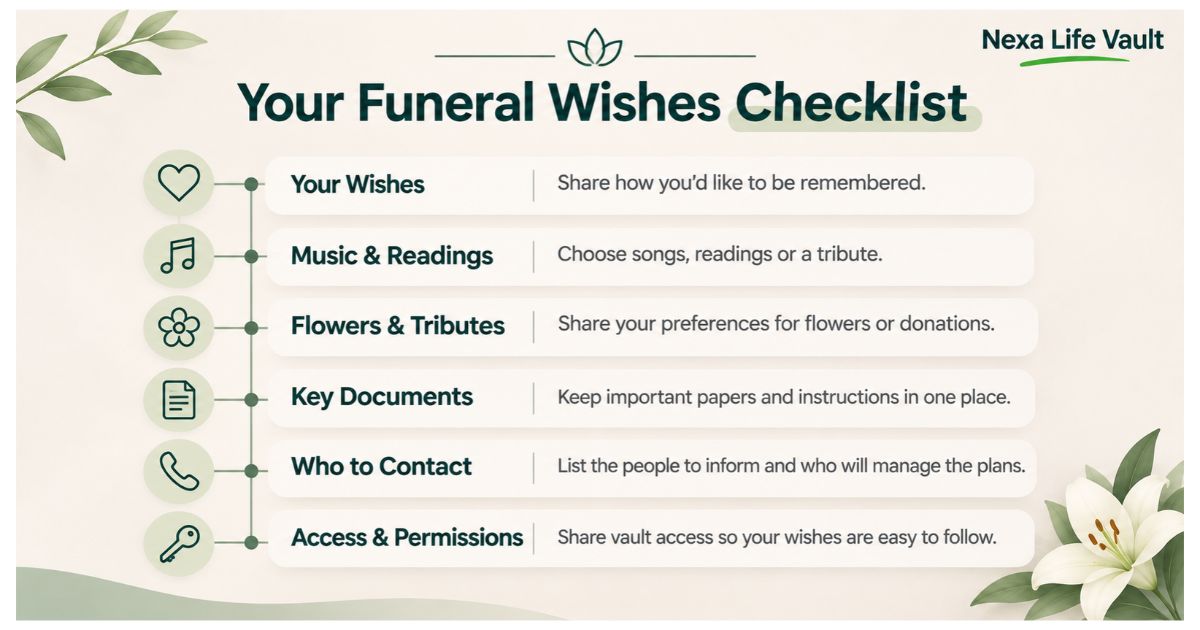
A good funeral wishes document covers the ceremony itself and the practical details around it. It does not need to be long. Two or three pages is enough for most people. Aim to cover the following:
- Burial or cremation. State your preference and, if you have one, the cemetery, crematorium or family plot.
- Type of service. Religious, humanist, civil, or no service. Name the place of worship or celebrant if you have a preference.
- Music, readings and tributes. List specific pieces or poems, and anyone you would like to speak.
- Flowers, donations and dress. Say whether you want flowers, donations to a charity, or a particular dress code.
- Funeral director. Name the firm if you have chosen one, with a phone number.
- Pre-paid funeral plan details. Provider, plan number and where the paperwork is kept.
- Ashes or burial location. Where you would like ashes scattered, kept or interred.
- Organ or body donation. Record your decision, and say where any registration or consent paperwork is.
- Who to tell. A short contact list of people who must hear first, including friends and employers your family may not know.
- Where other documents are. Your will, insurance policies, bank details and anything else your executor will need.
Be specific where you can, and say so honestly where you do not mind. "I have no strong view on flowers" is more useful than leaving the line blank.
Are funeral wishes legally binding in the UK?
Generally, no. In England and Wales, your executors usually have the final say over the funeral arrangements. Your wishes guide them, and most families follow them, but the document is not a legal order. Rules can differ in Scotland and Northern Ireland.
This is also why putting your wishes only in your will can backfire. A will is often read after the funeral has already taken place. Keep a separate, easy-to-find copy of your funeral wishes. If you want your will and related legal papers kept together, you can store them in a Legal Vault.
Verify with the official source (GOV.UK, or a solicitor) before acting on anything legal.
How do you record funeral wishes step by step?
You can finish a first draft in about an hour. Work through these steps in order:
- Gather what already exists. Look for old notes, any funeral plan paperwork, your will, and cemetery or plot documents.
- Decide the big choices first. Burial or cremation, and religious or non-religious. Details can follow.
- Talk to one person. Say your ideas aloud to your partner, a child or a close friend. You will notice gaps quickly.
- Write in plain sentences. "I would like a short service with no hymns" works better than formal wording.
- Add the practical details. Phone numbers, plan numbers and where papers are kept.
- Name your point of contact. Choose a person who will read it first, usually your executor or a trusted nominee.
- Store it and share it. A document nobody can find does not help anyone.
- Review it each year. Update it after major life changes.
What should you know about pre-paid funeral plan documents?
A pre-paid funeral plan lets you pay for some or all of your funeral costs in advance. If you have one, your family needs the paperwork quickly, because the funeral director linked to the plan often needs to be contacted first.
Keep these pre-paid funeral plan documents together:
- The plan agreement or contract
- Confirmation of payment, or a certificate from the provider
- The plan number and the provider’s contact details
- A note of exactly what the plan covers and what it does not
- Any changes you have requested since you bought it
Read the small print on what is included. Some plans do not cover every cost, such as certain third-party fees, so your family may still need to budget for extras. In the UK, funeral plan providers are regulated by the Financial Conduct Authority. Verify with the official source (the FCA, and the provider itself) to confirm current rules and what your own plan covers.
What does a funeral wishes template look like?
Copy the sections below into a document or email, fill in each line and save it. Where you have no strong view, write "no preference" instead of leaving a gap. Your family will not have to wonder whether you forgot.
1. About me
| Item | Your answer |
|---|---|
| Full name | |
| Date of birth | |
| Address | |
| Date written or last updated |
2. Quick summary (family read this first)
| Item | Your answer |
|---|---|
| Burial or cremation | |
| Funeral director and phone number | |
| Pre-paid plan provider and plan number | |
| First person to call | |
| Where my will is kept |
3. The funeral
| Item | Your answer |
|---|---|
| Burial or cremation | Name any cemetery, crematorium or family plot |
| Type of service | Religious, humanist, civil or none; venue or celebrant |
| Music | Songs you want, and any you do not |
| Readings and poems | |
| People to speak | |
| Flowers or donations | Flowers, family only, or a named charity |
| Dress code | |
| Gathering afterwards | Where, and any food or drink wishes |
4. Ashes and memorial
| Item | Your answer |
|---|---|
| Ashes | Scatter, keep or inter, and where |
| Memorial or headstone wishes |
5. Pre-paid funeral plan
| Item | Your answer |
|---|---|
| Provider name and phone number | |
| Plan number | |
| Where the agreement and payment confirmation are kept | |
| What the plan covers and what it does not |
6. Organ or body donation
| Item | Your answer |
|---|---|
| My decision | |
| Where related paperwork is kept |
7. People to tell
| Item | Your answer |
|---|---|
| Family | |
| Close friends | |
| Employer or workplace | |
| Clubs, faith groups, neighbours |
8. Where my documents are
| Item | Your answer |
|---|---|
| Will and solicitor details | |
| Life and other insurance | |
| Bank accounts and pensions | |
| Property papers | |
| Digital accounts and phone access | |
| Pets: who will care for them |
9. A message to my family (optional)
Write a few personal lines here, if you want to. Even two or three sentences can mean a great deal to the people reading them.
10. Sharing
| Item | Your answer |
|---|---|
| Trusted person who has this document | |
| Where the latest copy is stored | |
| Date I last told them it was updated |
| Section | What to write |
|---|---|
| Full name and date of birth | Your details, so the document is clearly yours |
| Burial or cremation | Your choice, and any named cemetery or crematorium |
| Service type and venue | Religious, humanist, civil, or none; preferred place or celebrant |
| Music and readings | Titles of songs, poems or passages you want, and any you do not |
| Flowers or donations | Flowers, family flowers only, or a named charity |
| Funeral director | Firm name, phone number, plan number if pre-paid |
| Ashes or memorial | Scatter, keep, inter, or a memorial you would like |
| Organ or body donation | Your decision and where related paperwork is held |
| People to contact first | Names and numbers, including friends and workplaces |
| Where documents are kept | Will, insurance policies, bank and pension details |
| Message to family (optional) | A few personal lines, if you want to add them |
How do you share final instructions with family?
Writing the document is half the job. The other half is making sure the right people know it exists and can reach it. Your final instructions for family should never be a secret that gets discovered by chance.
Here is a sensible way to share them:
- Pick one or two people. Your executor, your partner or an adult child. More than that risks confusion.
- Tell them in person. It can feel awkward. A calm, short conversation is usually easier than people expect.
- Say where the document is. Do not just say "it’s somewhere safe."
- Make sure they can open it. A locked file, or a password only you know, defeats the purpose.
- Send an updated copy after changes. Replace old versions so nobody follows outdated wishes.
If you have a family member who is likely to disagree, include a short reason for your choice. People are more willing to follow a wish when they understand why it matters to you.
For wider planning, you can also record where your will, insurance and property papers are held in a Family Vault, so that your funeral wishes sit alongside everything else your family may need.
How Nexa Life Vault helps
Your funeral wishes are only useful if the right person can reach them at the right time. The Family Vault gives you one place to keep your funeral wishes document, a copy of your pre-paid plan paperwork, key contacts and notes for your executor, instead of leaving them across drawers, email and phone photos.
With Nominee & Executor Access, you can set up a trusted nominee or executor who can access your vault documents. Your files are protected with AES-256-GCM encryption, and each file has its own key. A digital copy is a convenient record, and you should still check what your solicitor or funeral provider needs in original form.
Conclusion
A funeral wishes document is one of the kindest things you can leave behind. It takes an hour, spares your family difficult guesses, and keeps your wishes at the centre of the day. Write it, store it where it can be found, and tell someone it exists. Start today: share your instructions with a trusted nominee so they know where to look.
Frequently Asked Questions
Vishal Singh
Full-Stack Developer & Systems Contributor
Full-stack developer at NexaLifeVault specializing in secure web applications, data encryption standards, and digital legacy preservation systems.
Share this post
Comments (0)
No comments yet. Be the first to comment!