Lost Passport Abroad: A Step-by-Step Emergency Plan
Lost your passport abroad? Follow this time-ordered plan for Indian travellers: what to do in the first hour, how to file a police report, contact the Indian mission, and choose between an Emergency Certificate and a new passport.
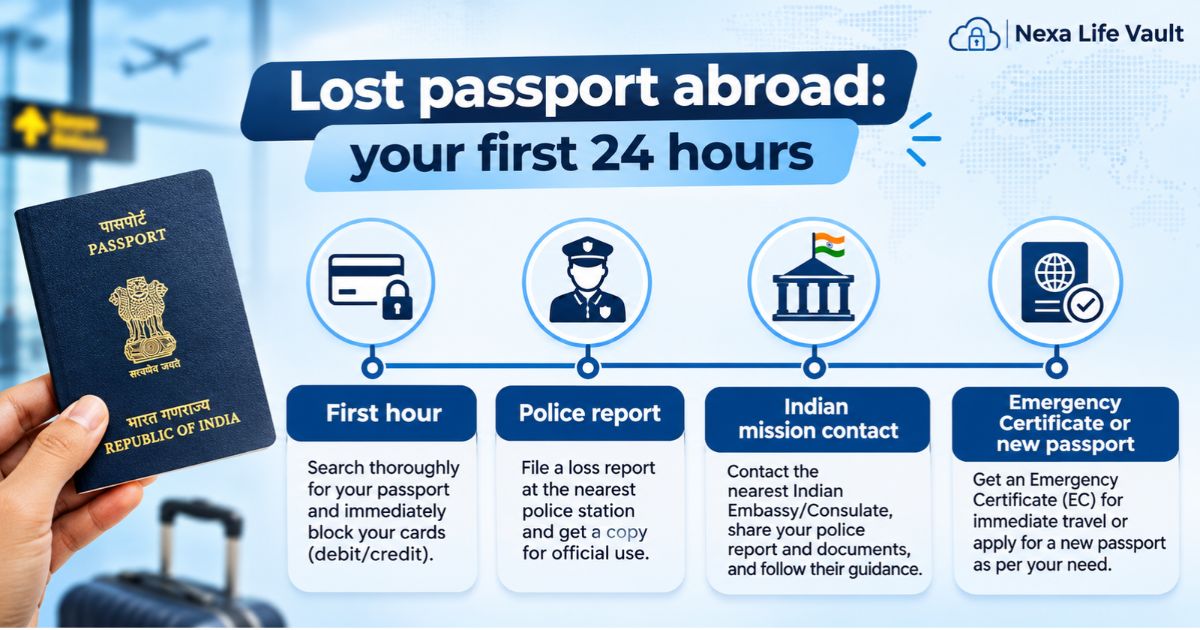
If you lose your passport abroad, stay calm, report it to the local police and get a written report, then contact the nearest Indian embassy or consulate. They can issue an Emergency Certificate or a replacement passport after checking your identity. Keep copies of your documents ready to speed things up.
A lost passport abroad can feel like the end of the trip. It isn't. Indian missions deal with this regularly, whether your bag was snatched in a market or the passport slipped out in a taxi. What changes the outcome is how fast you act and what paperwork you can show. This plan is ordered by time: the first hour, the first day, the days after, and what to do once you are home.
This is general information, not legal, tax or financial advice. Rules and processes differ by country and change over time, so verify with the official source (the website of the nearest Indian mission and the Ministry of External Affairs passport portal) before acting.
What should you do in the first hour after losing your passport?
The first hour is about two things: finding out whether the passport is truly gone, and stopping any further damage. Do not rush to the embassy before you have done this.
- Pause and retrace your steps. Check every bag and pocket. Think about where you last used the passport, such as a hotel check-in, a currency exchange counter or a tour desk.
- Call the places you visited. Hotel reception, the taxi or ride-hailing company, the restaurant and the airline lost-property desk are all worth a call. Passports are often handed in.
- Get to a safe place if it was stolen. If you were robbed or pickpocketed, move away from the area and into a hotel lobby, a shop or a police station.
- Block anything that went with it. If your wallet or phone was also taken, call your bank to block cards and ask your mobile operator to block the SIM. This protects your money and your one-time passwords.
- Tell someone you trust. Message a family member or friend in India so they know what happened and can help with calls, copies and bookings.
If an hour of searching turns up nothing, treat the passport as lost and move to the next stage.
What to do if your passport is lost overseas: the first day
Within the first day, you want three things in motion: a police report, contact with the Indian mission, and a folder of identity documents. Each one feeds the next.
Step 1: File a police report
Go to the nearest local police station and report the loss or theft. Ask for a written copy of the report, and if it is not in English, ask whether an English version or translation is available. Most missions ask for this report, and your travel insurer and bank may need it too. If your passport was stolen while travelling, say clearly that it was stolen, as this can change how the report is worded.
Note the report number, the officer's name and the station address. Take a photo of the paper on your phone straight away.
Step 2: Contact the nearest Indian embassy, High Commission or consulate
Look up the official website of the Indian mission in the country you are in. It will list how to book an appointment, the application process and the documents required. Many missions have an emergency contact number for stranded or distressed Indian nationals. India's Ministry of External Affairs also runs the MADAD portal for consular help. Confirm current details on the official sites, as processes and contact numbers can change.
When you reach the mission, explain what happened and ask two questions: which document you should apply for, and what you need to bring.
Step 3: Gather your identity documents
The mission has to be sure you are who you say you are. Anything that proves identity and Indian citizenship helps. The exact list varies by mission, so treat the table below as a starting point, not a rule.
| Document | Why it helps |
|---|---|
| Copy of your lost passport (photo page and address page) | Gives the mission your passport number, issue date and place of issue, which speeds up verification |
| Aadhaar card or e-Aadhaar | Supports proof of identity and address in India |
| PAN card, driving licence or voter ID | Extra identity proof if the mission asks for a second document |
| Police report | Shows the loss or theft was reported |
| Passport-size photographs | Needed for the application; some missions have a photo booth or can point you to one nearby |
| Flight tickets, visa copy and hotel booking | Shows your travel plan and your legal stay in the country |
Keep in mind that Aadhaar and PAN are not travel documents. They help you prove who you are, but they will not get you through an airport abroad.
Pro tip: Photograph every page of your passport before you leave India and email the images to yourself. Add the police report, your visa and your return ticket to the same folder as soon as you have them. When a mission officer asks "Do you have a copy of the passport?", a clear scan on your phone saves hours.
What if your passport, wallet and phone were all stolen?
This is the hardest version of the problem, and it happens more often than people expect. Picture a traveller whose bag is snatched outside a railway station. The passport, cards, cash and phone are gone in one go.
Start with the basics. Borrow a phone from your hotel, a local shop or the police station. Call your bank first to block cards, then your mobile operator for the SIM. Contact a family member in India and ask them to send you scans of your Aadhaar, PAN and any passport copies you may have left at home or in email. If you stored copies online, log in from a hotel computer or a borrowed device and download them.
Be careful on shared computers. Log out fully, do not save passwords, and delete downloaded files when you are done.
Tell the Indian mission about the phone as well. If your identity documents are limited, the officer will explain what other proof they can accept, such as copies of old passports or details that can be verified with authorities in India.
What is an Emergency Certificate, and do you need one?
An Emergency Certificate (EC) is a travel document issued by an Indian mission to an Indian citizen who has lost their passport abroad and needs to return to India. It is generally meant for a one-way journey home, not for onward travel to other countries. Its validity is usually limited, and the mission will tell you the terms when it is issued.
You are most likely to need an emergency certificate if your flight home is soon and a full replacement passport cannot be ready in time. If you are staying for a longer period, for example for work or study, the mission may advise applying for a new passport instead.
Whichever route you take, do not assume. Ask the officer which document suits your situation, and check the current rules on the mission's website. Verify with the official source (the Indian mission in your country and the Ministry of External Affairs) before acting.
Emergency Certificate or new passport: which should you choose?
The right answer depends on how long you need to stay and where you need to go next. This comparison is general. Your mission has the final say.
| Question | Emergency Certificate | Replacement passport |
|---|---|---|
| Main purpose | Get you back to India | Continue normal travel |
| Typical use | Short remaining stay, flight home booked | Longer stay abroad, more trips planned |
| Onward travel to other countries | Generally not intended | Yes, like any passport |
| Processing time | Often shorter, but varies by mission | Often longer, varies by mission and country |
| Good to know | Ask what the airline and local immigration need to see | Ask whether your existing visa needs to be transferred or re-issued |
What happens to your visa, flights and hotel bookings?
A lost passport can affect more than your identity. Your visa is usually stuck to or linked to that passport, and the country you are in may have its own rules about leaving without one.
Here is what to check, in this order:
- Local immigration. Some countries ask you to report the loss, get an exit permission or clear your visa status before you can leave. Ask the Indian mission, and confirm with local authorities.
- Your airline. Tell them what happened and ask what documents they will accept at check-in. Ask about change fees and rebooking options. If your travel insurance covers trip disruption, keep every receipt.
- Your hotel and onward bookings. If you will miss a connecting flight or a hotel night, contact the providers early. Many are flexible when you can show a police report.
- Your insurer. If you bought a travel policy, read the claim steps for lost documents and report within the time limit it sets.
Common mistake: Waiting for a day or two "in case it turns up" before filing a police report. The delay can make the mission process slower, and some insurers have reporting deadlines. File the report the same day, even if you still hope to find the passport.
What should you do after you return to India?
Once you are home, the situation is not fully closed. A few steps remain.
- Check what the mission told you to do. Some cases need a follow-up with the passport office in India.
- Apply for a new passport through the official Passport Seva portal. The process for a lost passport may differ from a normal renewal, so read the current instructions on the portal or ask your Regional Passport Office.
- Keep your paperwork together. Store the police report, the Emergency Certificate (if issued), mission receipts and airline tickets in one folder. You may need them for the new passport application or an insurance claim.
- Watch for misuse. Keep an eye on your bank accounts, and tell your bank and mobile operator if anything looks odd, especially if your wallet and phone were taken too.
This is also the right moment to fix your setup for the next trip, which brings us to the part that saves the most pain.
How can you prepare before your next trip?
Almost every delay in a lost-passport case comes from missing paperwork. A few habits remove most of the stress.
- Scan the passport photo page, address page and visa pages, and store them somewhere you can reach without your phone. Our guide to passport and visa storage tips explains how to organise them.
- Carry a printed set of copies, kept separately from the passport itself. If your bag is stolen, both should not go together.
- Keep two or three passport-size photographs in your luggage.
- Save the address and phone number of the Indian mission at your destination before you fly.
- Leave a set of copies with someone at home who can email them on request.
For a broader checklist covering tickets, insurance and IDs, read our piece on safe travel document management.
How Nexa Life Vault helps
The Travel Vault in Nexa Life Vault is built for exactly this. You can keep your passport copy, visa pages, tickets, travel insurance and hotel bookings in one place, so you are not hunting through email or chat threads while stressed.
With Mobile Access, you can open those documents from your phone when you need to show them to the police or an embassy officer. Your files are protected with AES-256-GCM encryption, and each file has its own key.
A digital copy helps you prove who you are, but it does not replace the original passport, and the mission decides what it will accept. Treat the vault as your backup, not your travel document.
Conclusion
A lost passport abroad is stressful, but the steps are clear: search, report to the police, contact the Indian mission, gather your documents and ask which travel document fits your plans. Most of the delay comes from missing paperwork, not from the process itself. Before your next trip, scan your documents and keep passport copies ready offline, so you can act in minutes instead of days.
Frequently Asked Questions
Nishi Naik
Product & Digital Legacy Writer
Product and technology writer passionate about digital estate planning, family data privacy, and secure information lifecycle management.
Share this post
Comments (0)
No comments yet. Be the first to comment!