Documents Your Family Needs After a Death in India: Complete Checklist
Not sure which papers your family will need after a death? Here is a simple 7, 30 and 90-day checklist covering the death certificate, legal heir certificate, bank and insurance claims in India.
The documents needed after death of family member in India start with the medical certificate of death and the official death certificate. After that, families usually need ID and relationship proof, the will if there is one, a legal heir certificate, and account, policy and property papers to make bank, insurance and other claims.
Last updated: October 2026. This is general information, not legal, tax or financial advice.
Grief is hard enough without a pile of forms. Within days, someone will ask for a death certificate, then a bank will want proof that you are the rightful claimant, and an insurer will ask for the original policy. If nobody knows where those papers are, a hard week turns into a hard year. This checklist shows what to collect and in what order, so you spend less time searching and more time with your family. Rules differ by state and institution, so treat it as a map, not a rulebook.
What are the documents needed after death of a family member in India?
Think of the paperwork in three groups. First, proof that the death happened. Second, proof of who you are and how you are related to the person. Third, the papers that show what the person owned or owed.
| Document | Usually issued by | What it is used for |
|---|---|---|
| Medical certificate of cause of death | Hospital or treating doctor | Registering the death; some insurance claims |
| Death certificate | Local registrar of births and deaths (municipal body, panchayat or equivalent) | Almost every claim: bank, insurance, pension, property |
| Legal heir certificate | Revenue authority such as the tehsildar; varies by state | Proving who the legal heirs are |
| Succession certificate or probate | Civil court | Claiming certain assets when there is a dispute, no nominee, or a will that needs court approval |
| Will | Family, lawyer or executor (keep a copy in the Life Vault) | Showing who inherits and who the executor is |
| ID and relationship proof | Aadhaar, PAN, passport, marriage certificate, ration card, school records | KYC of the claimant and proof of relationship |
| Bank, fixed deposit and locker papers | The bank | Account and locker claims |
| Insurance policies and premium receipts | The insurer | Life, health and accident claims |
| Provident fund, pension and salary records | EPFO, employer, pension office | Pending dues and family pension |
| Property, vehicle and investment records | Sub-registrar, RTO, depositories | Transfer of ownership |
Banks, insurers and government offices often ask for originals or attested copies. A scan on your phone helps you find details quickly, but it may not be accepted in place of the original.
Pro tip: When the death certificate is issued, ask for several certified copies at once. The bank, the insurer, the employer and the property office will each want one, and going back for more costs time you do not have. Photograph or scan every paper before you hand it over.
What is the step-by-step timeline after a death in India?
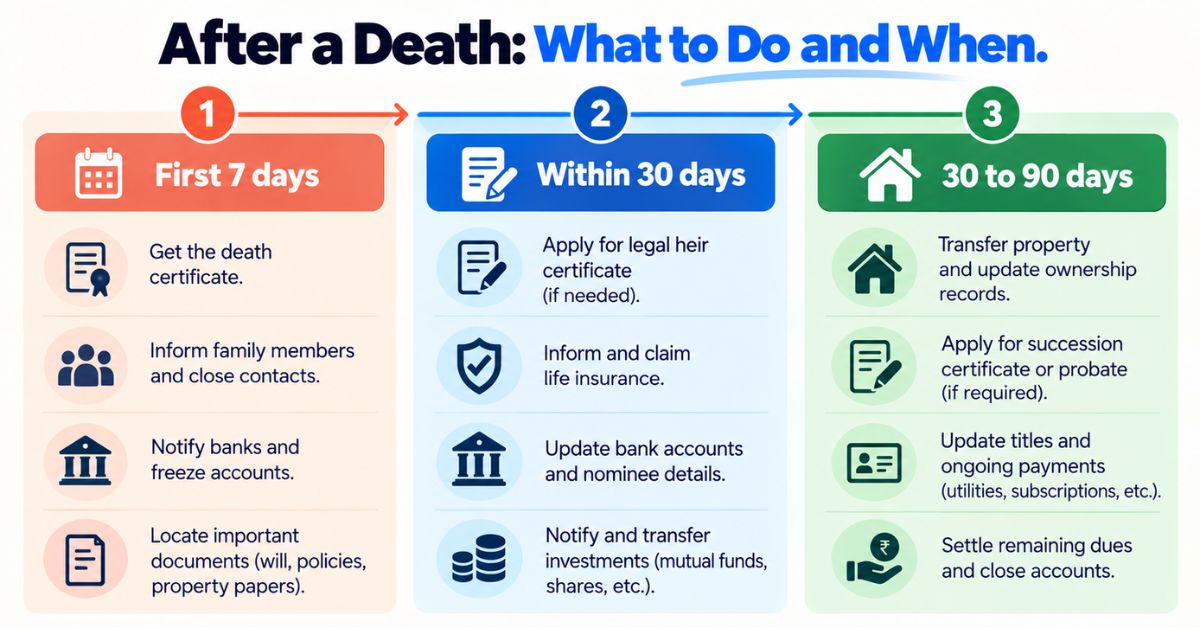
You cannot do everything at once, and you do not need to. This order puts the papers that unlock everything else first.
What should you do in the first 7 days?
- Get the medical certificate of cause of death from the hospital or doctor. You need it to register the death.
- Register the death with the local registrar. The law sets a short window for this, generally 21 days, so do not leave it.
- Ask for several certified copies of the death certificate once it is issued.
- Gather the person's ID papers: Aadhaar, PAN, passport, voter ID and driving licence.
- Find the will, if there is one, and note who is named as executor.
- Start a list of every bank account, insurance policy, loan, investment and property you know about. Check the wallet, diary, email, phone and old post.
- Check each insurance policy for how soon the insurer must be told, and inform them early.
What should you do within 30 days?
- Inform banks, insurers and the employer in writing. Ask each one for its claim form and its list of required documents, because requirements differ.
- Begin insurance claims while the details are fresh.
- Apply for a legal heir certificate if an institution asks for it, or if there is no nominee on an account.
- Review active EMIs, credit-card dues, subscriptions and auto-debits. Speak to the lender before a payment is missed.
- Keep a copy of everything you submit, along with the date and any acknowledgement number.
What should you do in 30 to 90 days?
- Settle bank, fixed deposit and locker claims using each bank's process.
- Claim provident fund, pension and pending salary through the employer and EPFO, where they apply.
- Request transmission of shares and mutual funds through the demat provider or the fund registrar.
- Transfer the vehicle through the RTO and update property records (often called mutation) with the municipal or revenue office.
- Update utility, gas, mobile and housing society records.
- Talk to a chartered accountant about the final income tax return and PAN-related steps.
Some matters run past 90 days, such as a succession certificate, probate or a property dispute. A lawyer is worth the fee here. Verify with the official source (your state revenue department or the district court) before acting.
How do you get a death certificate in India?
A death is registered with the local registrar of births and deaths. In cities this is usually the municipal corporation. In villages it is the panchayat or the registrar the state has appointed. Many states also accept applications online.
You will usually need the hospital's medical certificate, the ID of the person who died and of the person reporting the death, and address proof. If the death is registered late, extra steps such as an affidavit or an order from an officer may apply. Verify with the official source (your state's civil registration authority or municipal office) before acting.
What is a legal heir certificate, and when do you need it?
A legal heir certificate names the people recognised as the person's heirs. It is usually issued by a revenue authority, and the process differs from state to state.
Imagine a father who has a savings account but never added a nominee. His daughter walks into the branch with the death certificate and is told she also needs proof that she is a legal heir. That is the moment this certificate matters. It is not the same as a succession certificate, which comes from a civil court. Ask the institution which one it accepts. Verify with the official source (your state revenue department or district authority) before acting.
How do you make a bank account claim after death?
If the account has a nominee, the claim is usually simpler. If it does not, the bank may ask for more proof of heirship. Most banks ask for some combination of these:
- The bank's claim form
- The death certificate
- The claimant's KYC (Aadhaar, PAN, address proof)
- The passbook, account number or fixed deposit receipts
- A legal heir certificate, succession certificate or indemnity bond, if there is no nominee, depending on the bank's policy and the amount
A nominee can usually collect the money, but being a nominee does not always decide who finally owns it. Legal heirs may still have rights under a will or succession law. If the family might disagree, speak to a lawyer first. Verify with the official source (the bank's claim policy and RBI guidelines on settling claims of deceased customers) before acting.
How do you make an insurance claim after death?
An insurance claim after death starts with telling the insurer. The documents commonly asked for are:
- The claim form from the insurer
- The original policy document, or a policy number if the original is lost
- The death certificate
- The claimant's ID and bank details
- Hospital records and the medical certificate of cause of death
- Police papers, if the death was unnatural, such as an accident
Do not assume your family knows every policy exists. Premium reminders may go to an old email address or an agent who has retired. Check bank statements for regular premium debits, and look through the person's papers and inbox. Verify with the official source (the insurer's claim guidelines) before acting.
For a longer list of papers to gather while everyone is well, read our guide on important documents for loved ones.
How Nexa Life Vault helps
The hardest part of this list is rarely the forms. It is knowing where everything is.
The Family Vault gives you one place to keep IDs, marriage and birth certificates, policy details and account lists for the people you look after. With Nominee & Executor Access, you can choose the people you trust to reach those documents when they are needed, so your family is not searching through cupboards and old phones.
Your files are protected with AES-256-GCM encryption and per-file keys. A copy in the vault helps your family find the right details fast, but banks and insurers may still ask for originals or attested copies, so keep those safe as well.
Conclusion
Collecting the documents needed after death of family member in India feels heavy, but the order is simple: the death certificate first, then proof of heirship, then claims. You cannot make the loss lighter, but you can make the paperwork easier for the people you leave behind. Write down where things are, keep your will and policy details together, and tell someone you trust. Set up nominee access today.
Frequently Asked Questions
Shailesh Nagar
Cloud Infrastructure & Security Contributor
Technology specialist at NexaLifeVault focusing on cloud infrastructure, data resilience protocols, and modern digital asset management.
Share this post
Comments (0)
No comments yet. Be the first to comment!