Apostille Explained: What It Is, When You Need It and How to Store Apostilled Documents
An apostille is a single certificate that lets another country accept your official documents as genuine. Learn when you need one, how it differs from notarisation and legalisation, and how to store apostilled documents safely.
An apostille is a certificate attached to a public document so another country can accept it as genuine. Issued under the Hague Apostille Convention, it confirms the signature, the signer's official role and any seal or stamp on the document. It does not confirm that the contents of the document are true.
You have a degree certificate, a birth certificate or a power of attorney, and a foreign university, employer or court has asked for it to be "apostilled". If you have never heard the word, the request can feel like a trap. It is really a single stamp with a clear purpose. This article explains what an apostille is, when you need one, how it differs from notarisation and legalisation, and how to keep the finished document safe.
What is an apostille and what does it prove?
An apostille is a standard certificate, usually a stamp or a printed page attached to your document. It is issued by an authority that your country has named for this job. The certificate shows that the person who signed or sealed your document held the official role they claim.
Think of it as a check on the paperwork's origin, not its content. If a registrar signed your birth certificate, the apostille tells the foreign office that the registrar's signature and seal are real. It says nothing about whether the date of birth is correct.
The format is the same in every member country. That is the whole point. An official abroad can recognise it at a glance, without contacting the embassy of the country that issued your document.
What is the Hague Apostille Convention?
The Hague Apostille Convention is an international treaty from 1961. It replaced a slow, multi-step process with one certificate. Before it, a document might need approval from several offices in the home country, then the foreign embassy, before it was accepted abroad.
Under the treaty, each member country names one or more "competent authorities" to issue apostilles. Depending on the country, this can be a foreign ministry, a court or another government office. Many countries also issue electronic apostilles and offer online checking tools, though practice varies.
Verify with the official source (the Hague Conference on Private International Law, HCCH) before acting. The HCCH website keeps the current list of member countries and the authority named in each.
Which countries accept apostille documents?
An apostille works only between countries that are both members of the Convention. Well over 100 countries have joined, spread across Europe, the Americas, Asia, Africa and Oceania. Joining dates and entry-into-force dates differ, and some countries have objected to a particular new member joining, which means the treaty may not apply between those two countries.
So "apostille documents countries" is not a fixed list you can memorise. Check two things:
- Is the country that issued your document a member?
- Is the country where you will use it a member, and does the treaty apply between the two?
If both answers are yes, an apostille is the route. If either answer is no, you will probably need legalisation, covered below.
Verify with the official source (the HCCH status table) before acting. Membership changes over time.
When do you need an apostille?
You need one when a public document from one country will be used officially in another. These are the most common cases:
- Study abroad: degree certificates, transcripts and diplomas for university admission or credential checks. Keep these in your Education Vault.
- Work abroad: degree certificates, police clearance certificates and experience letters, for work permits or employer checks.
- Marriage or residency: birth, marriage and divorce certificates, often for visa or residence applications.
- Legal matters: court orders, powers of attorney, company registration papers and adoption papers.
- Buying property or running a business overseas: corporate documents and authority letters.
Here is a short example. Meera finishes a master's degree and accepts a job offer in another country. Her employer's immigration team asks for an apostilled degree certificate. She cannot apostille a photocopy of her own. She has to send the original to the issuing authority, wait for it to be returned with the certificate attached, and then forward it. If she had started the week the offer arrived instead of the week before her visa appointment, she would have saved herself a stressful month.
The receiving party decides what it needs. Always ask the university, employer, embassy or court for its exact requirements first. Some accept copies, some want recently issued documents, and some want a translation as well.
Apostille vs legalisation vs notarisation: what is the difference?
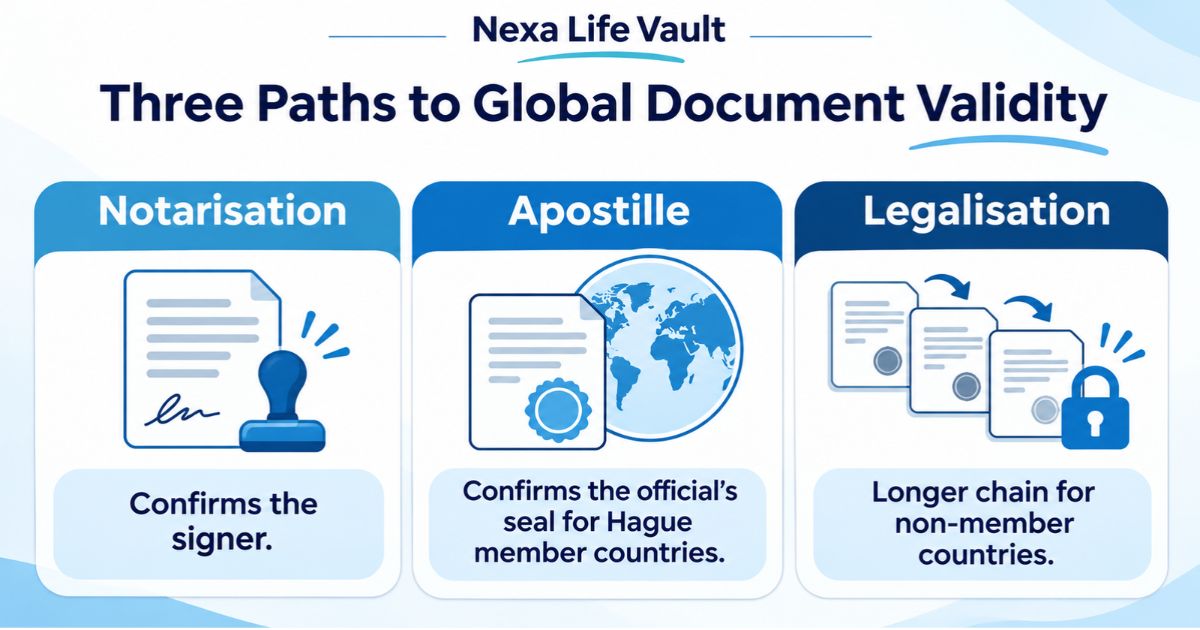
These three terms are often mixed up. They solve different problems. Notarisation confirms who signed something. An apostille confirms that an official's signature or seal is real, for use in another Convention country. Legalisation does the same job for countries outside the Convention, through a longer chain of approvals.
| Feature | Notarisation | Apostille | Legalisation |
|---|---|---|---|
| What it confirms | The identity of the signer, or that a copy matches the original (varies by country) | The authenticity of an official's signature, role and seal | The authenticity of an official's signature, role and seal |
| Who provides it | A notary or similar legal officer | A competent authority named by the issuing country | Several offices, usually ending at the destination country's embassy or consulate |
| Use abroad | Often not enough alone | Accepted in other Convention member countries | Needed when the destination is not covered by the Convention |
| Number of steps | One | One certificate | Multiple steps |
| Typical examples | Affidavits, copies of identity papers, private contracts | Birth certificates, degree certificates, court documents | The same documents, for non-member destinations |
Apostille vs notarisation matters most for private documents. A signed letter or affidavit is not a public document. In many countries it must be notarised first. The notary's signature is then the one that gets the apostille. Procedure differs from country to country, so ask the apostille authority how it handles notarised documents.
Verify with the official source (the apostille authority in your country) before acting.
How do you get a document apostilled?
The exact process depends on the country and the document. The general path looks like this:
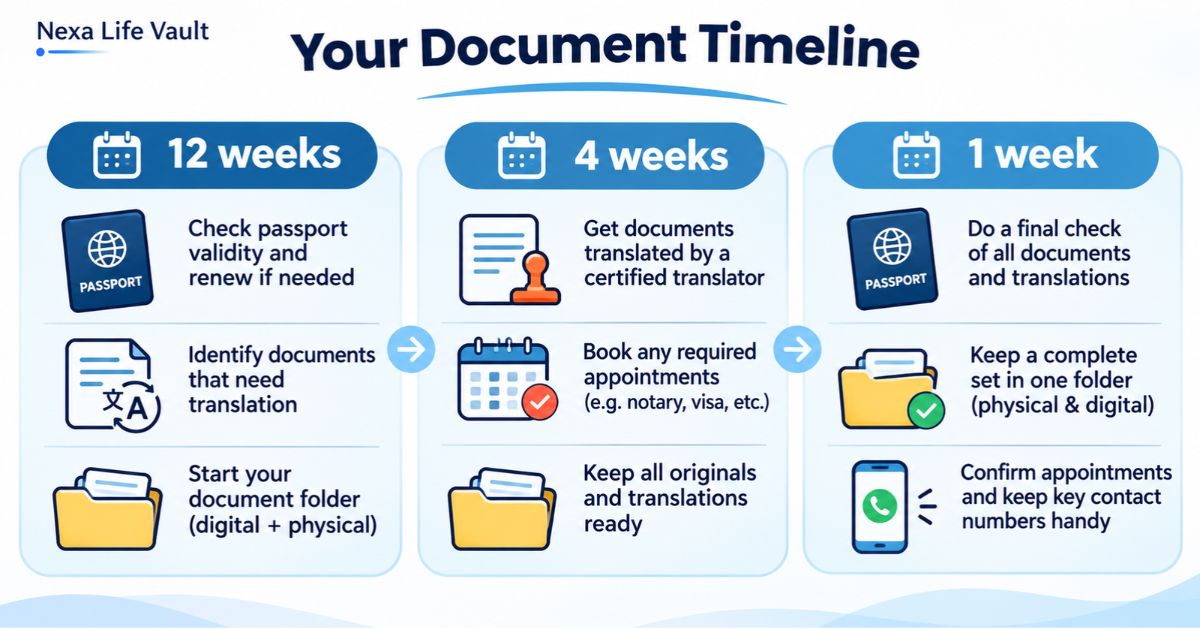
- Confirm the requirement. Ask the receiving organisation if it needs an apostille, and whether it must be on an original or a recently issued document.
- Check the destination. Look up whether the destination country is a Convention member. If it is not, ask about legalisation instead.
- Get the right document. Use an original or a certified copy from the issuing office. Educational documents may first need verification by the school or a state education office. Private documents may need a notary.
- Find the competent authority. The HCCH website lists the authority for each country.
- Submit the document. Follow the authority's process, which may be online, by post or in person. Fees and timelines vary.
- Collect and check the result. Make sure your name, document details and the certificate all match before you send it anywhere.
- Arrange a translation if asked. The receiving party may want a certified translation, sometimes of the apostille too.
Verify with the official source (your country's apostille authority) for fees, processing times and accepted document types.
Common mistake: Apostilling the wrong version of a document. If an apostille is attached to a photocopy that was not certified by the right official, the authority may refuse it. Worse, if you separate an apostille from its document, it usually becomes invalid. Do not remove staples or seals, and never detach the certificate.
How should you store apostilled documents?
An apostilled document is hard to replace. Getting another one means going back through the same process, and sometimes the issuing office needs weeks to respond. A few habits protect you:
- Keep the original physical set together. The document and its apostille form one unit. Store them flat in a folder, not folded or stapled to other papers.
- Make a full scan before you send anything. Scan both the document and the apostille page, front and back, at good quality. A digital copy is for reference and for sending to people who ask for a copy. It may not be accepted in place of the original, so check each time.
- Note the details. Record the apostille number, the issuing authority and the date issued. You will need these for online verification.
- Name files clearly. Use something like "degree-certificate-apostilled-2026" so you can find it in seconds.
- Track the paperwork you sent out. Keep a note of who holds an original and when it should come back.
For more on keeping related paperwork in order, read our guide on how to organize important legal documents.
How Nexa Life Vault helps
Apostilled documents belong in the Legal Vault, where you can keep the scanned document, the apostille page and your notes about the application in one place. Degree certificates can also be cross-filed with your Education Vault.
Smart Document Alerts is the feature worth using here. Some authorities ask for a recently issued document or a certificate dated within a set period. You can add a reminder date to your record so you know when to check whether a fresh copy is needed. Files are encrypted with AES-256-GCM using a per-file key, and they are decrypted only in server memory for authorised requests.
Keep your original physical documents safe too. A digital copy supports your records, but it does not replace the original, and Nexa Life Vault cannot promise that any authority will accept a digital copy.
Conclusion
Knowing what an apostille is saves you from wasted fees and last-minute scrambles. Check the destination country, confirm what the receiving party wants, and keep each document and its certificate together. Then keep a clear scan, with the details recorded, in a safe place. Ready to organise yours? Store apostilled copies safely in the Legal Vault, so they are there when the next application asks for them.
This is general information, not legal, tax or financial advice. Rules and fees vary by country and change over time, so confirm details with the official authority before you act.
Frequently Asked Questions
Pratyush Kumar
Technology Lead & Digital Transformation Strategist
Technology leader and digital transformation strategist writing about secure enterprise data architecture, privacy-first engineering, and next-generation vault solutions.
Share this post
Comments (0)
No comments yet. Be the first to comment!